

| Country | Great Britain |
|---|---|
| Ruler | George VI (1936-52) |
| Face Value | Crown |
| Year of issue | 1937 |
| Metal | Silver |
| Fineness | 500 |
| Catalogue # | KM# 857; SPINK 4078; ESC 4020; Davies 2010 |
| Weight | 28,24 g |
| Diameter | 38,69 mm |
| Our code | G465 |
| Die Axis | ↑↑ |
| Additional info | - |
Great Britain, George VI, Crown 1937, silver, UNC
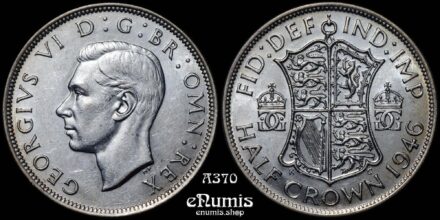
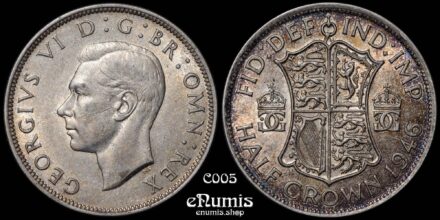
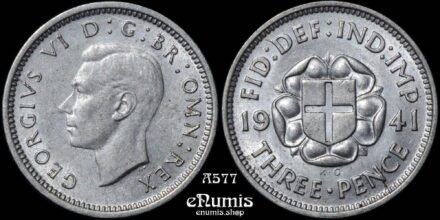
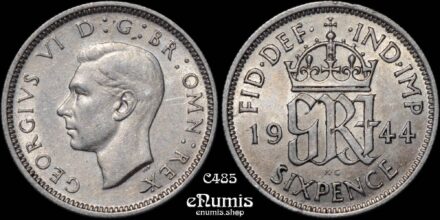
Uncrowned portrait of King George VI left, legend around.
Legend:
GEORGIVS VI D: G: BR: OMN: REX
Engraver:
♦
Crowned quartered shield of arms with supporters, legend above, denomination and date below.
Legend:
FID: DEF: : IND: IMP; DIEU ET MON DROIT; CROWN : 1937 ·
Engraver:
♦
Edge:
Reeded
George VI (1936-52)
Authenticity Guaranteed
Actual Coin Pictured
Ships within 1 business day
Worldwide Shipping
Great Britain, George VI, Crown 1937, silver, UNC
Availability:
In stock
Authenticity Guaranteed
Actual Coin Pictured
Ships within 1 business day
Worldwide Shipping
Obverse: Uncrowned portrait of King George VI left, legend around.
Legend (Latin): GEORGIVS VI D: G: BR: OMN: REX
Engraver: Thomas Humphrey Paget

Reverse: Crowned quartered shield of arms with supporters, legend above, denomination and date below.
Legend (Latin, English): FID: DEF: : IND: IMP; DIEU ET MON DROIT; CROWN : 1937 ·
Engraver: George Kruger Gray
Edge: Reeded
The pictures provided are of the actual coin for sale.Guaranteed genuine.
65 € Shipping from 7 € — FREE over 300 €*
*Except US, shipped via DHL Express — see Postage tab
In stock
Authenticity guaranteedPhotos show the actual coin30-day
returns
returns
Ships within 1 business day, worldwide
Shipping from 7 € · FREE over 300 €*
*US orders: DHL Express only - see Postage
Ships within 1 business day
Authenticity Guaranteed
Actual Coin Pictured
30-Day Returns
Worldwide Shipping
Secure payment




SHIPPING:
• We ship worldwide from Slovenia, a member of the European Union, within 1 business day after payment is received.
• Every order is carefully packed to ensure safe delivery.
• Standard registered shipping via The Post of Slovenia is available worldwide and includes a tracking number.
• DHL Express shipping is also available at checkout for customers who require faster delivery.
• Registered shipping via The Post of Slovenia: €7 within Europe and €8 for the rest of the world.
• FREE registered shipping via The Post of Slovenia for orders over €300.
• FREE DHL Express shipping, including full insurance, for orders over €800.
INSURANCE:
• Upon your request an order over 300 Euro can be sent with extra insurance.
• The price of the insurance is about 1% of the order total (minimum price of the insurance is €5).
OTHER:
• Import duties, taxes and charges are not included in the item’s price or shipping charges. Buyers are responsible for these charges.
• Please check with your country’s customs office to determine what these additional costs will be prior to buying.
22 August 2025 (updated 21 July 2026):
Important Notice for USA Customers
Please note that, due to the new U.S. customs tariffs, the Post of Slovenia has temporarily suspended shipments to the United States. Unfortunately, this means we are unable to send orders to the USA at this time.
We will resume shipping to the USA as soon as the service becomes available again. Thank you for your understanding and patience.
However, we can still ship to the USA via DHL Express. Please be aware that additional U.S. customs duties or fees may apply, which are the responsibility of the buyer.
The coins remain with the seller until the goods have been paid for in full.
We accept the following payment methods:
- All major debit and credit cards (services provided by Stripe Inc. and Bankart d.o.o.)
- Cash in Euros, US Dollars or British Pounds;
- Bank Transfer – to our corporate bank account (eNumis d.o.o., OTP banka d.d. Bank account: SI56 04 0000 2762 09090 BIC: KBMASI2X );
- We also accept PayPal (only for regular customers).
At eNumis.shop, your satisfaction is our top priority. If, for any reason, you are not completely satisfied with your purchase, please contact us immediately.
You may return any item within 30 days of receipt, provided it is in the same condition as when sent. All returns must be shipped using Registered Post or your country’s equivalent postal service with a tracking number.
Upon receiving and inspecting your return, we will offer you an exchange or a refund of the coin’s purchase price, as agreed.
Please note:
Return shipping costs are the responsibility of the buyer and are non-refundable.
Items must be securely packaged to avoid damage during return shipping.
Returns sent without prior notification may not be accepted.
To initiate a return, please contact us at info@enumis.shop or through our Contact Form.
Thank you for shopping with eNumis.shop, where your trust and confidence matter.
Purchasing Power
The Purchasing Power of a Crown in 1937
Five shillings in 1937 was a coin worth pausing over. For an industrial worker earning around 65–70 shillings a week, a crown represented the better part of a working day’s wages – substantial enough to think twice before spending, modest enough to appear in everyday transactions.
For five shillings you could expect to receive:
- about half a day’s wages for an industrial worker
- roughly 12–15 pints of beer at fourpence to fivepence a pint
- around 15 loaves of bread at fourpence each
- 5 packets of cigarettes at a shilling each
- 3 cinema tickets at a local picture house
- 2 modest restaurant lunches
- 30 copies of The Times at twopence each
- 15 return bus fares across London
History
This coin was never supposed to exist. At least, not with this face on it.
The coronation date of the 12th of May 1937 had been set months in advance – for Edward VIII, the charming, modernizing Prince of Wales who had finally inherited the throne in January 1936 after the death of his father George V. The Royal Mint had commissioned portraits, prepared dies, and begun striking pattern coins. The post offices had designed stamps. Manufacturers across the empire had produced millions of commemorative mugs, plates, and tin boxes bearing Edward’s face. Then, on the eleventh of December 1936, Edward sat down at a microphone and told the nation that he found it impossible to carry the heavy burden of responsibility and to discharge his duties as King without the help and support of the woman he loved. Wallis Simpson – American, twice divorced, wholly unacceptable to the Church of England and the Prime Minister – had cost him his throne. He abdicated that evening and went into exile, leaving behind a constitutional crisis, a country in shock, and a younger brother who had never in his life wanted to be king.
Prince Albert, Duke of York – shy, plagued by a debilitating stammer, devoted to his wife Elizabeth and their two daughters – became George VI on a December evening with five months to go before the coronation that had been planned for someone else. The date was kept. The ceremony at Westminster Abbey on the 12th of May 1937 proceeded on schedule, with a different man beneath the crown. One bishop stood on the king’s robes. Another covered the words of the oath with his thumb at the critical moment. A third offered St Edward’s Crown the wrong way round. The Archbishop of Canterbury was seen consulting crib notes hidden in his Order of Service. George VI got through it – as he got through everything – by sheer, painful determination.
The Crown struck for the coronation carries on its obverse the portrait of the new king by the sculptor Humphrey Paget, who had also, with considerable irony, created the portrait of Edward VIII that was now melted down and forgotten. Paget completed the new effigy in a single month – extraordinary speed for a commission of such importance – producing a portrait of quiet authority, the new king facing left in the convention established by his predecessors. In doing so, numismatically erasing the brief reign of Edward VIII as if it had never interrupted the succession at all.
The reverse was designed by George Kruger Gray – an intricate arrangement of crowned shields bearing the arms of England, Scotland, and Ireland, quartered and regimented with the geometric precision of medieval heraldry, four crowns anchoring the composition at its cardinal points. The edge was plainly reeded – clean, modern, unlettered – a deliberate departure from the ornate inscribed edges of earlier British crowns, and a small but telling signal that the new reign intended to carry its dignity without unnecessary ornament.
This was also the last British Crown ever struck in silver for general circulation. The coin entered the world carrying a great deal on its shoulders – the weight of an abdication, a reluctant king’s first year, a nation steadying itself between the Great Depression and a war that most people were beginning to suspect was coming. George VI would carry those same weights for the rest of his reign, and would carry them, as it turned out, with a quiet grace that nobody had predicted in December 1936.
He became, in the end, exactly the king that the crisis required. The coin struck for his coronation is the silver record of the moment that began.
Coin condition (grade) is described using the following scale, based on internationally recognised numismatic grading standards. Where a grade is separated by a slash (e.g. VF/XF), the obverse and reverse differ in condition – VF obverse, XF reverse in this example.
| Grade | Full name | Description |
|---|---|---|
| F | Fine | Noticeable, moderate to considerable wear across the design; major details, lettering and date remain clearly legible |
| F+ | Choice Fine | Slightly better than Fine |
| F‑VF | Fine to Very Fine | Between Fine and Very Fine |
| aVF | About Very Fine | Slightly below Very Fine |
| VF | Very Fine | Moderate wear on the higher points; major design elements and lettering remain sharp and well-defined |
| VF+ | Choice Very Fine | Slightly better than Very Fine |
| VF‑XF | Very Fine to Extremely Fine | Between Very Fine and Extremely Fine |
| aXF | About Extremely Fine | Slightly below Extremely Fine |
| XF | Extremely Fine | Light wear confined to the highest points of the design; most original detail and some mint lustre remain |
| XF+ | Choice Extremely Fine | Slightly better than Extremely Fine |
| XF‑UNC | Extremely Fine to Uncirculated | Between Extremely Fine and Uncirculated |
| aUNC | About Uncirculated | Slightly below Uncirculated |
| UNC | Uncirculated | Shows no evidence of circulation wear; retains its original mint lustre, which may appear naturally subdued with age |
| Proof | Proof | Struck specifically for collectors from specially prepared, polished dies on polished planchets, giving sharp detail and mirror-like fields. Refers to how the coin was made, not to its state of preservation |
| Prooflike (PL) | Prooflike | A coin from the ordinary circulation production that happens to show mirror-like fields, usually from early strikes with fresh dies – it looks similar to a Proof but was not specially struck for collectors |
Grading is inherently somewhat subjective. If you would like additional photos or have any question about a coin’s condition before ordering, please contact us – we’re happy to help.