


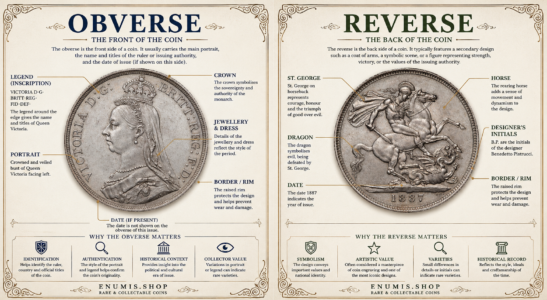
Obverse
The obverse is a coin’s front – its primary face, and traditionally the side that carries the greatest authority. Here appears the portrait of a monarch, a head of state, or a national emblem standing in for the issuing power, accompanied by the country’s name, a ruler’s titles, a motto, or mint marks that anchor the coin to a specific place and moment.
For the numismatist, the obverse is often the first key to identification. Portrait style, legend, and lettering can point to a coin’s country of origin, its issuing period, sometimes even the engraver behind the dies. Variations that look trivial at a glance – a letterform, a slightly repositioned mint mark, a portrait redrawn between issues – can separate a common date from a genuine rarity and can shift a coin’s value considerably.
When a collector picks up a coin, the obverse is usually where the examination begins: wear patterns, surface preservation, strike quality, and the small tells that distinguish an original from a later strike or an altered piece. It sets the historical frame before the reverse fills in the rest.
Reverse
The reverse is the coin’s back, carrying what is traditionally the secondary design – though often not the lesser one. Depending on the country and era, it may show the denomination, a coat of arms, a national symbol, a historical scene, or an allegorical figure. Some of the most recognized images in coinage live here: Saint George confronting the dragon, or Liberty striding forward on the American half dollar.
The reverse is rarely just ornamental. Its inscriptions, denomination, and mint marks help pin down the exact issue, separate one variety from another, and support the case for authenticity. It is also, for many collectors, where a coin’s artistic and historical voice comes through most clearly – a small canvas for the ideas a nation wished to project through its currency.
Taken together, obverse and reverse complete a coin’s story. Reading both carefully – their design, their wear, their inscriptions – is how a collector moves from simply owning a coin to understanding it: its origin, its purpose, and the place it holds in the wider history of money.