

The crown is, by common agreement among collectors, the grandest of England’s regular circulating coins – a broad silver disc some 38-39 mm across, heavy enough to feel substantial in the hand, and large enough to carry some of the finest engraving the Royal Mint ever produced. Its history stretches from the reign of Henry VIII to the present day, and along the way it has been struck in gold and silver, in sterling and debased alloy, in cupro-nickel, and finally as a commemorative piece with no circulating role at all. Few denominations trace the political and economic history of Britain so directly.
A gold beginning: Henry VIII’s monetary reform
The crown began life not as a silver coin but as gold. In 1526, as part of a wider recoinage intended to stem the outflow of English gold to the Continent, Henry VIII introduced a new denomination struck in 22-carat “crown gold” rather than the softer 23-carat fine gold used previously. This first version, known today as the Crown of the Rose, was valued at four shillings and sixpence and lasted only a few months before being replaced by the Crown of the Double Rose, valued at the rounder and more convenient five shillings – the value the crown would carry for centuries to come – and paired a crowned Tudor rose with the king’s initials on the reverse. Both early types are exceptionally rare survivors today; the Crown of the Rose in particular is known from only a handful of specimens.
The first silver crowns

England, Edward VI, Crown 1552

England, James I, Crown 1624
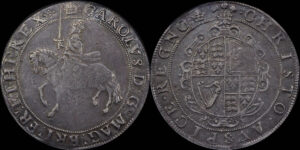
England, Charles I, Crown 1635
Twenty-five years later, under Henry’s son Edward VI, the crown appeared for the first time in silver. The 1551 issue, weighing around 31 grams and valued, like its gold predecessor, at five shillings, carried an equestrian portrait of the young king on the obverse and a quartered shield set over a long cross on the reverse. Gold and silver crowns were minted side by side through the reigns of Elizabeth I, James I and Charles I, with the silver crown eventually becoming the dominant form. A crown was even struck under the Commonwealth during the Interregnum, its design deliberately avoiding any royal imagery.
Gold crowns continued intermittently until the reign of Charles II, whose 1662 issue – coinciding with the Royal Mint’s permanent switch from hand-hammered to machine-milled coinage – is generally reckoned the last. From that point, the crown was a silver coin only.
From English crown to British crown
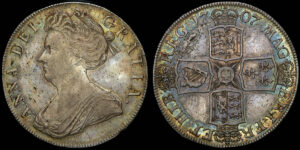
Great Britain, Anne, Crown 1707

Great Britain, George I, Crown 1716
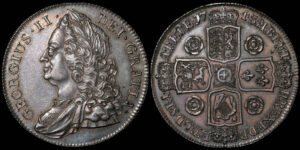
Great Britain, George II, Crown 1743
The Act of Union of 1707, which created the Kingdom of Great Britain, formally ended the “English crown” as a coin type, though production continued much as before under the new designation. By the mid-eighteenth century, however, a chronic shortage of silver bullion brought regular crown production to a halt. From 1751 no further crowns were struck for well over half a century.
The Great Recoinage and Pistrucci’s St George

Great Britain, George III, Crown 1820
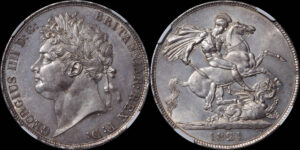
Great Britain, George IV, Crown 1821

Great Britain, George IV, Crown 1826

Great Britain, William IV, Crown 1831
The crown returned in earnest with the Great Recoinage of 1816, the sweeping reform enacted in the aftermath of the Napoleonic Wars to restore confidence in a currency that had lost, on average, around a quarter of its weight through decades of wear and clipping. The Coinage Act of 1816 fixed a new standard that would remain essentially unchanged for well over a century: 28.276 grams of 0.925 sterling silver, 38.61 mm in diameter. Crowns struck to this standard from 1818 carried the celebrated image of St George slaying the dragon, engraved by the Italian artist Benedetto Pistrucci – the same design still used on the modern sovereign – paired with a conventional laureate portrait of George III. (The heavy-necked “bull head” portrait often associated with this recoinage belongs to the half-crowns and shillings of 1816–1820, not to the crown itself.)
Victoria’s crowns: Young Head, Gothic, Jubilee, and Old Head

Great Britain, Victoria, Crown 1845
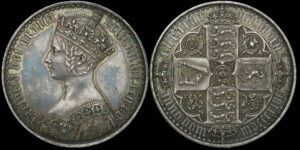
Great Britain, Victoria, Gothic Crown 1847
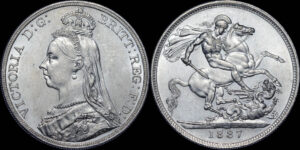
Great Britain, Victoria, Crown 1887

Great Britain, Victoria, Crown 1893
Queen Victoria’s long reign produced four quite distinct crown types, and the gaps between them are as telling as the coins themselves. The first, the Young Head, appeared with a conventional portrait of the eighteen-year-old Queen and a crowned shield-of-arms reverse, and was struck for circulation only in 1844, 1845 and 1847 (an earlier proof-only version exists dated 1839). In 1847 the design changed dramatically for a second type: a Gothic-lettered portrait of the Queen was paired with an ornate reverse of four cruciform shields, the whole rendered in a deliberately archaic style associated with the Gothic Revival then fashionable in British art and architecture. Struck only as a proof, in a mintage of some 8,000, the 1847 Gothic crown is now considered one of the most beautiful coins the Royal Mint ever issued, and a very small proof-only re-issue of the same design followed in 1853 for that year’s presentation sets, in a quantity so small that the exact figure remains unknown today.
After 1853 the crown disappeared from production entirely for over three decades, returning only in 1887 for Victoria’s Golden Jubilee with a third type, the Jubilee Head, designed by Joseph Edgar Boehm and showing the Queen in a lace veil – a portrait immediately and widely criticised for depicting a crown many contemporaries felt was too small for the sovereign’s head. It was replaced in 1893 by the fourth and final type, the more dignified Old Head, paired once again with Pistrucci’s St George and the dragon, which was struck on the crown through 1900, the year before Victoria’s death.
Edwardian and Georgian crowns, and the retreat of silver
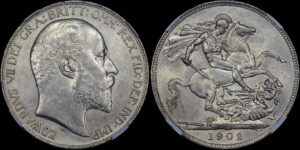
Great Britain, Edward VII, Crown 1902

Great Britain, George V, Crown 1927

Great Britain, George V, Crown 1935
Only a single crown was struck under Edward VII – the coronation issue of 1902 – and it proved to be the last crown minted for general circulation in Britain. No crown was struck at all during the first sixteen years of George V’s reign. When the Treasury debased the entire circulating silver coinage from 0.925 sterling fineness to 0.500 fine in 1920, in response to soaring silver prices after the First World War, there was in fact no crown in production to be affected by it; the change fell on the shillings, florins and half-crowns still being struck for everyday use.
The crown itself returned only in 1927, in the form of a low-mintage proof “Wreath” issue designed by George Kruger Gray, struck in the new 0.500 silver standard. These were distributed by the Bank of England chiefly as Christmas presents for valued clients rather than released for general circulation, and further Wreath crowns, one design updated only by date, followed in small numbers through most years to 1936. In 1935, to mark George V’s Silver Jubilee, that annual design was set aside for a single year in favour of Britain’s first deliberately commemorative crown: a striking Art Deco piece by Percy Metcalfe, nicknamed the “Rocking Horse” crown for its dynamic, rearing rendering of St George’s mount.
The end of silver, and a coin without a purse to live in

Great Britain, George VI, Crown 1937

Great Britain, George VI, Crown 1951

Great Britain, Elizabeth II, Crown 1953
The coronation of George VI in 1937 brought a new crown bearing the Royal Arms, and in 1951, to mark the Festival of Britain and the four-hundredth anniversary of the first silver crown, the Mint struck the first crown in cupro-nickel rather than silver – silver coinage for circulation having been abandoned altogether in 1947. Elizabeth II’s coronation in 1953 was marked with a crown of her own, and further commemorative crowns followed through the 1960s and 1970s, including a 1965 issue honouring Winston Churchill, often cited as the first modern British coin to carry the portrait of a named individual who was not the reigning monarch.
By this point the crown had long since ceased to function as everyday money; its size and weight made it unwieldy alongside the other coins of the pre-decimal system, and it survived chiefly as a collector’s and commemorative piece. Decimalisation in 1971 formally redenominated it at 25 new pence, and in 1990 it was redenominated again, to its present face value of £5, at which it continues to be issued for royal and national anniversaries.
Crown-sized: a term of art
Among collectors, “crown-sized” has become a generic term for any large silver or cupro-nickel coin of roughly 38-40 mm diameter, whether or not it was ever called a crown by its issuing authority – a testament to how thoroughly this one denomination came to define a whole class of coinage in the popular and numismatic imagination.