


| Country | Great Britain |
|---|---|
| Ruler | Edward VII (1901-10) |
| Face Value | Crown |
| Year of issue | 1902 |
| Metal | Silver |
| Fineness | 925 |
| Catalogue # | KM# 803; SPINK 3979; ESC 3562; Davies 1500 |
| Weight | 28,3 g |
| Diameter | 38,5 mm |
| Our code | Z412 |
| Die Axis | ↑↑ |
| Additional info | old slab (about 11 years old) |
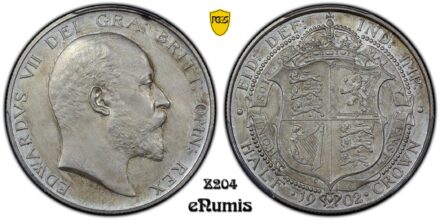
Great Britain, Edward VII, Crown 1902, Matte PROOF, NGC PF 64
You can verify the NGC certification number: 3825371-003
 – FREE DHL Express delivery with Full insurance
Uncrowned portrait of King Edward VII right, legend around.
Legend:
EDWARDVS VII DEI GRA: BRITT: OMN: REX FID: DEF: IND: IMP:; DES.
Engraver:
♦
St. George slaying the dragon right, date and engraver’s initials in exergue.
Legend:
1902; B.P.
Engraver:
♦
Edge:
DECUS ET TUTAMEN ANNO REGNI II
Edward VII (1901-10)
Authenticity Guaranteed
Actual Coin Pictured
Ships within 1 business day
Worldwide Shipping
Great Britain, Edward VII, Crown 1902, Matte PROOF, NGC PF 64
Availability:
In stock
Authenticity Guaranteed
Actual Coin Pictured
Ships within 1 business day
Worldwide Shipping
Obverse: Uncrowned portrait of King Edward VII right, legend around.
Legend (Latin): EDWARDVS VII DEI GRA: BRITT: OMN: REX FID: DEF: IND: IMP:; DES.
Engraver: George William de Saulles

Reverse: St. George slaying the dragon right, date and engraver’s initials in exergue.
Legend (Latin): 1902; B.P.
Engraver: Benedetto Pistrucci
Edge (text in Latin): DECUS ET TUTAMEN ANNO REGNI II
You can verify the NGC certification number: 3825371-003
– FREE DHL Express delivery with Full insurance
The pictures provided are of the actual coin for sale.Guaranteed genuine.
1350 € Shipping from 7 € — FREE over 300 €*
*Except US, shipped via DHL Express — see Postage tab
In stock
Shipping from 7 € · FREE over 300 €*
*US orders: DHL Express only - see Postage
Ships within 1 business day
Authenticity Guaranteed
Actual Coin Pictured
30-Day Returns
Worldwide Shipping
Secure payment






SHIPPING:
• We ship worldwide from Slovenia, a member of the European Union, within 1 business day after payment is received.
• Every order is carefully packed to ensure safe delivery.
• Standard registered shipping via The Post of Slovenia is available worldwide and includes a tracking number.
• DHL Express shipping is also available at checkout for customers who require faster delivery.
• Registered shipping via The Post of Slovenia: €7 within Europe and €8 for the rest of the world.
• FREE registered shipping via The Post of Slovenia for orders over €300.
• FREE DHL Express shipping, including full insurance, for orders over €800.
INSURANCE:
• Upon your request an order over 300 Euro can be sent with extra insurance.
• The price of the insurance is about 1% of the order total (minimum price of the insurance is €5).
OTHER:
• Import duties, taxes and charges are not included in the item’s price or shipping charges. Buyers are responsible for these charges.
• Please check with your country’s customs office to determine what these additional costs will be prior to buying.
22 August 2025 (updated 21 July 2026):
Important Notice for USA Customers
Please note that, due to the new U.S. customs tariffs, the Post of Slovenia has temporarily suspended shipments to the United States. Unfortunately, this means we are unable to send orders to the USA at this time.
We will resume shipping to the USA as soon as the service becomes available again. Thank you for your understanding and patience.
However, we can still ship to the USA via DHL Express. Please be aware that additional U.S. customs duties or fees may apply, which are the responsibility of the buyer.
The coins remain with the seller until the goods have been paid for in full.
We accept the following payment methods:
- All major debit and credit cards (services provided by Stripe Inc. and Bankart d.o.o.)
- Cash in Euros, US Dollars or British Pounds;
- Bank Transfer – to our corporate bank account (eNumis d.o.o., OTP banka d.d. Bank account: SI56 04 0000 2762 09090 BIC: KBMASI2X );
- We also accept PayPal (only for regular customers).
At eNumis.shop, your satisfaction is our top priority. If, for any reason, you are not completely satisfied with your purchase, please contact us immediately.
You may return any item within 30 days of receipt, provided it is in the same condition as when sent. All returns must be shipped using Registered Post or your country’s equivalent postal service with a tracking number.
Upon receiving and inspecting your return, we will offer you an exchange or a refund of the coin’s purchase price, as agreed.
Please note:
Return shipping costs are the responsibility of the buyer and are non-refundable.
Items must be securely packaged to avoid damage during return shipping.
Returns sent without prior notification may not be accepted.
To initiate a return, please contact us at info@enumis.shop or through our Contact Form.
Thank you for shopping with eNumis.shop, where your trust and confidence matter.
History
Edward VII had been waiting sixty years for this moment. He was fifty-nine when his mother finally died in January 1901, and in that time he had accumulated a reputation for dissolute brilliance – a man who had been deliberately excluded from affairs of state by a queen who distrusted his judgement, who had spent his adult life filling the void with horse racing, continental travel, extramarital affairs, and a natural diplomatic charm that his mother’s governments quietly used whenever a difficult conversation needed a royal face. Victoria had once written that she could not imagine Albert approving of him. He had spent half a century not quite agreeing.
The coronation was set for June 1902. Ten days before the ceremony, the King was struck by acute appendicitis and taken into emergency surgery – an operation that, in 1902, still carried genuine mortality risk. London, which had filled with visitors from across the empire for the occasion, suspended itself in collective anxiety. He survived. The coronation was rescheduled for August and proceeded, somewhat diminished in scale but no less charged with the weight of what it represented.
The Royal Mint had prepared for the coronation with uncommon artistic ambition. Rather than the standard mirror proof that convention dictated, the Mint chose to introduce an entirely new finish – a velvety, satin-like matte surface, applied uniformly across both the fields and the raised devices, that produced what collectors would later describe as a velvet glow. It was unlike anything British coinage had previously attempted. No harsh reflective flash, no cameo contrast between frosted devices and polished fields – only a soft, even luminosity, precise and understated, the visual equivalent of speaking quietly in a room that commands attention.
The set produced in this finish was comprehensive – thirteen pieces in the long version, from the commanding five-pound gold piece down to the tiny Maundy penny, each denomination struck to the same exacting standard and housed in a red leather case. The Crown was its silver centerpiece. On the obverse, the bare-headed portrait of Edward VII by George William de Saulles – an engraver who died the following year at only forty, leaving this coronation coinage as the defining work of a career cut short. The portrait is notable for what it does not attempt: there is no laurel wreath, no military decoration, no attempt to aggrandize. Just a man’s face, observed with clarity and confidence, the initials DeS below the truncation as a craftsman’s quiet signature. On the reverse, Benedetto Pistrucci’s St George and the Dragon – the same image first cut in 1817, still the most enduring design in the history of British coinage, here rendered with a precision that the matte surface displays without mercy or flattery.
This coin, graded PF 64 by NGC, occupies a particular position among its surviving peers. The 1902 matte proof set was produced in limited numbers, and a century of handling, cleaning, and well-intentioned mismanagement has reduced the population of high-grade survivors considerably. A coin at PF 64 retains the full integrity of its matte surfaces – the velvety texture that defines the issue still present and uncorrupted, the fine die detail that the finish was designed to reveal still visible under examination. It is a coin that has been understood, at every stage of its life, as something worth preserving.
No other British coronation before or since produced a matte proof set. The technique was used once, for one king, in one year. Then it was gone. What remains is a small population of coins with a finish that no subsequent generation thought to repeat – objects that carry in their surfaces the evidence of a moment when the Royal Mint decided to do something genuinely new, and then quietly moved on.
Coin condition (grade) is described using the following scale, based on internationally recognised numismatic grading standards. Where a grade is separated by a slash (e.g. VF/XF), the obverse and reverse differ in condition – VF obverse, XF reverse in this example.
| Grade | Full name | Description |
|---|---|---|
| F | Fine | Noticeable, moderate to considerable wear across the design; major details, lettering and date remain clearly legible |
| F+ | Choice Fine | Slightly better than Fine |
| F‑VF | Fine to Very Fine | Between Fine and Very Fine |
| aVF | About Very Fine | Slightly below Very Fine |
| VF | Very Fine | Moderate wear on the higher points; major design elements and lettering remain sharp and well-defined |
| VF+ | Choice Very Fine | Slightly better than Very Fine |
| VF‑XF | Very Fine to Extremely Fine | Between Very Fine and Extremely Fine |
| aXF | About Extremely Fine | Slightly below Extremely Fine |
| XF | Extremely Fine | Light wear confined to the highest points of the design; most original detail and some mint lustre remain |
| XF+ | Choice Extremely Fine | Slightly better than Extremely Fine |
| XF‑UNC | Extremely Fine to Uncirculated | Between Extremely Fine and Uncirculated |
| aUNC | About Uncirculated | Slightly below Uncirculated |
| UNC | Uncirculated | Shows no evidence of circulation wear; retains its original mint lustre, which may appear naturally subdued with age |
| Proof | Proof | Struck specifically for collectors from specially prepared, polished dies on polished planchets, giving sharp detail and mirror-like fields. Refers to how the coin was made, not to its state of preservation |
| Prooflike (PL) | Prooflike | A coin from the ordinary circulation production that happens to show mirror-like fields, usually from early strikes with fresh dies – it looks similar to a Proof but was not specially struck for collectors |
Grading is inherently somewhat subjective. If you would like additional photos or have any question about a coin’s condition before ordering, please contact us – we’re happy to help.