



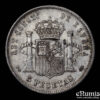


| Country | Spain |
|---|---|
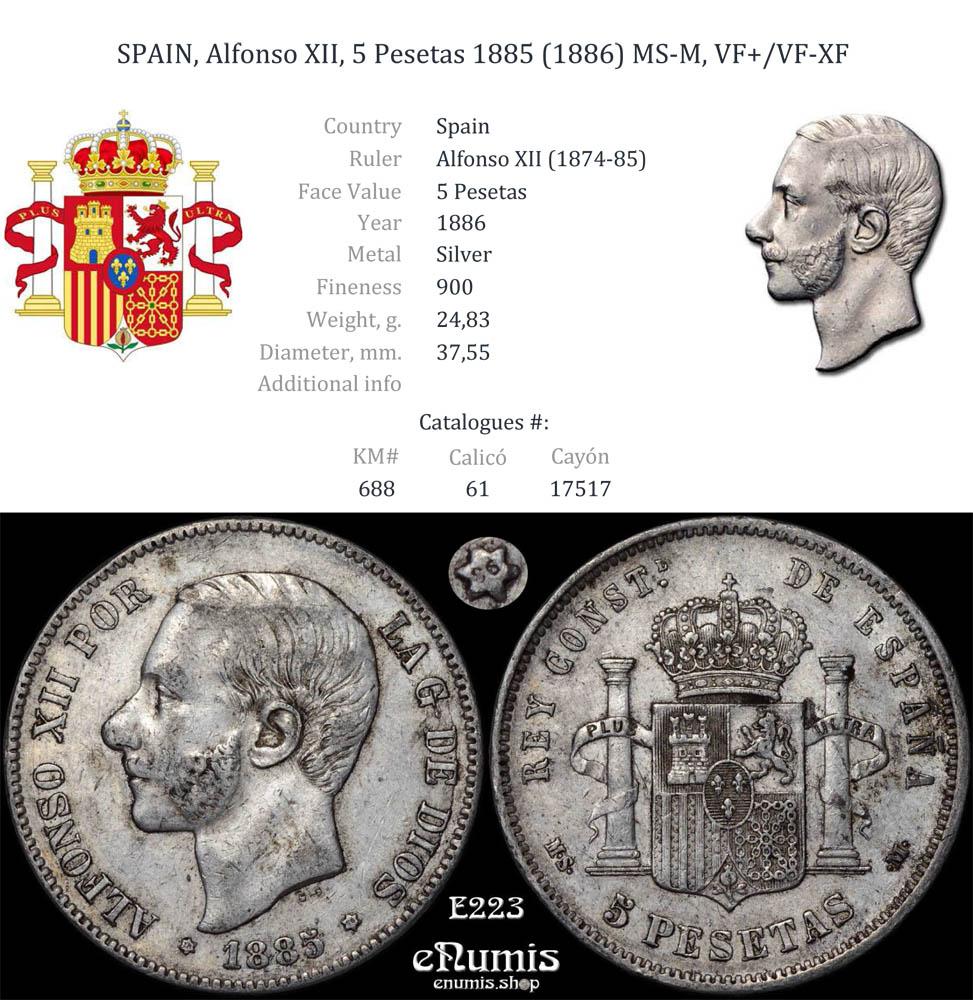
| Ruler | Alfonso XII (1874-85) |
| Face Value | 5 Pesetas |
| Year of issue | 1886 |
| Metal | Silver |
| Fineness | 900 |
| Catalogue # | KM# 688; Calico 61; Cayon 17517 |
| Weight | 24,83 g |
| Diameter | 37,55 mm |
| Our code | E223 |
| Die Axis | ↑↓ |
| Additional info | 1885 (1886) |
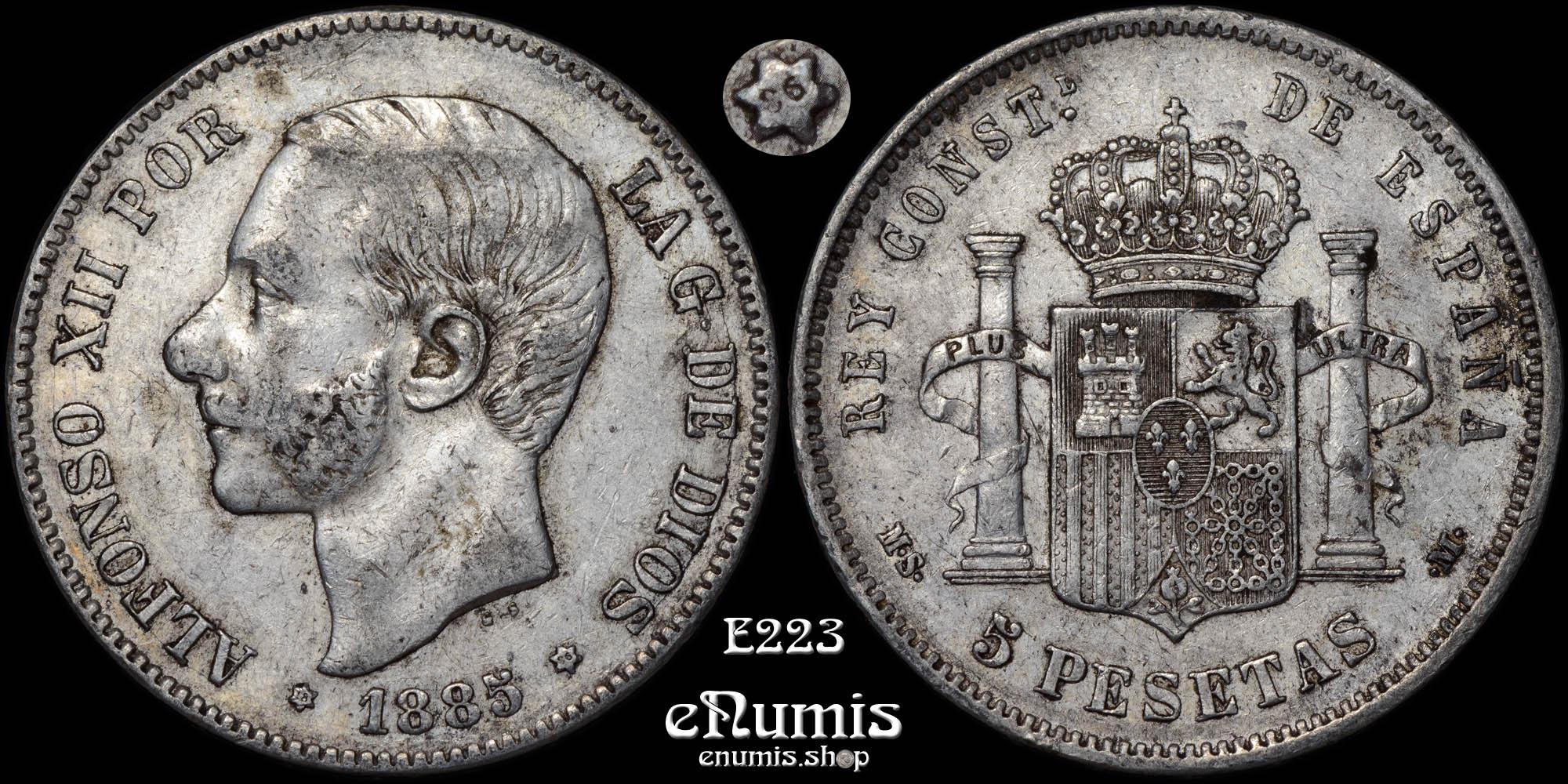
Spain, Alfonso XII, 5 Pesetas 1885 (1886) MS-M, VF+/VF‑XF
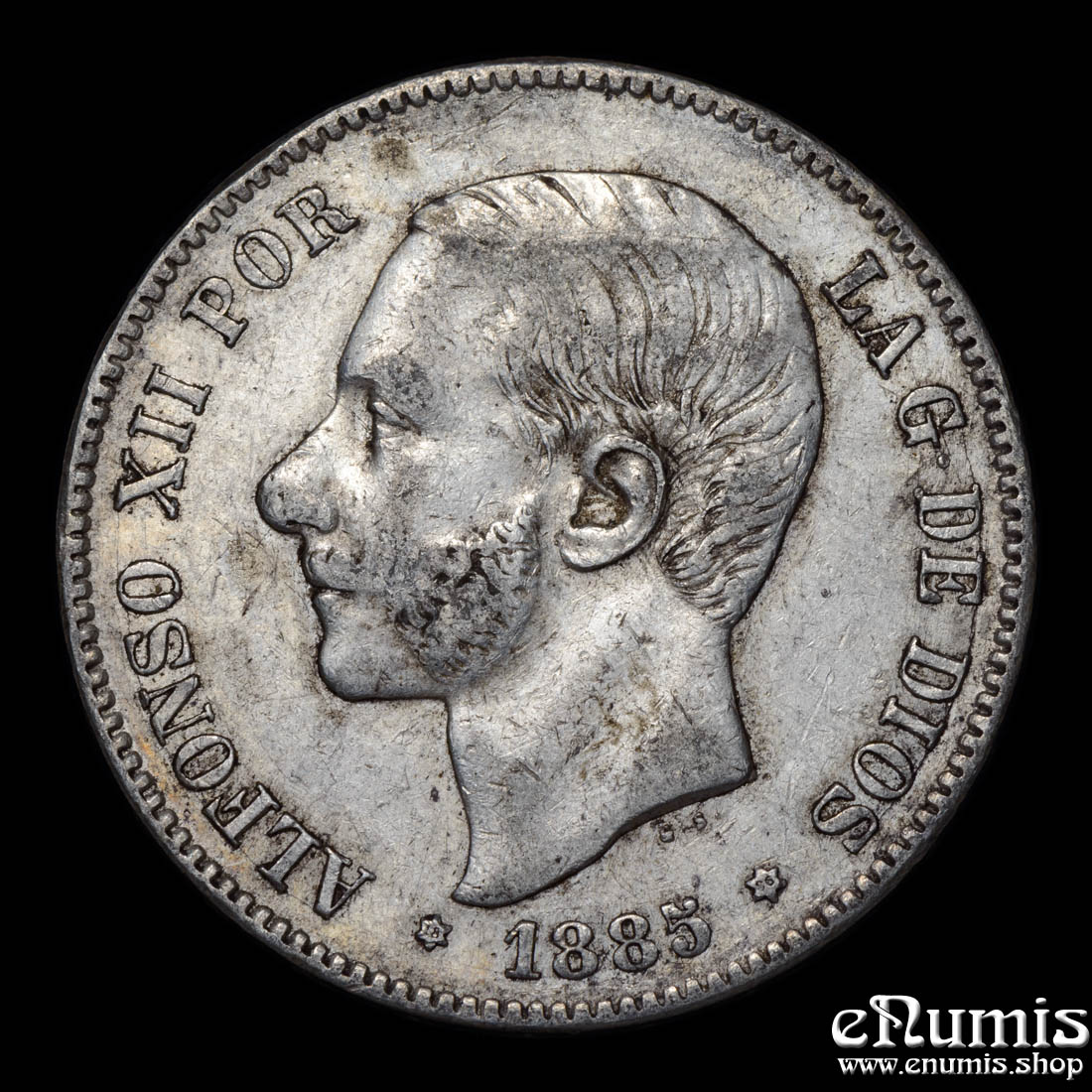
The bust of Alfonso XII facing left and the date below, legend around.
Legend:
ALFONSO XII POR LA G·DE DIOS; * 1885 *
Engraver:
♦
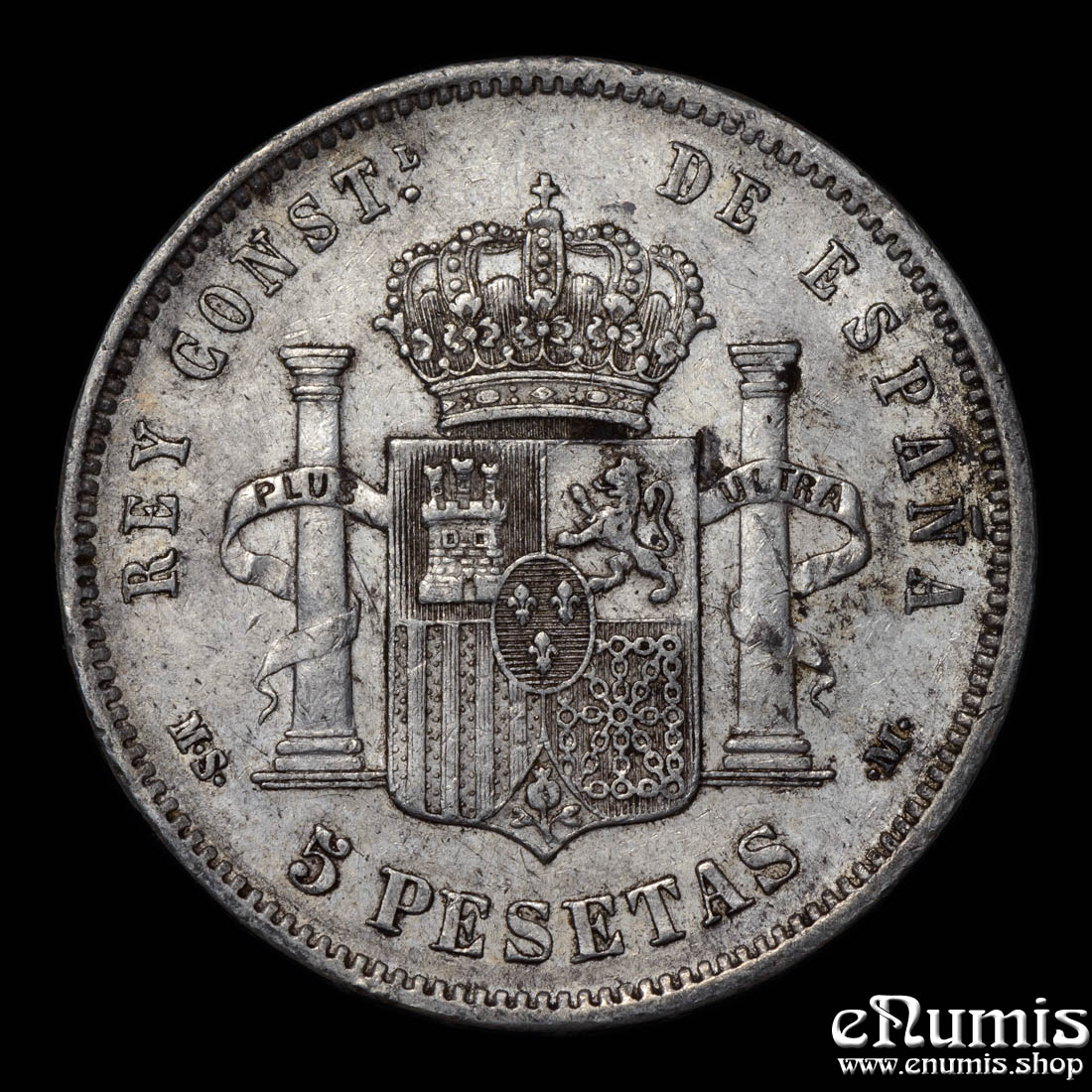
The crowned arms of Spain with pillars, value below, legend around. Mint official’s initials: M (M. Morejon), S (P. Sala), M (A. Mendoza)
Legend:
REY CONSTL. DE E S P A Ñ A; PLUS ULTRA; M·S· 5 PESETAS ·M·
Engraver:
♦
Edge:
27 fleurs-de-lis
Alfonso XII (1874-85)
Authenticity Guaranteed
Actual Coin Pictured
Ships within 1 business day
Worldwide Shipping
Spain, Alfonso XII, 5 Pesetas 1885 (1886) MS-M, VF+/VF‑XF
Availability:
In stock
Authenticity Guaranteed
Actual Coin Pictured
Ships within 1 business day
Worldwide Shipping
Obverse: The bust of Alfonso XII facing left and the date below, legend around.
Legend (Spanish): ALFONSO XII POR LA G·DE DIOS; * 1885 *
Engraver: Gregorio Sellán González

Reverse: The crowned arms of Spain with pillars, value below, legend around. Mint official’s initials: M (M. Morejon), S (P. Sala), M (A. Mendoza)
Legend (Spanish): REY CONSTL. DE E S P A Ñ A; PLUS ULTRA; M·S· 5 PESETAS ·M·
Engraver: Gregorio Sellán González
Edge: 27 fleurs-de-lis
The pictures provided are of the actual coin for sale.Guaranteed genuine.
57 € Shipping from 7 € — FREE over 300 €*
*Except US, shipped via DHL Express — see Postage tab
In stock
Authenticity guaranteedPhotos show the actual coin30-day
returns
returns
Ships within 1 business day, worldwide
Shipping from 7 € · FREE over 300 €*
*US orders: DHL Express only - see Postage
Ships within 1 business day
Authenticity Guaranteed
Actual Coin Pictured
30-Day Returns
Worldwide Shipping
Secure payment



SHIPPING:
• We ship worldwide from Slovenia, a member of the European Union, within 1 business day after payment is received.
• Every order is carefully packed to ensure safe delivery.
• Standard registered shipping via The Post of Slovenia is available worldwide and includes a tracking number.
• DHL Express shipping is also available at checkout for customers who require faster delivery.
• Registered shipping via The Post of Slovenia: €7 within Europe and €8 for the rest of the world.
• FREE registered shipping via The Post of Slovenia for orders over €300.
• FREE DHL Express shipping, including full insurance, for orders over €800.
INSURANCE:
• Upon your request an order over 300 Euro can be sent with extra insurance.
• The price of the insurance is about 1% of the order total (minimum price of the insurance is €5).
OTHER:
• Import duties, taxes and charges are not included in the item’s price or shipping charges. Buyers are responsible for these charges.
• Please check with your country’s customs office to determine what these additional costs will be prior to buying.
22 August 2025 (updated 21 July 2026):
Important Notice for USA Customers
Please note that, due to the new U.S. customs tariffs, the Post of Slovenia has temporarily suspended shipments to the United States. Unfortunately, this means we are unable to send orders to the USA at this time.
We will resume shipping to the USA as soon as the service becomes available again. Thank you for your understanding and patience.
However, we can still ship to the USA via DHL Express. Please be aware that additional U.S. customs duties or fees may apply, which are the responsibility of the buyer.
The coins remain with the seller until the goods have been paid for in full.
We accept the following payment methods:
- All major debit and credit cards (services provided by Stripe Inc. and Bankart d.o.o.)
- Cash in Euros, US Dollars or British Pounds;
- Bank Transfer – to our corporate bank account (eNumis d.o.o., OTP banka d.d. Bank account: SI56 04 0000 2762 09090 BIC: KBMASI2X );
- We also accept PayPal (only for regular customers).
At eNumis.shop, your satisfaction is our top priority. If, for any reason, you are not completely satisfied with your purchase, please contact us immediately.
You may return any item within 30 days of receipt, provided it is in the same condition as when sent. All returns must be shipped using Registered Post or your country’s equivalent postal service with a tracking number.
Upon receiving and inspecting your return, we will offer you an exchange or a refund of the coin’s purchase price, as agreed.
Please note:
Return shipping costs are the responsibility of the buyer and are non-refundable.
Items must be securely packaged to avoid damage during return shipping.
Returns sent without prior notification may not be accepted.
To initiate a return, please contact us at info@enumis.shop or through our Contact Form.
Thank you for shopping with eNumis.shop, where your trust and confidence matter.
Date in Stars
The Date in Stars: Understanding Spanish Peseta Coinage
Among the many curious conventions of European numismatics, few are as distinctive – or as frequently misunderstood – as the dating system used on Spanish peseta coins. From the introduction of the peseta in 1868 until 1982, Spanish coins carried not one but two dates: a large, prominently struck year on the obverse, and a second, hidden date concealed within two small six-pointed stars elsewhere on the coin. For the uninitiated, this can be baffling. For the collector, it is one of the most fascinating peculiarities of the entire series.
How the system works
The large date visible on the coin is not the year of minting. It is the authorization date – the year in which the law governing the issue of that particular coin was passed. The actual year of striking is found inside the stars, where two small numerals are incused, one in each star, together forming a four-digit year. The first star typically carries the first two digits (usually 19) and the second carries the last two. A coin catalogued as “5 Pesetas 1949 *50”, for example, was authorized in 1949 but actually struck in 1950.
In numismatic references and price guides, the star date is conventionally written with an asterisk preceding the number – a notation collectors quickly learn to read.
Why it matters enormously
This system is far more than a historical curiosity. The star date can make the difference between a coin worth a few dollars and one worth thousands. The most dramatic illustration comes from the 5 Pesetas of 1949: with the star date *50, the coin is common and essentially valueless in numismatic terms. With the star date *52 – a year when only a tiny number of pieces were struck – the same coin in comparable condition can fetch prices approaching €15.000. Same obverse date. Same design. Worlds apart in value.
Forgeries and blank stars
Precisely because of such discrepancies, star dates have attracted forgers willing to alter the incused numerals to simulate a rarer variety. Collectors examining high-value pieces should scrutinize the stars carefully under magnification. Conversely, coins with completely blank stars – known as estrellas anepígrafas – are not necessarily forgeries. They may represent genuine minting errors in which the inner numerals were never punched, and depending on the coin, such pieces can carry a modest premium of their own.
A system unique to Spain
No other major European coinage tradition employed this dual-dating convention in quite the same way, which gives the peseta series a character entirely its own. Whether you are assembling a type set of Alfonso XIII silver or hunting the elusive varieties of the Franco era, reading the stars is not optional – it is the first thing any serious collector of Spanish coins must learn to do.
Coin condition (grade) is described using the following scale, based on internationally recognised numismatic grading standards. Where a grade is separated by a slash (e.g. VF/XF), the obverse and reverse differ in condition – VF obverse, XF reverse in this example.
| Grade | Full name | Description |
|---|---|---|
| F | Fine | Noticeable, moderate to considerable wear across the design; major details, lettering and date remain clearly legible |
| F+ | Choice Fine | Slightly better than Fine |
| F‑VF | Fine to Very Fine | Between Fine and Very Fine |
| aVF | About Very Fine | Slightly below Very Fine |
| VF | Very Fine | Moderate wear on the higher points; major design elements and lettering remain sharp and well-defined |
| VF+ | Choice Very Fine | Slightly better than Very Fine |
| VF‑XF | Very Fine to Extremely Fine | Between Very Fine and Extremely Fine |
| aXF | About Extremely Fine | Slightly below Extremely Fine |
| XF | Extremely Fine | Light wear confined to the highest points of the design; most original detail and some mint lustre remain |
| XF+ | Choice Extremely Fine | Slightly better than Extremely Fine |
| XF‑UNC | Extremely Fine to Uncirculated | Between Extremely Fine and Uncirculated |
| aUNC | About Uncirculated | Slightly below Uncirculated |
| UNC | Uncirculated | Shows no evidence of circulation wear; retains its original mint lustre, which may appear naturally subdued with age |
| Proof | Proof | Struck specifically for collectors from specially prepared, polished dies on polished planchets, giving sharp detail and mirror-like fields. Refers to how the coin was made, not to its state of preservation |
| Prooflike (PL) | Prooflike | A coin from the ordinary circulation production that happens to show mirror-like fields, usually from early strikes with fresh dies – it looks similar to a Proof but was not specially struck for collectors |
Grading is inherently somewhat subjective. If you would like additional photos or have any question about a coin’s condition before ordering, please contact us – we’re happy to help.