






| Country | Great Britain |
|---|---|
| Ruler | William IV (1830-37) |
| Face Value | 4 Pence Groat |
| Year of issue | 1836 |
| Metal | Silver |
| Fineness | 925 |
| Catalogue # | KM# 723; SPINK 3837; ESC unlisted; Davies unlisted |
| Weight | 1,89 g |
| Diameter | 16,3 mm |
| Our code | Z140 |
| Die Axis | ↑↑ |
| Additional info | Obv.3: Large head - Rare!, unlisted in Davies & ESC |
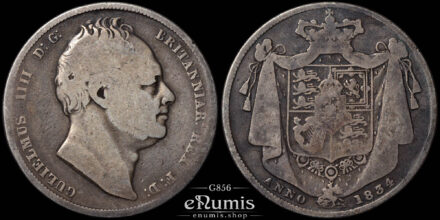
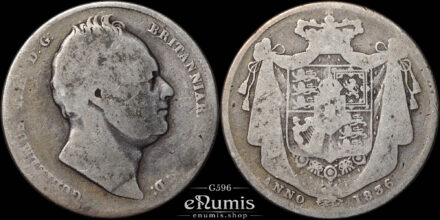
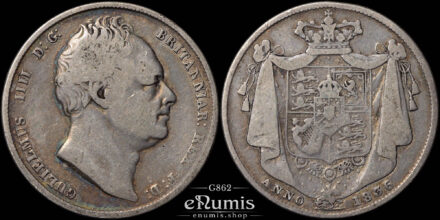
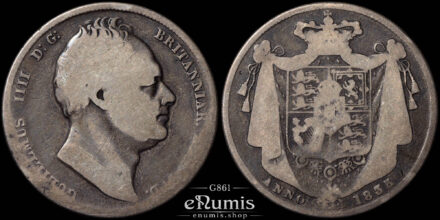
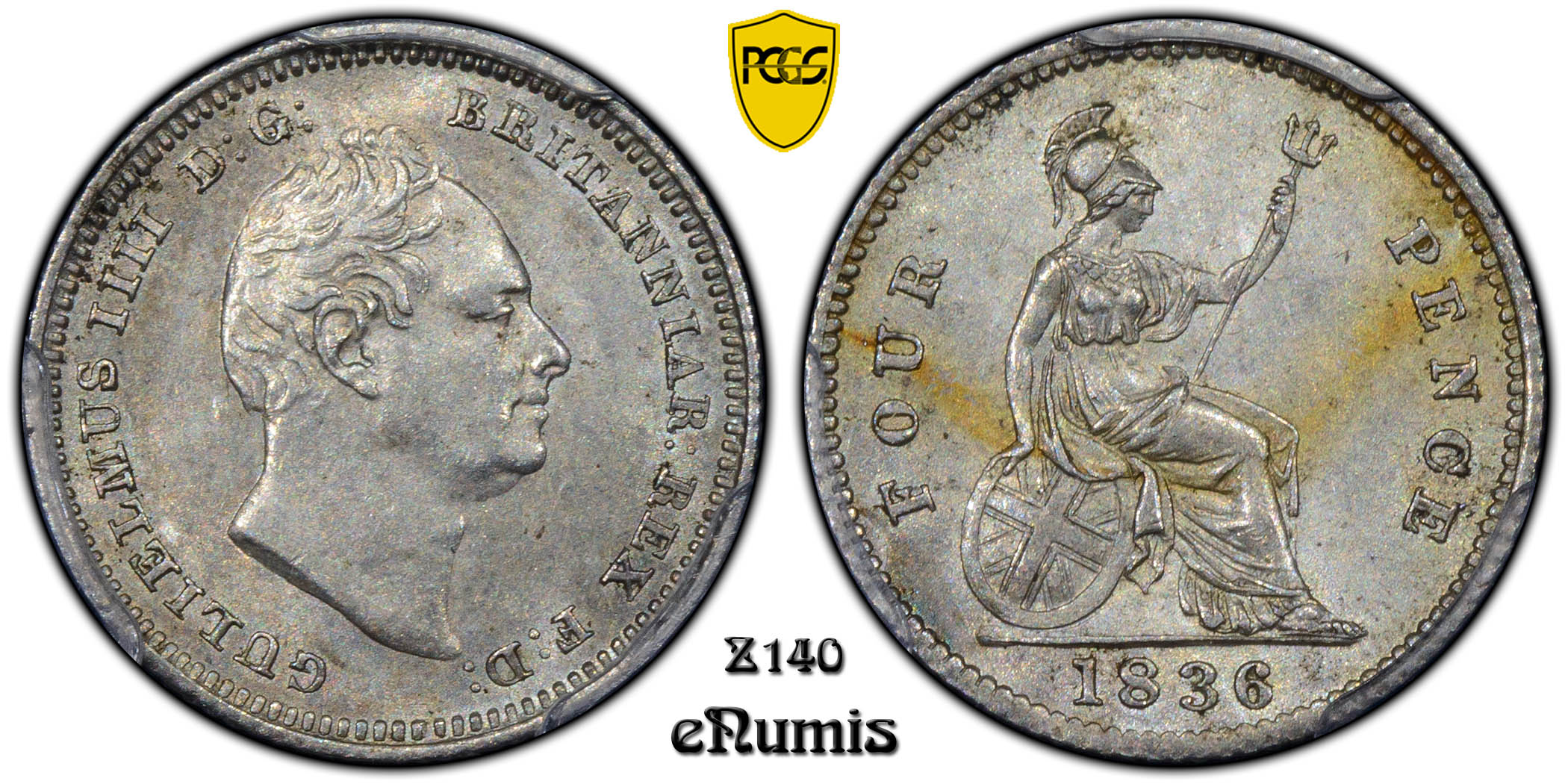
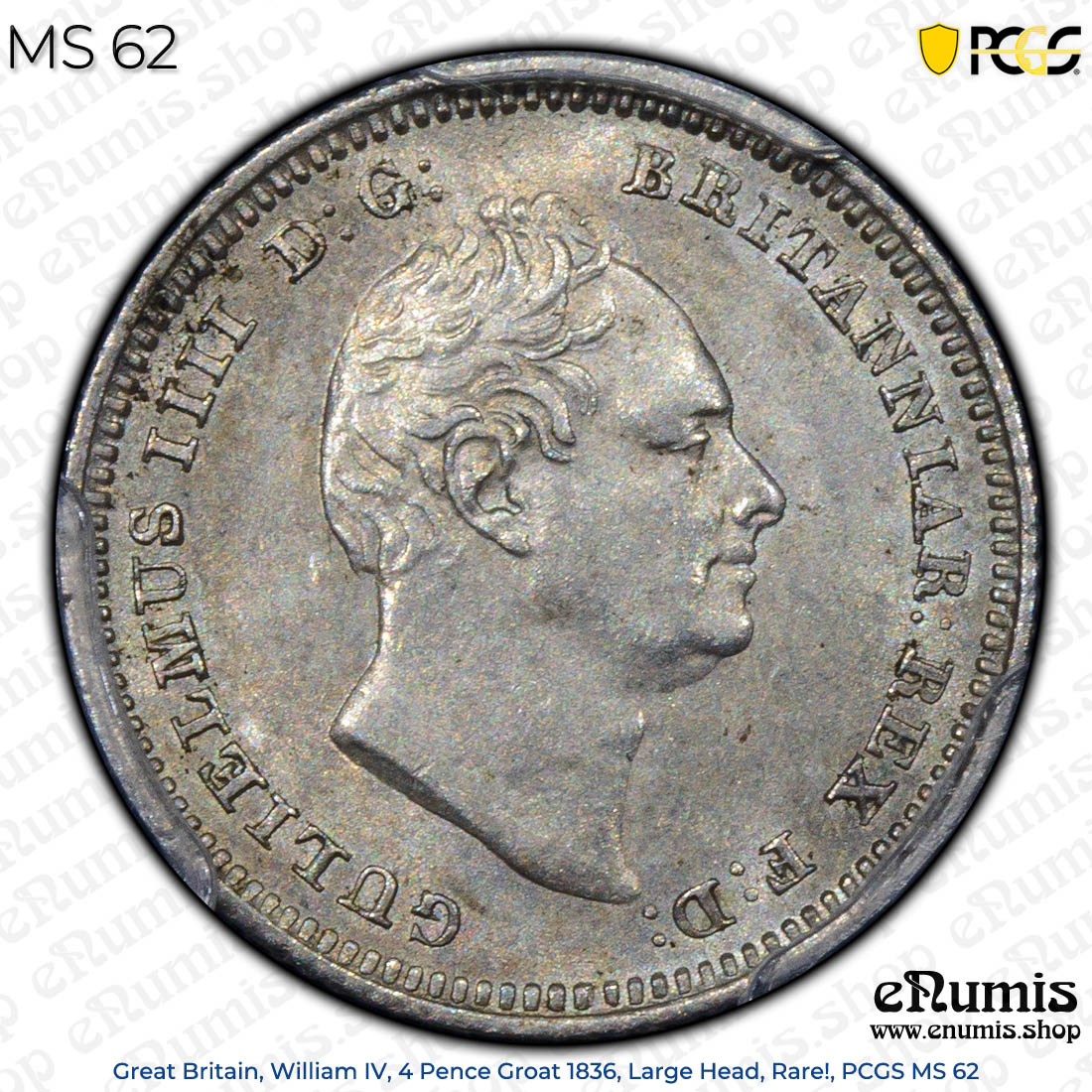
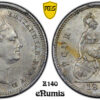
Great Britain, William IV, 4 Pence Groat 1836, Large Head, Rare!, PCGS MS 62
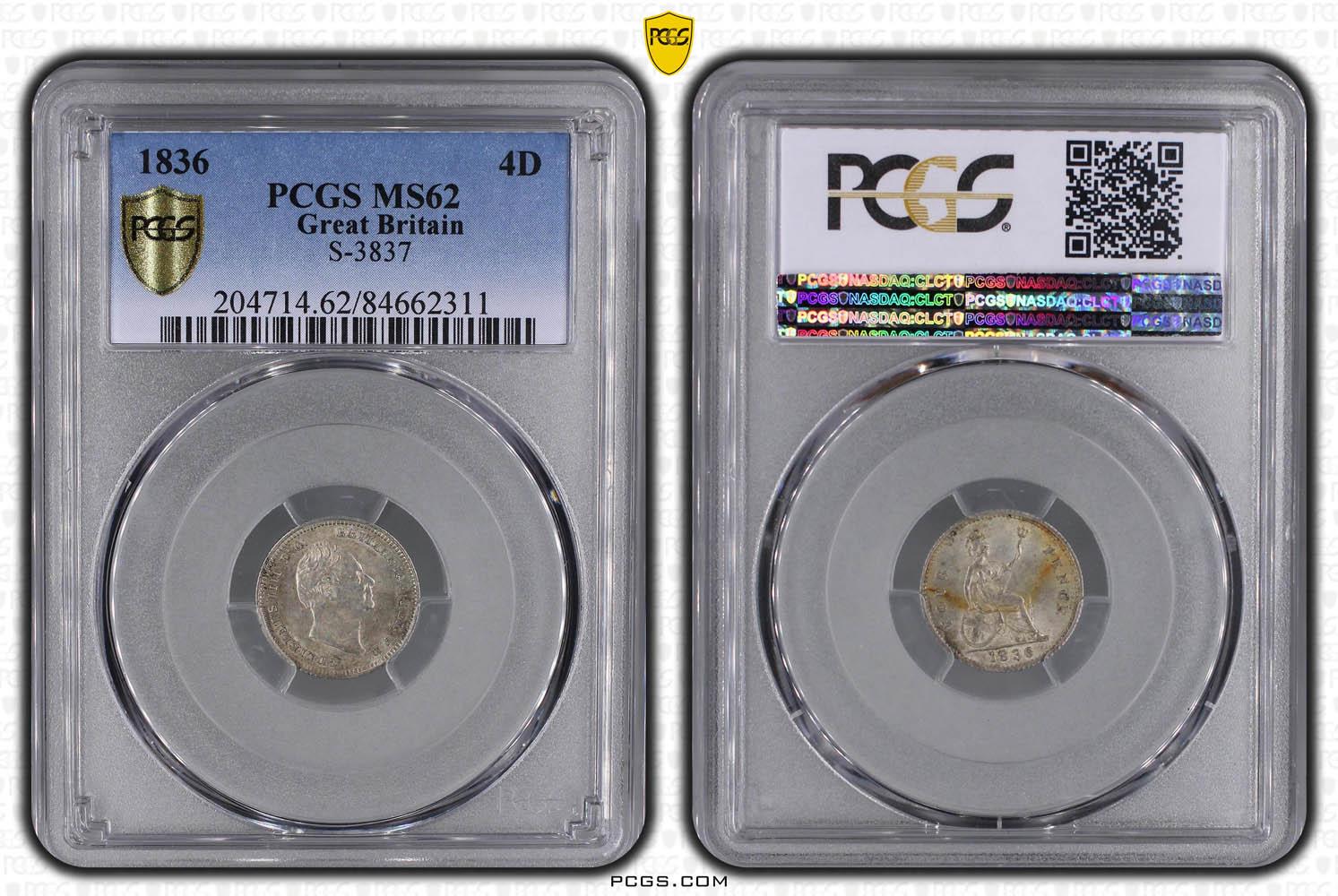
You can verify the PCGS certification number: 84662311
Uncrowned portrait of King William IV right, legend around.
Legend:
GULIELMUS IIII D:G: BRITANNIAR: REX F:D:
Engraver:
♦
Seated figure of Britannia right, trident in left hand, shield bearing the Union flag in the right, denomination around, date in exergue.
Legend:
FOUR PENCE 1836
Engraver:
♦
Edge:
Reeded
William IV (1830-37)
Authenticity Guaranteed
Actual Coin Pictured
Ships within 1 business day
Worldwide Shipping
Great Britain, William IV, 4 Pence Groat 1836, Large Head, Rare!, PCGS MS 62
MS 62
Availability:
In stock
Authenticity Guaranteed
Actual Coin Pictured
Ships within 1 business day
Worldwide Shipping
Obverse: Uncrowned portrait of King William IV right, legend around.
Legend (Latin): GULIELMUS IIII D:G: BRITANNIAR: REX F:D:
Engraver: William Wyon

Reverse: Seated figure of Britannia right, trident in left hand, shield bearing the Union flag in the right, denomination around, date in exergue.
Legend (English): FOUR PENCE 1836
Engraver: William Wyon
Edge: Reeded
You can verify the PCGS certification number: 84662311
The pictures provided are of the actual coin for sale.Guaranteed genuine.
249 € Shipping from 7 € — FREE over 300 €*
*Except US, shipped via DHL Express — see Postage tab
In stock
Authenticity guaranteedPhotos show the actual coin30-day
returns
returns
Ships within 1 business day, worldwide
Shipping from 7 € · FREE over 300 €*
*US orders: DHL Express only - see Postage
Ships within 1 business day
Authenticity Guaranteed
Actual Coin Pictured
30-Day Returns
Worldwide Shipping
Secure payment



SHIPPING:
• We ship worldwide from Slovenia, a member of the European Union, within 1 business day after payment is received.
• Every order is carefully packed to ensure safe delivery.
• Standard registered shipping via The Post of Slovenia is available worldwide and includes a tracking number.
• DHL Express shipping is also available at checkout for customers who require faster delivery.
• Registered shipping via The Post of Slovenia: €7 within Europe and €8 for the rest of the world.
• FREE registered shipping via The Post of Slovenia for orders over €300.
• FREE DHL Express shipping, including full insurance, for orders over €800.
INSURANCE:
• Upon your request an order over 300 Euro can be sent with extra insurance.
• The price of the insurance is about 1% of the order total (minimum price of the insurance is €5).
OTHER:
• Import duties, taxes and charges are not included in the item’s price or shipping charges. Buyers are responsible for these charges.
• Please check with your country’s customs office to determine what these additional costs will be prior to buying.
22 August 2025 (updated 21 July 2026):
Important Notice for USA Customers
Please note that, due to the new U.S. customs tariffs, the Post of Slovenia has temporarily suspended shipments to the United States. Unfortunately, this means we are unable to send orders to the USA at this time.
We will resume shipping to the USA as soon as the service becomes available again. Thank you for your understanding and patience.
However, we can still ship to the USA via DHL Express. Please be aware that additional U.S. customs duties or fees may apply, which are the responsibility of the buyer.
The coins remain with the seller until the goods have been paid for in full.
We accept the following payment methods:
- All major debit and credit cards (services provided by Stripe Inc. and Bankart d.o.o.)
- Cash in Euros, US Dollars or British Pounds;
- Bank Transfer – to our corporate bank account (eNumis d.o.o., OTP banka d.d. Bank account: SI56 04 0000 2762 09090 BIC: KBMASI2X );
- We also accept PayPal (only for regular customers).
At eNumis.shop, your satisfaction is our top priority. If, for any reason, you are not completely satisfied with your purchase, please contact us immediately.
You may return any item within 30 days of receipt, provided it is in the same condition as when sent. All returns must be shipped using Registered Post or your country’s equivalent postal service with a tracking number.
Upon receiving and inspecting your return, we will offer you an exchange or a refund of the coin’s purchase price, as agreed.
Please note:
Return shipping costs are the responsibility of the buyer and are non-refundable.
Items must be securely packaged to avoid damage during return shipping.
Returns sent without prior notification may not be accepted.
To initiate a return, please contact us at info@enumis.shop or through our Contact Form.
Thank you for shopping with eNumis.shop, where your trust and confidence matter.
History
The groat had been dead for decades. Not entirely – it survived in the narrow, ceremonial form of Maundy money, distributed by the monarch to the poor on Holy Thursday – but as a coin of everyday commerce it had quietly vanished from British life. For most of the 18th century, small silver simply wasn’t worth the trouble of minting. And then London grew.
By the 1830s, the capital was transforming at a pace that bewildered its own inhabitants. The railways were coming. The streets teemed with hackney carriages, omnibuses, market traders, and factory workers – a vast new urban economy generating millions of small daily transactions that the existing coinage handled awkwardly. Between the penny and the sixpence there was an uncomfortable gap and nowhere was it felt more keenly than at the end of a short cab ride. The standard fare was fourpence. Passengers typically tendered a sixpence. Cab drivers typically pocketed the change.
Into this gap stepped Joseph Hume, Member of Parliament for Weymouth, who lobbied persistently for the reintroduction of a fourpenny coin. The Royal Mint concurred, and on the 3rd of February 1836, a royal proclamation declared the new groat legal tender. The cab drivers were furious. They had grown comfortable with the twopenny gratuity that the absence of a fourpenny coin had effectively made compulsory, and they took their revenge in language – dubbing the unwanted coin a “joey” after Hume himself, a term of pure contempt. The nickname stuck long after the grievance was forgotten.
The 1836 groat bears the bare-headed portrait of King William IV, engraved by the masterful William Wyon, and on the reverse – in a departure from earlier fourpenny pieces – a seated Britannia holding a trident, shield at her side. William IV had come to the throne in 1830, a bluff former naval officer known as the Sailor King, refreshingly unpretentious after the excesses of his brother George IV. He had little more than a year left to live when this coin entered circulation. The following year he died, and the crown passed to an eighteen-year-old girl named Victoria.
The 1836 groat is therefore a coin of the threshold – the last reign before the longest, a small silver disc produced in the final months before Britain entered the Victorian age and began its extraordinary transformation into the most powerful empire the world had ever seen.
Coin condition (grade) is described using the following scale, based on internationally recognised numismatic grading standards. Where a grade is separated by a slash (e.g. VF/XF), the obverse and reverse differ in condition – VF obverse, XF reverse in this example.
| Grade | Full name | Description |
|---|---|---|
| F | Fine | Noticeable, moderate to considerable wear across the design; major details, lettering and date remain clearly legible |
| F+ | Choice Fine | Slightly better than Fine |
| F‑VF | Fine to Very Fine | Between Fine and Very Fine |
| aVF | About Very Fine | Slightly below Very Fine |
| VF | Very Fine | Moderate wear on the higher points; major design elements and lettering remain sharp and well-defined |
| VF+ | Choice Very Fine | Slightly better than Very Fine |
| VF‑XF | Very Fine to Extremely Fine | Between Very Fine and Extremely Fine |
| aXF | About Extremely Fine | Slightly below Extremely Fine |
| XF | Extremely Fine | Light wear confined to the highest points of the design; most original detail and some mint lustre remain |
| XF+ | Choice Extremely Fine | Slightly better than Extremely Fine |
| XF‑UNC | Extremely Fine to Uncirculated | Between Extremely Fine and Uncirculated |
| aUNC | About Uncirculated | Slightly below Uncirculated |
| UNC | Uncirculated | Shows no evidence of circulation wear; retains its original mint lustre, which may appear naturally subdued with age |
| Proof | Proof | Struck specifically for collectors from specially prepared, polished dies on polished planchets, giving sharp detail and mirror-like fields. Refers to how the coin was made, not to its state of preservation |
| Prooflike (PL) | Prooflike | A coin from the ordinary circulation production that happens to show mirror-like fields, usually from early strikes with fresh dies – it looks similar to a Proof but was not specially struck for collectors |
Grading is inherently somewhat subjective. If you would like additional photos or have any question about a coin’s condition before ordering, please contact us – we’re happy to help.