

| Country | Great Britain |
|---|---|
| Ruler | William III (1694-1702) |
| Face Value | Halfcrown |
| Year of issue | 1696 |
| Metal | Silver |
| Fineness | 925 |
| Catalogue # | KM# 491.1; SPINK 3481; ESC 1016 |
| Weight | 13,49 g |
| Diameter | 33,4 mm |
| Our code | G499 |
| Die Axis | ↑↓ |
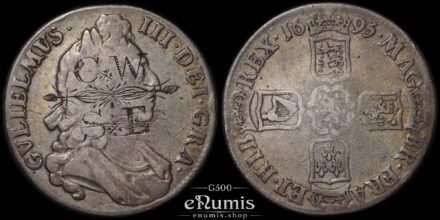
| Additional info | Obv. & Rev.: graffiti |
Great Britain, William III, Halfcrown 1696, Fine
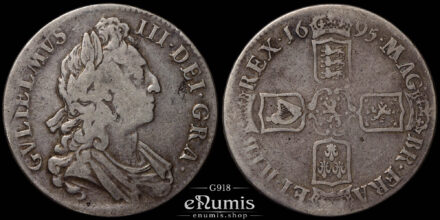
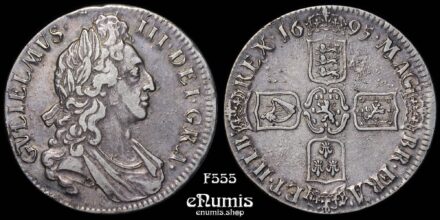
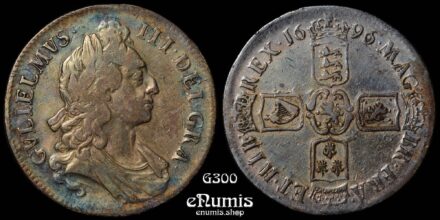
Third laureate and draped bust of King William III right, legend around.
Legend:
GVLIELMVS · III · DEI · GRA ·
Translation:
William III by the Grace of God
Engraver:
James Roettier
♦
Crowned cruciform shields around central Nassau lion, divided date above, legend around.
Legend:
MAG BR·FRA· ET·HIB· REX·16 96·
Translation:
King of Great Britain France and Ireland
Engraver:
♦
Edge:
DECVS ET TVTAMEN. ANNO REGNI OCTAVO
William III (1694-1702)
Authenticity Guaranteed
Actual Coin Pictured
Ships within 1 business day
Worldwide Shipping
Great Britain, William III, Halfcrown 1696, Fine
Availability:
In stock
Authenticity Guaranteed
Actual Coin Pictured
Ships within 1 business day
Worldwide Shipping
Obverse: Third laureate and draped bust of King William III right, legend around.
Legend (Latin): GVLIELMVS · III · DEI · GRA ·
Translation: William III by the Grace of God
Engraver: James Roettier

Reverse: Crowned cruciform shields around central Nassau lion, divided date above, legend around.
Legend (Latin): MAG BR·FRA· ET·HIB· REX·16 96·
Translation: King of Great Britain France and Ireland
Engraver: John Roettier
Edge (Text in Latin, Regnal year): DECVS ET TVTAMEN. ANNO REGNI OCTAVO
The pictures provided are of the actual coin for sale.Guaranteed genuine.
59 € Shipping from 7 € — FREE over 300 €*
*Except US, shipped via DHL Express — see Postage tab
In stock
Shipping from 7 € · FREE over 300 €*
*US orders: DHL Express only - see Postage
Ships within 1 business day
Authenticity Guaranteed
Actual Coin Pictured
30-Day Returns
Worldwide Shipping
Secure payment



SHIPPING:
• We ship worldwide from Slovenia, a member of the European Union, within 1 business day after payment is received.
• Every order is carefully packed to ensure safe delivery.
• Standard registered shipping via The Post of Slovenia is available worldwide and includes a tracking number.
• DHL Express shipping is also available at checkout for customers who require faster delivery.
• Registered shipping via The Post of Slovenia: €7 within Europe and €8 for the rest of the world.
• FREE registered shipping via The Post of Slovenia for orders over €300.
• FREE DHL Express shipping, including full insurance, for orders over €800.
INSURANCE:
• Upon your request an order over 300 Euro can be sent with extra insurance.
• The price of the insurance is about 1% of the order total (minimum price of the insurance is €5).
OTHER:
• Import duties, taxes and charges are not included in the item’s price or shipping charges. Buyers are responsible for these charges.
• Please check with your country’s customs office to determine what these additional costs will be prior to buying.
22 August 2025 (updated 21 July 2026):
Important Notice for USA Customers
Please note that, due to the new U.S. customs tariffs, the Post of Slovenia has temporarily suspended shipments to the United States. Unfortunately, this means we are unable to send orders to the USA at this time.
We will resume shipping to the USA as soon as the service becomes available again. Thank you for your understanding and patience.
However, we can still ship to the USA via DHL Express. Please be aware that additional U.S. customs duties or fees may apply, which are the responsibility of the buyer.
The coins remain with the seller until the goods have been paid for in full.
We accept the following payment methods:
- All major debit and credit cards (services provided by Stripe Inc. and Bankart d.o.o.)
- Cash in Euros, US Dollars or British Pounds;
- Bank Transfer – to our corporate bank account (eNumis d.o.o., OTP banka d.d. Bank account: SI56 04 0000 2762 09090 BIC: KBMASI2X );
- We also accept PayPal (only for regular customers).
At eNumis.shop, your satisfaction is our top priority. If, for any reason, you are not completely satisfied with your purchase, please contact us immediately.
You may return any item within 30 days of receipt, provided it is in the same condition as when sent. All returns must be shipped using Registered Post or your country’s equivalent postal service with a tracking number.
Upon receiving and inspecting your return, we will offer you an exchange or a refund of the coin’s purchase price, as agreed.
Please note:
Return shipping costs are the responsibility of the buyer and are non-refundable.
Items must be securely packaged to avoid damage during return shipping.
Returns sent without prior notification may not be accepted.
To initiate a return, please contact us at info@enumis.shop or through our Contact Form.
Thank you for shopping with eNumis.shop, where your trust and confidence matter.
History
In the winter of 1695, England’s currency was in a state of quiet catastrophe.
For decades, the silver coins in everyday circulation had been systematically destroyed by clipping – the practice of shaving thin slices of metal from the edges of hammered coins and selling the clippings as bullion. Since the value of a coin was determined by its weight rather than its face, clipping was in effect a slow theft from every transaction in the kingdom. By 1695, the average silver coin in circulation weighed barely half of what it should. Trade was seizing up. Soldiers and creditors abroad refused English silver. The Treasury was hemorrhaging confidence along with metal.
The crisis forced an unlikely collaboration. William Lowndes of the Treasury turned for advice to the recently appointed Warden of the Royal Mint – a Cambridge mathematician and natural philosopher named Isaac Newton, who had spent the previous three decades studying optics, gravity, and the nature of the universe, and who now found himself wrestling with the rather more immediate problem of England’s debased coinage. Newton threw himself into the task with characteristic thoroughness, and in January 1696 Parliament passed the Act for Remedying the Ill State of the Coin of the Kingdom. The Great Recoinage had begun.
The Half Crown of 1696 was born from this upheaval. It was among the first fruits of the new order – machine-struck, perfectly round, its edges milled with the legend *DECUS ET TUTAMEN*, an ornament and a safeguard, making clipping immediately visible and therefore pointless. The old hammered coins were called in and returned by weight rather than face value, at a rate that penalized no one but rewarded no clipper either. To handle the sheer volume of work, branch mints were established at Bristol, Chester, Exeter, Norwich, and York – a nationwide operation of a scale England had never attempted.
On the obverse, the laureate and draped bust of William III faces right, identified in the Latin legend as *GVLIELMVS III DEI GRA* – William III, by the Grace of God, King of Great Britain, France, and Ireland. He was forty-five years old in 1696, perpetually at war with Louis XIV, perpetually reliant on English money to fund campaigns on the Continent that Parliament supported only grudgingly. The monetary crisis had been as much his crisis as anyone’s: the army in Flanders needed paying, and debased silver was no use to a soldier’s landlord in Brussels.
The reverse displayed the crowned cruciform shields of England, Scotland, France, and Ireland – the heraldic geography of a composite monarchy that had only eight years earlier arrived by invitation, when William had crossed the Channel from the Netherlands to displace the Catholic James II in the Glorious Revolution of 1688. The lion at the centre of the cross, tiny but precise, completed an image of sovereignty reasserted through good silver.
This coin was also the work of a man who had just scratched something into it three centuries ago – a monogram, two crossed swords, a personal emblem we will never fully decode. Whoever he was, he owned this halfcrown specifically enough to mark it. In an age when coins were the only portable wealth most people possessed, that mark was a statement of ownership as serious as a deed.
He handed it to someone, or spent it, or lost it. It survived him by three hundred years.
Coin condition (grade) is described using the following scale, based on internationally recognised numismatic grading standards. Where a grade is separated by a slash (e.g. VF/XF), the obverse and reverse differ in condition – VF obverse, XF reverse in this example.
| Grade | Full name | Description |
|---|---|---|
| F | Fine | Noticeable, moderate to considerable wear across the design; major details, lettering and date remain clearly legible |
| F+ | Choice Fine | Slightly better than Fine |
| F‑VF | Fine to Very Fine | Between Fine and Very Fine |
| aVF | About Very Fine | Slightly below Very Fine |
| VF | Very Fine | Moderate wear on the higher points; major design elements and lettering remain sharp and well-defined |
| VF+ | Choice Very Fine | Slightly better than Very Fine |
| VF‑XF | Very Fine to Extremely Fine | Between Very Fine and Extremely Fine |
| aXF | About Extremely Fine | Slightly below Extremely Fine |
| XF | Extremely Fine | Light wear confined to the highest points of the design; most original detail and some mint lustre remain |
| XF+ | Choice Extremely Fine | Slightly better than Extremely Fine |
| XF‑UNC | Extremely Fine to Uncirculated | Between Extremely Fine and Uncirculated |
| aUNC | About Uncirculated | Slightly below Uncirculated |
| UNC | Uncirculated | Shows no evidence of circulation wear; retains its original mint lustre, which may appear naturally subdued with age |
| Proof | Proof | Struck specifically for collectors from specially prepared, polished dies on polished planchets, giving sharp detail and mirror-like fields. Refers to how the coin was made, not to its state of preservation |
| Prooflike (PL) | Prooflike | A coin from the ordinary circulation production that happens to show mirror-like fields, usually from early strikes with fresh dies – it looks similar to a Proof but was not specially struck for collectors |
Grading is inherently somewhat subjective. If you would like additional photos or have any question about a coin’s condition before ordering, please contact us – we’re happy to help.