

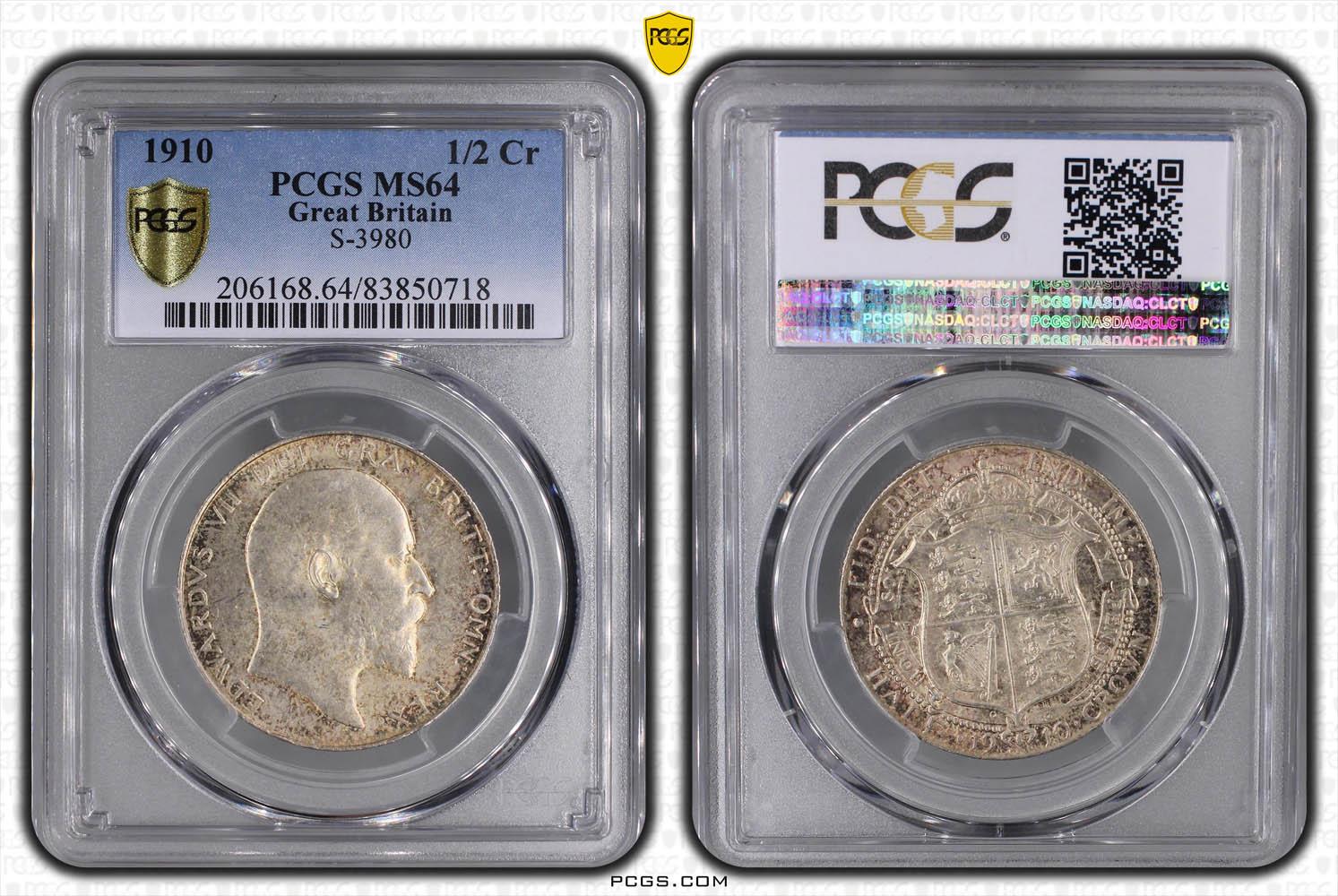



| Country | Great Britain |
|---|---|
| Ruler | Edward VII (1901-10) |
| Face Value | Halfcrown |
| Year of issue | 1910 |
| Metal | Silver |
| Fineness | 925 |
| Catalogue # | KM# 802; SPINK 3980; ESC 3576; Davies 1518 |
| Weight | 14,14 g |
| Diameter | 32,1 mm |
| Our code | Z124 |
| Die Axis | ↑↑ |
| Additional info | - |
Great Britain, Edward VII, Halfcrown 1910, PCGS MS 64
You can verify the PCGS certification number: 83850718
Uncrowned portrait of King Edward VII right, legend around.
Legend:
EDWARDVS VII DEI GRA: BRITT: OMN: REX; DE S·
Engraver:
♦
Crowned quartered shield of arms within Garter band, legend around, divided date below.
Legend:
· FID: DEF: IND: IMP: ·; HALF · 19 10 · CROWN; HONI SOIT· QVI MAL· Y PENSE·
Engraver:
♦
Edge:
Reeded
Edward VII (1901-10)
Authenticity Guaranteed
Actual Coin Pictured
Ships within 1 business day
Worldwide Shipping
Great Britain, Edward VII, Halfcrown 1910, PCGS MS 64
Availability:
In stock
Authenticity Guaranteed
Actual Coin Pictured
Ships within 1 business day
Worldwide Shipping
Obverse: Uncrowned portrait of King Edward VII right, legend around.
Legend (Latin): EDWARDVS VII DEI GRA: BRITT: OMN: REX; DE S·
Engraver: George William de Saulles

Reverse: Crowned quartered shield of arms within Garter band, legend around, divided date below.
Legend (Latin, English): · FID: DEF: IND: IMP: ·; HALF · 19 10 · CROWN; HONI SOIT· QVI MAL· Y PENSE·
Engraver: George William de Saulles
Edge: Reeded
You can verify the PCGS certification number: 83850718
The pictures provided are of the actual coin for sale.Guaranteed genuine.
699 € Shipping from 7 € — FREE over 300 €*
*Except US, shipped via DHL Express — see Postage tab
In stock
Shipping from 7 € · FREE over 300 €*
*US orders: DHL Express only - see Postage
Ships within 1 business day
Authenticity Guaranteed
Actual Coin Pictured
30-Day Returns
Worldwide Shipping
Secure payment





SHIPPING:
• We ship worldwide from Slovenia, a member of the European Union, within 1 business day after payment is received.
• Every order is carefully packed to ensure safe delivery.
• Standard registered shipping via The Post of Slovenia is available worldwide and includes a tracking number.
• DHL Express shipping is also available at checkout for customers who require faster delivery.
• Registered shipping via The Post of Slovenia: €7 within Europe and €8 for the rest of the world.
• FREE registered shipping via The Post of Slovenia for orders over €300.
• FREE DHL Express shipping, including full insurance, for orders over €800.
INSURANCE:
• Upon your request an order over 300 Euro can be sent with extra insurance.
• The price of the insurance is about 1% of the order total (minimum price of the insurance is €5).
OTHER:
• Import duties, taxes and charges are not included in the item’s price or shipping charges. Buyers are responsible for these charges.
• Please check with your country’s customs office to determine what these additional costs will be prior to buying.
22 August 2025 (updated 21 July 2026):
Important Notice for USA Customers
Please note that, due to the new U.S. customs tariffs, the Post of Slovenia has temporarily suspended shipments to the United States. Unfortunately, this means we are unable to send orders to the USA at this time.
We will resume shipping to the USA as soon as the service becomes available again. Thank you for your understanding and patience.
However, we can still ship to the USA via DHL Express. Please be aware that additional U.S. customs duties or fees may apply, which are the responsibility of the buyer.
The coins remain with the seller until the goods have been paid for in full.
We accept the following payment methods:
- All major debit and credit cards (services provided by Stripe Inc. and Bankart d.o.o.)
- Cash in Euros, US Dollars or British Pounds;
- Bank Transfer – to our corporate bank account (eNumis d.o.o., OTP banka d.d. Bank account: SI56 04 0000 2762 09090 BIC: KBMASI2X );
- We also accept PayPal (only for regular customers).
At eNumis.shop, your satisfaction is our top priority. If, for any reason, you are not completely satisfied with your purchase, please contact us immediately.
You may return any item within 30 days of receipt, provided it is in the same condition as when sent. All returns must be shipped using Registered Post or your country’s equivalent postal service with a tracking number.
Upon receiving and inspecting your return, we will offer you an exchange or a refund of the coin’s purchase price, as agreed.
Please note:
Return shipping costs are the responsibility of the buyer and are non-refundable.
Items must be securely packaged to avoid damage during return shipping.
Returns sent without prior notification may not be accepted.
To initiate a return, please contact us at info@enumis.shop or through our Contact Form.
Thank you for shopping with eNumis.shop, where your trust and confidence matter.
Purchasing Power
What Could This Halfcrown Buy in 1910?
In Edwardian Britain, a halfcrown represented a useful everyday sum.
• about 1/3-1/2 of a skilled worker’s daily wage
• roughly 6-8 loaves of bread
• about 3-4 pints of ale at a public house
• a railway ticket for a short journey
Coins of this value were commonly used for everyday purchases and small expenses.
History
On the sixth of May 1910, Edward VII refused to go to bed. He had suffered several heart attacks through the course of that afternoon, his breathing was failing, and every doctor in the palace knew what was coming. But the King sat upright in his chair and said – in words that became immediately famous – No, I shall not give in; I shall go on; I shall work to the end. Between moments of faintness, his son told him that his horse, Witch of the Air, had won that afternoon at Kempton Park. Edward rallied briefly, said he was very glad, and lost consciousness for the last time. He died that evening, sixty-eight years old, still dressed, still in his chair.
The Half Crown of 1910 was struck in the months before that afternoon – in the early part of a year that had begun badly and never recovered. Edward had returned from convalescence in Biarritz in late April, visibly unwell, to find London in the grip of a constitutional crisis over the House of Lords’ rejection of Lloyd George’s People’s Budget. He had spent his final weeks attempting to broker a resolution between a Liberal government he distrusted and a Conservative opposition he could not move, while his lungs failed steadily around him. He died with the crisis unresolved, leaving it to his son and successor George V to navigate the Parliament Act of 1911 that finally stripped the Lords of their absolute veto.
This particular coin, graded MS 64 by PCGS, survived the century in a condition its contemporaries did not. The vast majority of Edwardian halfcrowns went into circulation and stayed there – passing through pockets and tills and counting houses across the empire, accumulating the honest wear of commerce, until the silver shortage of the First World War prompted the wholesale melting of sterling coinage that destroyed an enormous proportion of the surviving stock. A coin that emerged from the twentieth century in mint state, its surfaces still carrying the crisp detail of the Royal Mint’s dies, is a coin that was set aside almost immediately – handled with care, kept from the rough democracy of everyday use, preserved by someone who understood that it was worth preserving.
The obverse carries the right-facing laureate bust of Edward VII, engraved by George William de Saulles – the same portrait that had appeared on British coinage since the coronation issue of 1902. The reverse displays the crowned quartered shield within the Garter band, the legend HONI SOIT QUI MAL Y PENSE encircling it in the manner of medieval chivalry. Two and a half shillings of sterling silver, 92.5% fine, fourteen grams of metal that outlasted the king whose face it bears, the constitutional crisis that consumed his final weeks, the war that melted most of its contemporaries, and a century of general indifference to small silver coins.
Edward VII is often overshadowed – by his mother’s enormity before him, and by the catastrophe that followed him. But the Edwardian age he gave his name to was, for those who lived in it comfortably, the last period of genuine, uncomplicated confidence in the permanence of the world they knew. The halfcrown of 1910 is a small, perfect, mint-state fragment of that confidence.
It survived. Most things from that world did not.
Coin condition (grade) is described using the following scale, based on internationally recognised numismatic grading standards. Where a grade is separated by a slash (e.g. VF/XF), the obverse and reverse differ in condition – VF obverse, XF reverse in this example.
| Grade | Full name | Description |
|---|---|---|
| F | Fine | Noticeable, moderate to considerable wear across the design; major details, lettering and date remain clearly legible |
| F+ | Choice Fine | Slightly better than Fine |
| F‑VF | Fine to Very Fine | Between Fine and Very Fine |
| aVF | About Very Fine | Slightly below Very Fine |
| VF | Very Fine | Moderate wear on the higher points; major design elements and lettering remain sharp and well-defined |
| VF+ | Choice Very Fine | Slightly better than Very Fine |
| VF‑XF | Very Fine to Extremely Fine | Between Very Fine and Extremely Fine |
| aXF | About Extremely Fine | Slightly below Extremely Fine |
| XF | Extremely Fine | Light wear confined to the highest points of the design; most original detail and some mint lustre remain |
| XF+ | Choice Extremely Fine | Slightly better than Extremely Fine |
| XF‑UNC | Extremely Fine to Uncirculated | Between Extremely Fine and Uncirculated |
| aUNC | About Uncirculated | Slightly below Uncirculated |
| UNC | Uncirculated | Shows no evidence of circulation wear; retains its original mint lustre, which may appear naturally subdued with age |
| Proof | Proof | Struck specifically for collectors from specially prepared, polished dies on polished planchets, giving sharp detail and mirror-like fields. Refers to how the coin was made, not to its state of preservation |
| Prooflike (PL) | Prooflike | A coin from the ordinary circulation production that happens to show mirror-like fields, usually from early strikes with fresh dies – it looks similar to a Proof but was not specially struck for collectors |
Grading is inherently somewhat subjective. If you would like additional photos or have any question about a coin’s condition before ordering, please contact us – we’re happy to help.