

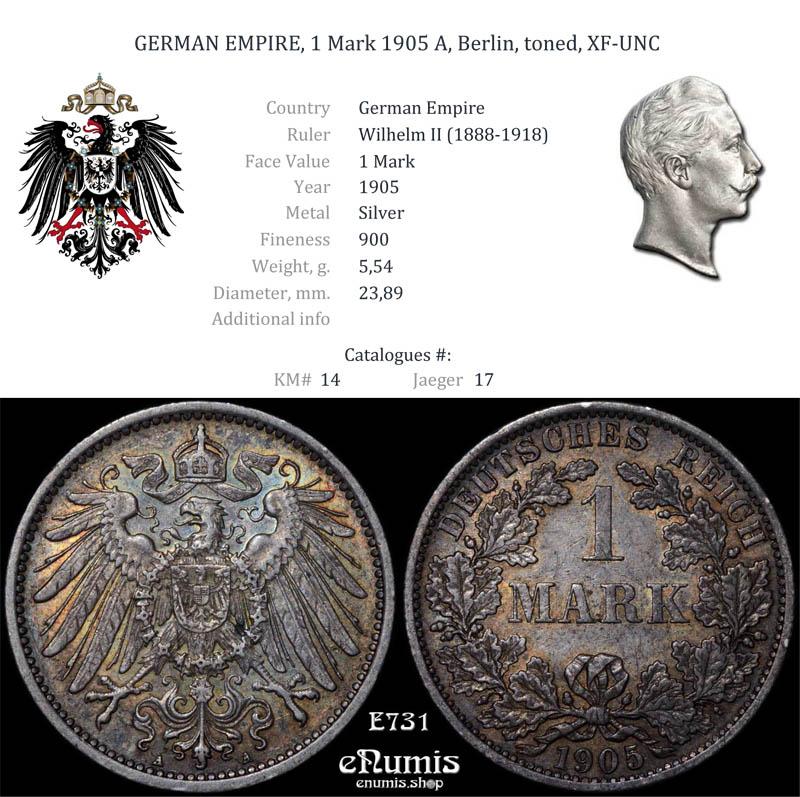



| Country | Germany, Empire |
|---|---|
| Ruler | Wilhelm II (1888-1918) |
| Face Value | 1 Mark |
| Year of issue | 1905 |
| Metal | Silver |
| Fineness | 900 |
| Catalogue # | KM# 14; J. 17 |
| Weight | 5,54 g |
| Diameter | 23,89 mm |
| Our code | E731 |
| Die Axis | ↑↑ |
| Additional info | - |
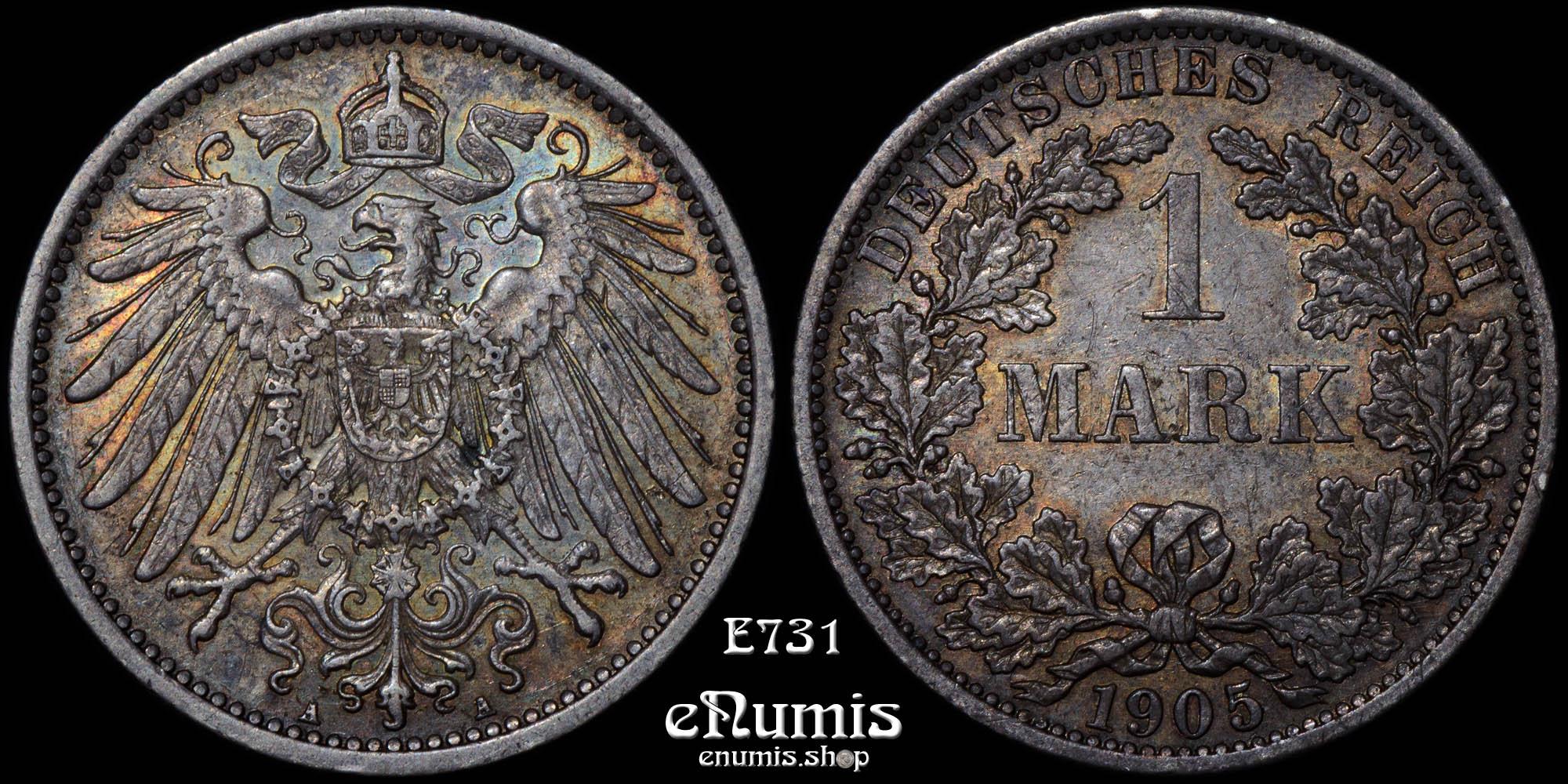
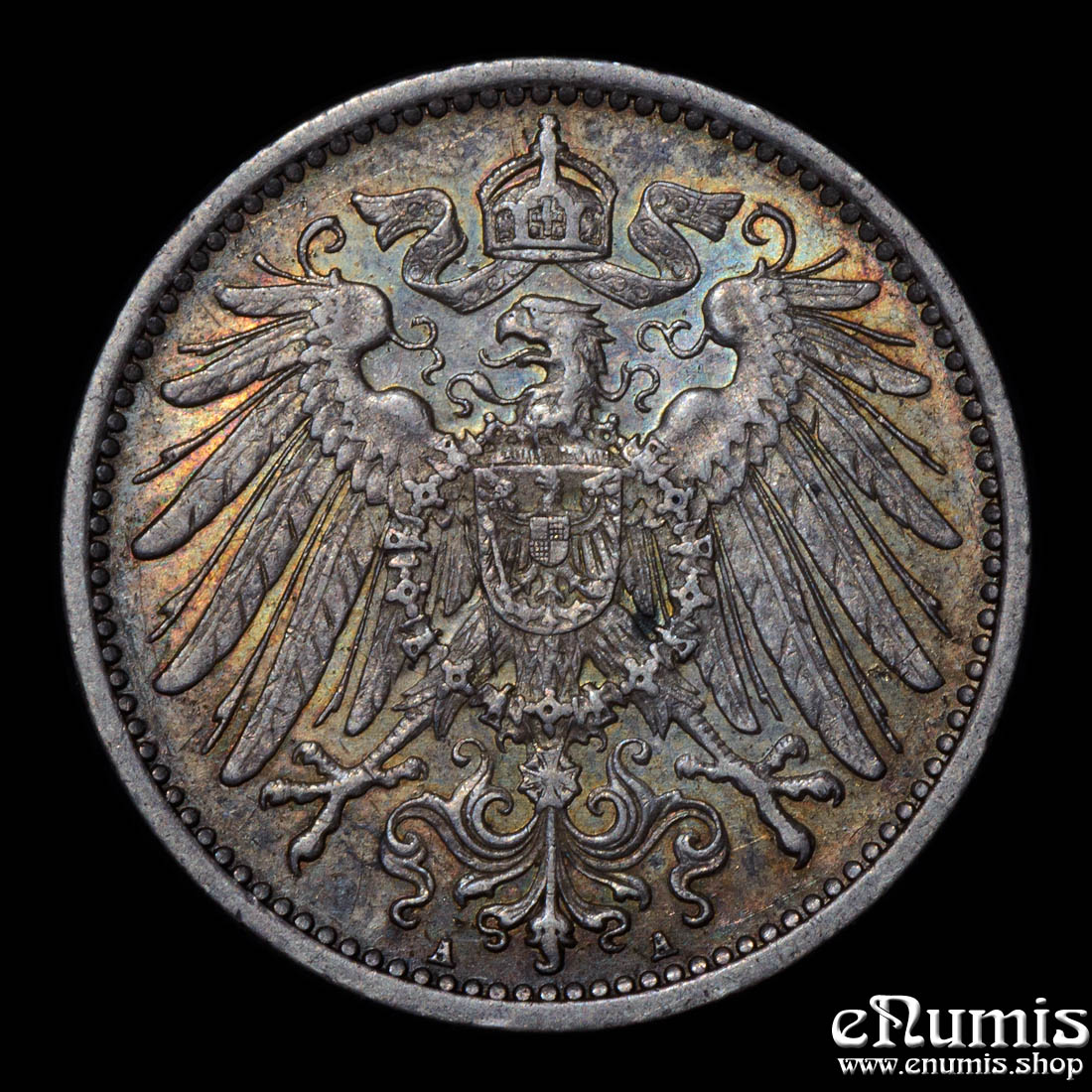
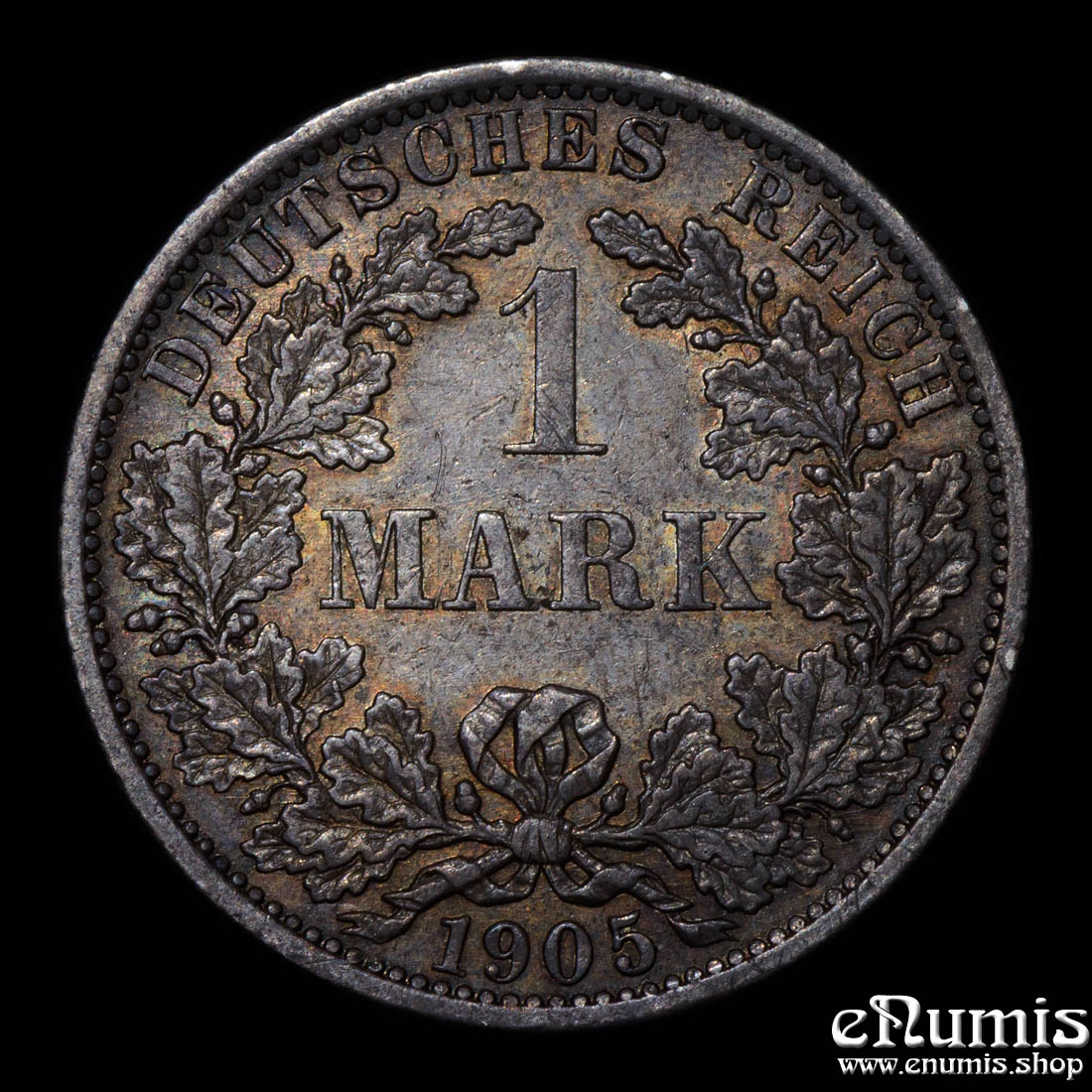
German Empire, 1 Mark 1905 A, Berlin, toned, XF‑UNC
Obverse: The crowned Imperial German eagle, mintmarks below
Legend (German): A A
Engraver: Otto Schultz

Reverse: The denomination within an ornate wreath, the country name above, and the date below.
Legend (German): DEUTSCHES REICH; 1 MARK; 1905
Engraver: Johann Adam Ries
Edge: Milled
German Empire, Small coins
Authenticity Guaranteed
Actual Coin Pictured
Ships within 1 business day
Worldwide Shipping
German Empire, 1 Mark 1905 A, Berlin, toned, XF‑UNC
Availability:
In stock
Authenticity Guaranteed
Actual Coin Pictured
Ships within 1 business day
Worldwide Shipping
Obverse: The crowned Imperial German eagle, mintmarks below
Legend (German): A A
Engraver: Otto Schultz
Reverse: The denomination within an ornate wreath, the country name above, and the date below.
Legend (German): DEUTSCHES REICH; 1 MARK; 1905
Engraver: Johann Adam Ries
Edge: Milled
The pictures provided are of the actual coin for sale.Guaranteed genuine.
18 € Shipping from 7 € — FREE over 300 €*
*Except US, shipped via DHL Express — see Postage tab
In stock
Shipping from 7 € · FREE over 300 €*
*US orders: DHL Express only - see Postage
Ships within 1 business day
Authenticity Guaranteed
Actual Coin Pictured
30-Day Returns
Worldwide Shipping
Secure payment



SHIPPING:
• We ship worldwide from Slovenia, a member of the European Union, within 1 business day after payment is received.
• Every order is carefully packed to ensure safe delivery.
• Standard registered shipping via The Post of Slovenia is available worldwide and includes a tracking number.
• DHL Express shipping is also available at checkout for customers who require faster delivery.
• Registered shipping via The Post of Slovenia: €7 within Europe and €8 for the rest of the world.
• FREE registered shipping via The Post of Slovenia for orders over €300.
• FREE DHL Express shipping, including full insurance, for orders over €800.
INSURANCE:
• Upon your request an order over 300 Euro can be sent with extra insurance.
• The price of the insurance is about 1% of the order total (minimum price of the insurance is €5).
OTHER:
• Import duties, taxes and charges are not included in the item’s price or shipping charges. Buyers are responsible for these charges.
• Please check with your country’s customs office to determine what these additional costs will be prior to buying.
22 August 2025 (updated 21 July 2026):
Important Notice for USA Customers
Please note that, due to the new U.S. customs tariffs, the Post of Slovenia has temporarily suspended shipments to the United States. Unfortunately, this means we are unable to send orders to the USA at this time.
We will resume shipping to the USA as soon as the service becomes available again. Thank you for your understanding and patience.
However, we can still ship to the USA via DHL Express. Please be aware that additional U.S. customs duties or fees may apply, which are the responsibility of the buyer.
The coins remain with the seller until the goods have been paid for in full.
We accept the following payment methods:
- All major debit and credit cards (services provided by Stripe Inc. and Bankart d.o.o.)
- Cash in Euros, US Dollars or British Pounds;
- Bank Transfer – to our corporate bank account (eNumis d.o.o., OTP banka d.d. Bank account: SI56 04 0000 2762 09090 BIC: KBMASI2X );
- We also accept PayPal (only for regular customers).
At eNumis.shop, your satisfaction is our top priority. If, for any reason, you are not completely satisfied with your purchase, please contact us immediately.
You may return any item within 30 days of receipt, provided it is in the same condition as when sent. All returns must be shipped using Registered Post or your country’s equivalent postal service with a tracking number.
Upon receiving and inspecting your return, we will offer you an exchange or a refund of the coin’s purchase price, as agreed.
Please note:
Return shipping costs are the responsibility of the buyer and are non-refundable.
Items must be securely packaged to avoid damage during return shipping.
Returns sent without prior notification may not be accepted.
To initiate a return, please contact us at info@enumis.shop or through our Contact Form.
Thank you for shopping with eNumis.shop, where your trust and confidence matter.
History
In 1905, the German Empire was at the height of its power and the peak of its anxiety.
Thirty-four years had passed since Bismarck’s unified Germany was proclaimed in the Hall of Mirrors at Versailles, and the transformation had been staggering. From a collection of feuding kingdoms and principalities, Germany had become the foremost industrial power on the European continent – its steel output surpassing Britain’s, its chemical and electrical industries leading the world, its universities the envy of civilization. Berlin had reinvented itself as a great capital: electric trams, grand boulevards, the new Reichstag building gleaming in Portland stone. The population of the empire had grown from 41 million at unification to over 60 million by 1905 and was still climbing.
Presiding over all of this was Kaiser Wilhelm II – forty-six years old in 1905, restless, theatrical, and constitutionally incapable of the patient diplomacy that Bismarck had practiced. Where his grandfather Wilhelm I had been content to reign quietly while his chancellor managed Europe, Wilhelm II needed to be seen, needed Germany to be seen. In March of that very year, he landed in Tangier on a white horse to challenge French influence in Morocco, triggering the First Moroccan Crisis and alarming every chancellery in Europe. It was a characteristic move: bold, loud, and ultimately counterproductive. The crisis served mainly to draw France and Britain closer together.
The 1 Mark coin of 1905 carries the Imperial Eagle on one face and the denomination on the other – austere, functional, entirely without royal portraiture. Unlike the coins of the individual German kingdoms, which still bore the faces of their own monarchs, the unified Imperial Mark was deliberately impersonal. It belonged not to any one king, but to the empire itself. It passed through the hands of factory workers in the Ruhr, merchants in Hamburg, soldiers in the Berlin garrison, and farmers in Bavaria – the daily currency of a nation that was simultaneously the most dynamic and the most dangerous in the world.
Nine years after this coin was minted, that world would be gone. The war that came in 1914 was not an accident. It was the accumulated consequence of fifteen years of Wilhelm’s blundering ambition, his naval arms race with Britain, his habit of making enemies faster than allies. The empire he inherited had been the envy of Europe. The one he destroyed had been its nightmare.
This small silver coin circulated through the last confident years of the Kaiserreich – before the trenches, before the hunger blockades, before November 1918 and the abdication that ended it all.
Coin condition (grade) is described using the following scale, based on internationally recognised numismatic grading standards. Where a grade is separated by a slash (e.g. VF/XF), the obverse and reverse differ in condition – VF obverse, XF reverse in this example.
| Grade | Full name | Description |
|---|---|---|
| F | Fine | Noticeable, moderate to considerable wear across the design; major details, lettering and date remain clearly legible |
| F+ | Choice Fine | Slightly better than Fine |
| F‑VF | Fine to Very Fine | Between Fine and Very Fine |
| aVF | About Very Fine | Slightly below Very Fine |
| VF | Very Fine | Moderate wear on the higher points; major design elements and lettering remain sharp and well-defined |
| VF+ | Choice Very Fine | Slightly better than Very Fine |
| VF‑XF | Very Fine to Extremely Fine | Between Very Fine and Extremely Fine |
| aXF | About Extremely Fine | Slightly below Extremely Fine |
| XF | Extremely Fine | Light wear confined to the highest points of the design; most original detail and some mint lustre remain |
| XF+ | Choice Extremely Fine | Slightly better than Extremely Fine |
| XF‑UNC | Extremely Fine to Uncirculated | Between Extremely Fine and Uncirculated |
| aUNC | About Uncirculated | Slightly below Uncirculated |
| UNC | Uncirculated | Shows no evidence of circulation wear; retains its original mint lustre, which may appear naturally subdued with age |
| Proof | Proof | Struck specifically for collectors from specially prepared, polished dies on polished planchets, giving sharp detail and mirror-like fields. Refers to how the coin was made, not to its state of preservation |
| Prooflike (PL) | Prooflike | A coin from the ordinary circulation production that happens to show mirror-like fields, usually from early strikes with fresh dies – it looks similar to a Proof but was not specially struck for collectors |
Grading is inherently somewhat subjective. If you would like additional photos or have any question about a coin’s condition before ordering, please contact us – we’re happy to help.