

| Country | Cyprus |
|---|---|
| Ruler | Edward VII (1901-10) |
| Face Value | 18 Piastres |
| Year of issue | 1907 |
| Metal | Silver |
| Fineness | 925 |
| Catalogue # | KM# 10 |
| Weight, g. | 11,01 |
| Diameter, mm. | 29,75 |
| Our code | C749 |
| Die Axis | ↑↑ |
| Additional info | - |
Cyprus
Cyprus, Edward VII, 18 Piastres 1907, Rare, VF
Availability:
Out of stock
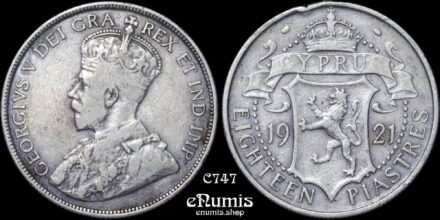
Obverse: Portrait of King Edward VII
Legend (Latin): EDWARDVS VII DEI GRATIA REX IMPERATOR
Engraver: George William de Saulles

Reverse: A crowned shield of arms which divides the dates. The crown rests on a scroll inscribed CYPRUS and the value is set out in words (EIGHTEEN PIASTRES) around the lower edge of the design.
Legend (English): CYPRUS; 19 07; EIGHTEEN PIASTRES
Engraver: George Kruger Gray
Edge: Milled
The pictures provided are of the actual coin for sale.
Guaranteed genuine.

Out of stock
SHIPPING:
• We ship worldwide from Slovenia, a member of the European Union, within 1 business day after payment is received.
• Every order is carefully packed to ensure safe delivery.
• Standard registered shipping via The Post of Slovenia is available worldwide and includes a tracking number.
• DHL Express shipping is also available at checkout for customers who require faster delivery.
• Registered shipping via The Post of Slovenia: €7 within Europe and €8 for the rest of the world.
• FREE registered shipping via The Post of Slovenia for orders over €300.
• FREE DHL Express shipping, including full insurance, for orders over €800.
INSURANCE:
• Upon your request an order over 300 Euro can be sent with extra insurance.
• The price of the insurance is about 1% of the order total (minimum price of the insurance is €5).
OTHER:
• Import duties, taxes and charges are not included in the item’s price or shipping charges. Buyers are responsible for these charges.
• Please check with your country’s customs office to determine what these additional costs will be prior to buying.
22 August 2025 (updated 21 July 2026):
Important Notice for USA Customers
Please note that, due to the new U.S. customs tariffs, the Post of Slovenia has temporarily suspended shipments to the United States. Unfortunately, this means we are unable to send orders to the USA at this time.
We will resume shipping to the USA as soon as the service becomes available again. Thank you for your understanding and patience.
However, we can still ship to the USA via DHL Express. Please be aware that additional U.S. customs duties or fees may apply, which are the responsibility of the buyer.
The coins remain with the seller until the goods have been paid for in full.
We accept the following payment methods:
- All major debit and credit cards (services provided by Stripe Inc. and Bankart d.o.o.)
- Cash in Euros, US Dollars or British Pounds;
- Bank Transfer – to our corporate bank account (eNumis d.o.o., OTP banka d.d. Bank account: SI56 04 0000 2762 09090 BIC: KBMASI2X );
- We also accept PayPal (only for regular customers).
At eNumis.shop, your satisfaction is our top priority. If, for any reason, you are not completely satisfied with your purchase, please contact us immediately.
You may return any item within 30 days of receipt, provided it is in the same condition as when sent. All returns must be shipped using Registered Post or your country’s equivalent postal service with a tracking number.
Upon receiving and inspecting your return, we will offer you an exchange or a refund of the coin’s purchase price, as agreed.
Please note:
Return shipping costs are the responsibility of the buyer and are non-refundable.
Items must be securely packaged to avoid damage during return shipping.
Returns sent without prior notification may not be accepted.
To initiate a return, please contact us at info@enumis.shop or through our Contact Form.
Thank you for shopping with eNumis.shop, where your trust and confidence matter.
History
By 1907, the British administration of Cyprus had settled into a rhythm of quiet, efficient, and largely unwanted governance.
Twenty-nine years had passed since the Cyprus Convention of 1878, when Britain had taken the island from the Ottoman Empire as a diplomatic prize and strategic outpost on the sea route to India. Roads had been built, a railway constructed between Nicosia and Famagusta, malaria brought under some control, and a modest Legislative Council established – nine seats for Greek Cypriots, three for Turkish Cypriots, and enough appointed British officials to ensure that nothing inconvenient was ever actually decided. From London’s perspective, the arrangement was working tolerably well. From the perspective of the Greek Cypriot majority, it was simply an occupation by different management.
The desire for enosis – union with Greece – had been present from the first day of British rule, voiced at the very welcoming ceremony for the first High Commissioner by a bishop who apparently could not help himself. By 1907 it had evolved from a bishop’s hope into a sustained political movement, petitioning, demonstrating, and sending memoranda to London with a persistence that the Colonial Office found tiresome and chose largely to ignore. That same year, a young under-secretary named Winston Churchill visited the island on an official tour and wrote a confidential report criticizing the financial arrangements by which Cyprus was required to contribute to Ottoman tribute payments – an arrangement he described with characteristic bluntness as indefensible. Parliament eventually agreed with him and voted an annual grant to reduce the burden. It was one of the rare moments when British policy on Cyprus moved in a direction the islanders could appreciate.
The coin itself carries on its obverse the portrait of Edward VII – sixty-five years old in 1907, six years into the reign he had waited for his entire adult life while his mother Victoria lived on and on to the age of eighty-one. He was a different kind of monarch from his mother: sociable, cosmopolitan, diplomatically gifted, the architect of the Entente Cordiale with France that was quietly reshaping European alliances. His portrait on the 18 Piastres was the work of George William de Saulles, the Royal Mint’s engraver, showing a right-facing laureate bust of the King in the dignified Edwardian manner. The reverse retained the Lusignan lion on its crowned shield – that medieval heraldic ghost, reaching back past Ottoman centuries to the Christian kingdom that had once made Cyprus one of the wealthiest islands in the Mediterranean.
Eighteen piastres equalled two shillings – a significant denomination, the largest silver coin in everyday Cypriot circulation, passing through the hands of farmers in the Mesaoria plain, merchants in the Nicosia bazaar, fishermen on the Famagusta waterfront. The piastre itself was an Ottoman inheritance, a unit of account that the British had simply adopted and continued, one of the many quiet accommodations an imperial administration makes with the world it finds rather than the world it intended.
Edward VII would be dead within three years, his diplomacy outlasting him by decades. The Ottoman Empire, which still nominally owned Cyprus when this coin was struck, would be gone within eleven years, swept away by the same war that finally prompted Britain to annex the island outright in 1914.
This coin circulated in the calm before all of that – on an island that knew what it wanted, governed by an empire that had not yet decided what to do about it.
Coin condition (grade) is described using the following scale, based on internationally recognised numismatic grading standards. Where a grade is separated by a slash (e.g. VF/XF), the obverse and reverse differ in condition – VF obverse, XF reverse in this example.
| Grade | Full name | Description |
|---|---|---|
| F | Fine | Noticeable, moderate to considerable wear across the design; major details, lettering and date remain clearly legible |
| F+ | Choice Fine | Slightly better than Fine |
| F‑VF | Fine to Very Fine | Between Fine and Very Fine |
| aVF | About Very Fine | Slightly below Very Fine |
| VF | Very Fine | Moderate wear on the higher points; major design elements and lettering remain sharp and well-defined |
| VF+ | Choice Very Fine | Slightly better than Very Fine |
| VF‑XF | Very Fine to Extremely Fine | Between Very Fine and Extremely Fine |
| aXF | About Extremely Fine | Slightly below Extremely Fine |
| XF | Extremely Fine | Light wear confined to the highest points of the design; most original detail and some mint lustre remain |
| XF+ | Choice Extremely Fine | Slightly better than Extremely Fine |
| XF‑UNC | Extremely Fine to Uncirculated | Between Extremely Fine and Uncirculated |
| aUNC | About Uncirculated | Slightly below Uncirculated |
| UNC | Uncirculated | Shows no evidence of circulation wear; retains its original mint lustre, which may appear naturally subdued with age |
| Proof | Proof | Struck specifically for collectors from specially prepared, polished dies on polished planchets, giving sharp detail and mirror-like fields. Refers to how the coin was made, not to its state of preservation |
| Prooflike (PL) | Prooflike | A coin from the ordinary circulation production that happens to show mirror-like fields, usually from early strikes with fresh dies – it looks similar to a Proof but was not specially struck for collectors |
Grading is inherently somewhat subjective. If you would like additional photos or have any question about a coin’s condition before ordering, please contact us – we’re happy to help.