

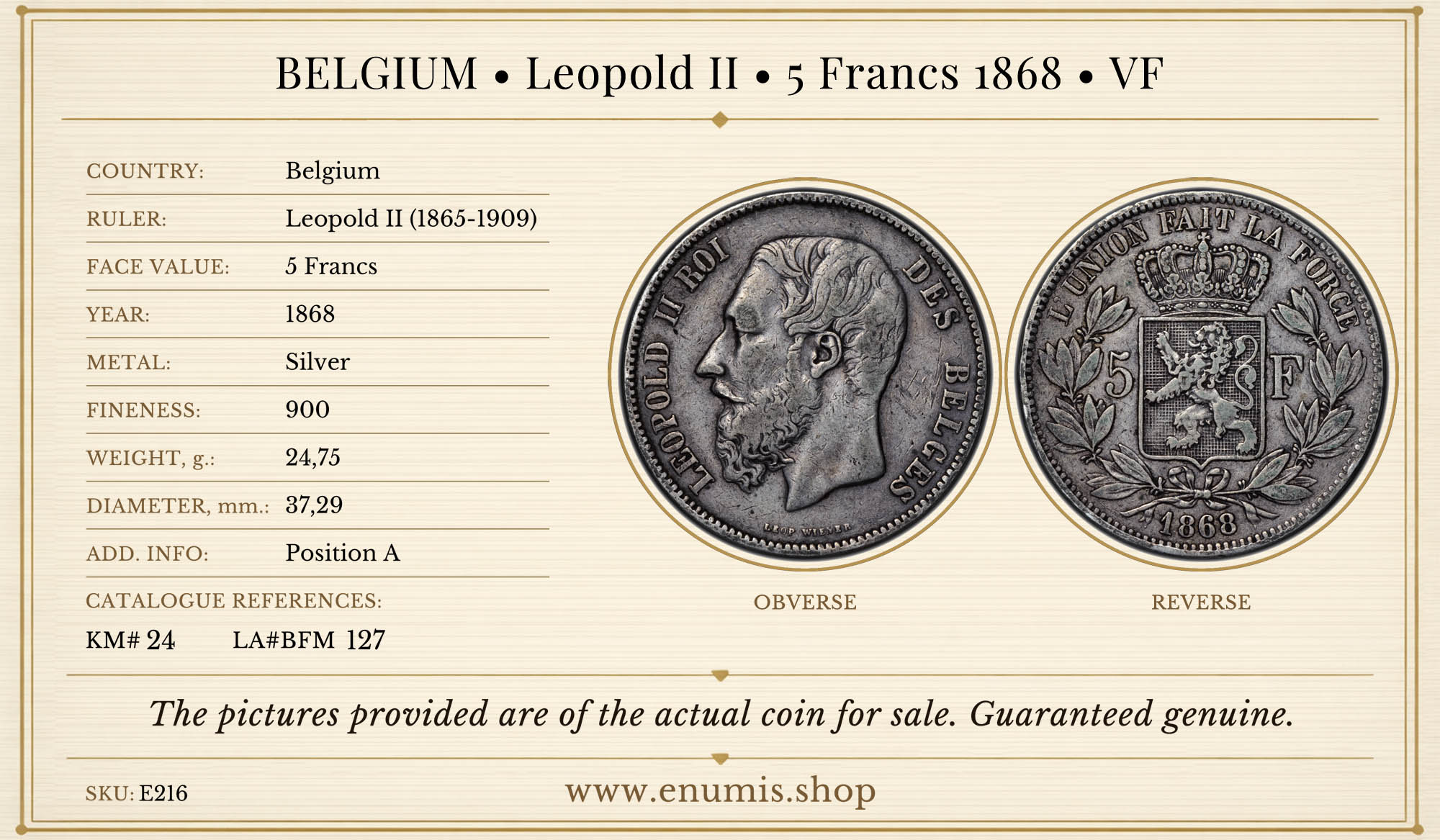


| Country | Belgium |
|---|---|
| Ruler | Leopold II (1865-1909) |
| Face Value | 5 Francs |
| Year of issue | 1868 |
| Metal | Silver |
| Fineness | 900 |
| Catalogue # | KM# 24; LA#BFM 127 |
| Weight, g. | 24,75 |
| Diameter, mm. | 37,29 |
| Our code | E216 |
| Die Axis | ↑↓ |
| Additional info | Position A: reverse (value) facing up, text on edge is normal. |
Leopold II (1865-1909)
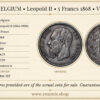
BELGIUM, Leopold II, 5 Francs 1868, VF
Availability:
In stock
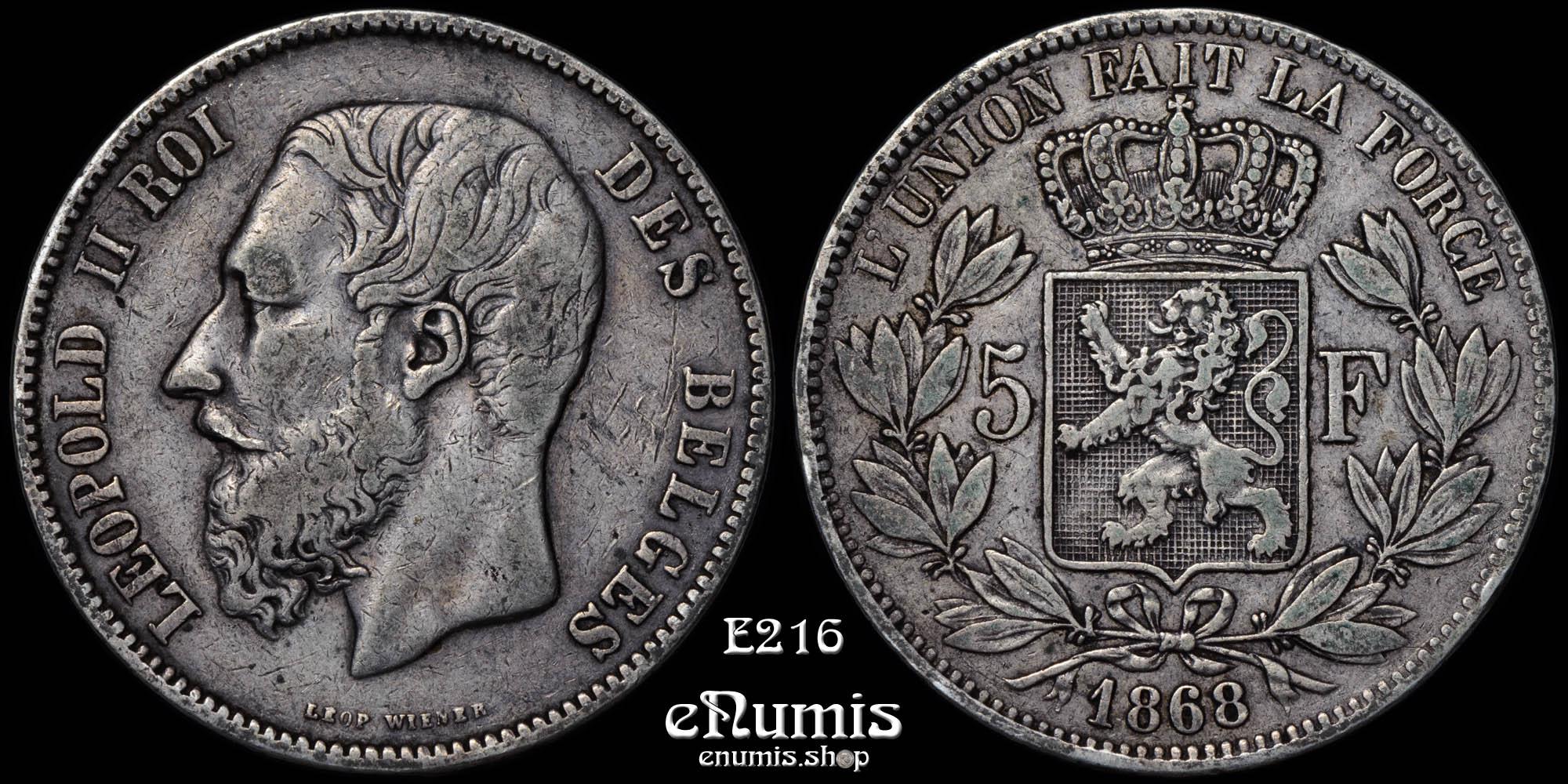
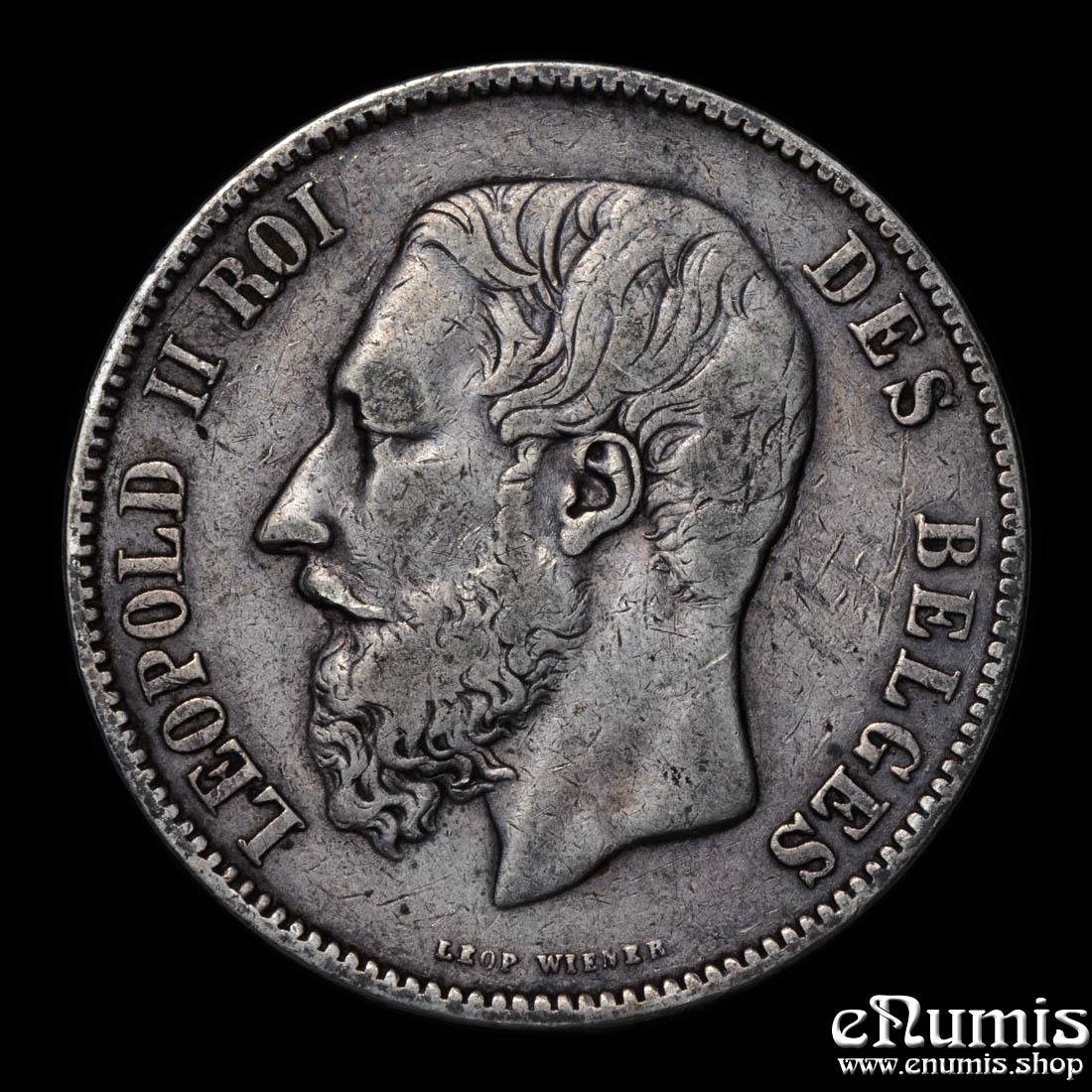
Obverse: The portrait in left profile of Leopold II of Belgium surrounded with the legend in French and the designer’s name at the bottom.
Legend (French): LEOPOLD II ROI DES BELGES; LEOP WIENER
Engraver: Leopold Wiener

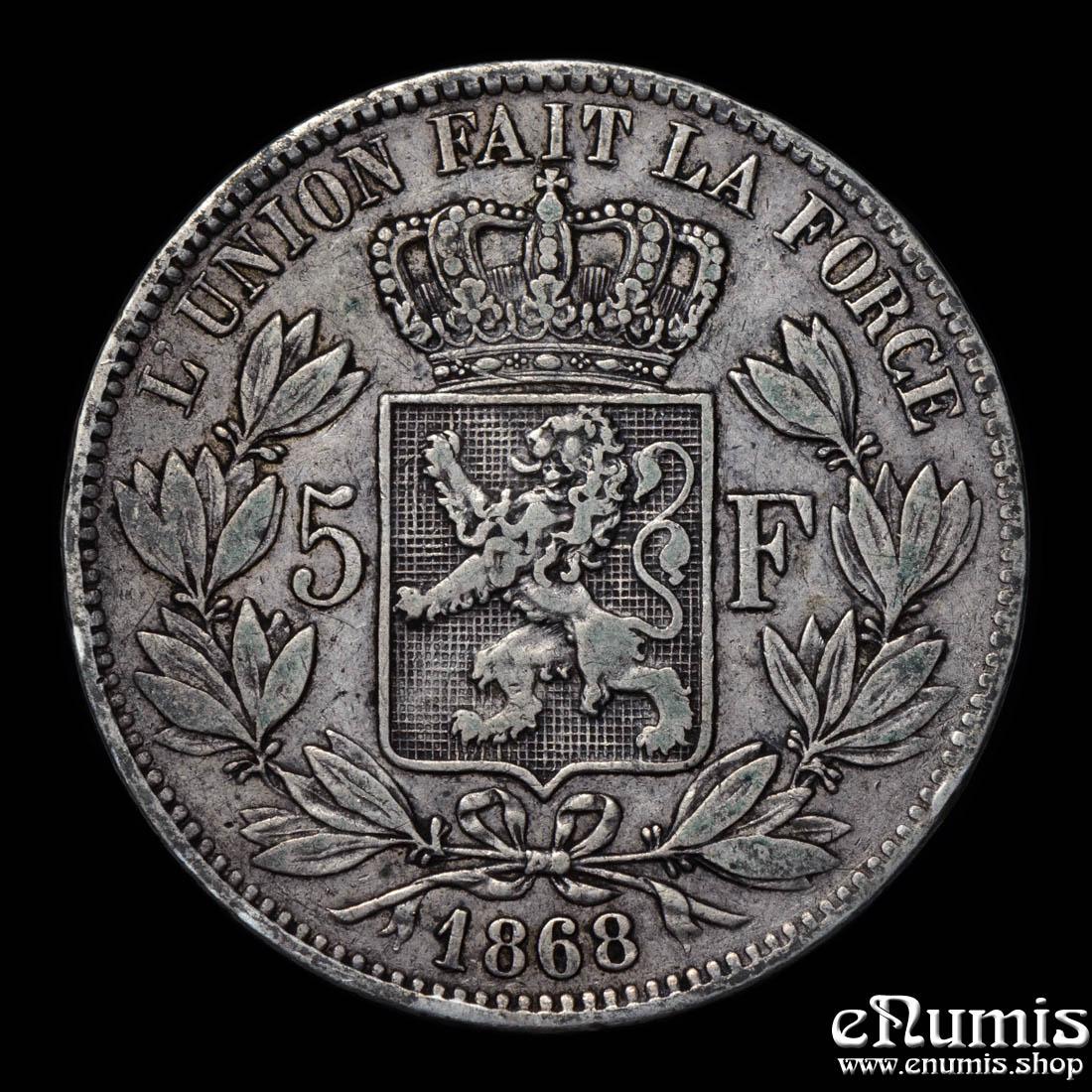
Reverse: The Belgian coat of arms within a wreath dividing the value with a motto in French above and the year below.
Legend (French): L’UNION FAIT LA FORCE; 5 F; 1868
Translation: Unity Makes Strength
Engraver: Leopold Wiener
Edge: Plain with lettering
Legend (French): DIEU PROTEGE LA BELGIQUE ***
Translation: God Protects Belgium
The pictures provided are of the actual coin for sale.
Guaranteed genuine.

56 € 59 €
In stock
SHIPPING:
• We ship worldwide from Slovenia, a member of the European Union, within 1 working day after payment is received.
• Every order is carefully packed to ensure safe delivery.
• Standard registered shipping via The Post of Slovenia is available worldwide and includes a tracking number.
• DHL Express shipping is also available at checkout for customers who require faster delivery.
• Registered shipping via The Post of Slovenia: €7 within Europe and €8 for the rest of the world.
• FREE registered shipping via The Post of Slovenia for orders over €300.
• FREE DHL Express shipping, including full insurance, for orders over €800.
INSURANCE:
• Upon your request an order over 300 Euro can be sent with an extra insurance.
• The price of the insurance is about 1% of the order total (minimal price of the insurance is €5).
OTHER:
• Import duties, taxes and charges are not included in the item’s price or shipping charges. Buyers are responsible for these charges.
• Please check with your country’s customs office to determine what these additional costs will be prior to buying.
22 August 2025 (updated 21 July 2026):
Important Notice for USA Customers
Please note that, due to the new U.S. customs tariffs, Post of Slovenia has temporarily suspended shipments to the United States. Unfortunately, this means we are unable to send orders to the USA at this time.
We will resume shipping to the USA as soon as the service becomes available again. Thank you for your understanding and patience.
However, we can still ship to the USA via DHL Express. Please be aware that additional U.S. customs duties or fees may apply, which are the responsibility of the buyer.
The coins remain with the seller until goods have been paid for in full.
We accept these different kinds of payment:
- All major debit or credit cards (services provided by Stripe Inc. and Bankart d.o.o.)
- Cash in Euro, US Dollars or British Pounds;
- Bank Transfer – to our corporate bank account (eNumis d.o.o., OTP banka d.d. Bank account: SI56 04 0000 2762 09090 BIC: KBMASI2X );
- We also accept PayPal (only for regular customers).
At eNumis.shop, your satisfaction is our top priority. If, for any reason, you are not completely satisfied with your purchase, please contact us immediately.
You may return any item within 30 days of receipt, provided it is in the same condition as when sent. All returns must be shipped using Registered Post or your country’s equivalent postal service with a tracking number.
Upon receiving and inspecting your return, we will offer you an exchange or a refund of the coin’s purchase price, as agreed.
Please note:
Return shipping costs are the responsibility of the buyer and are non-refundable.
Items must be securely packaged to avoid damage during return shipping.
Returns sent without prior notification may not be accepted.
To initiate a return, please contact us at info@enumis.shop or through our Contact Form.
Thank you for shopping with eNumis.shop, where your trust and confidence matter.
History
Belgium in 1868 was a country that had existed for less than forty years – and was already one of the most industrialized nations on earth.
Born from revolution in 1830, carved out of the Kingdom of the Netherlands in a moment of romantic nationalist uprising, the new Kingdom of Belgium had chosen its king from the House of Saxe-Coburg-Gotha and set about building a modern state with remarkable speed. By the 1860s, Belgium had the densest railway network in Europe, coalfields and ironworks that rivalled Britain’s, a textile industry that clothed half the continent. For a small, flat country wedged between France, Prussia, and the sea, it had achieved something extraordinary: prosperity through industriousness, and sovereignty through the careful cultivation of great-power neutrality.
The 5 Francs of 1868 bears the profile of Leopold II, just three years into a reign that would last forty-four years and carry his name across two continents – though for very different reasons. In 1868 he was thirty-three years old, newly crowned, outwardly conventional, inwardly consumed by an ambition that Belgium itself was too small to contain. He studied colonial maps obsessively. He corresponded with explorers. He was already dreaming of Africa, though it would be another decade before he found his way there.
The coin itself was part of a wider European architecture. In 1865, Belgium, France, Italy, and Switzerland had established the Latin Monetary Union – a bold agreement to standardize their silver and gold coinage so that a Belgian franc, a French franc, and an Italian lira would be freely interchangeable across borders. The 5 Francs piece, struck to precise specifications of weight and fineness, was the flagship denomination of this system – the largest silver coin in everyday circulation, accepted from Brussels to Palermo without question or exchange. It was, in its quiet way, the nineteenth century’s attempt at a common European currency.
The reverse inscription reads L’UNION FAIT LA FORCE – Unity Makes Strength – the Belgian national motto, adopted at independence and never more apt than in this era of monetary cooperation and industrial confidence.
What makes 1868 a particularly charged moment is the shadow of what follows. The Franco-Prussian War of 1870 would shatter the European balance of power. The German Empire, proclaimed in 1871 in the Hall of Mirrors at Versailles, would transform Belgium’s eastern neighbor from a patchwork of states into a single, formidable, and increasingly menacing power. And Leopold II, the composed young king on this coin’s obverse, would go on to establish a private empire in the Congo of such brutal exploitation that it became a scandal that shook the conscience of the Western world.
But in 1868, none of that had happened yet. The coin circulated through a prosperous, optimistic small nation that had every reason to believe the future was bright.
Related products
-
Albert I (1909-34)
BELGIUM, Albert I, 5 Francs 1934, Des Belges, Rare, XF
Obverse: The portrait in left profile of Albert I of Belgium is surrounded with the legend in French and the designer’s name below.
Legend (French): ·ALBERT·ROI· ·DES·BELGES·; G. DEVREESE
Engraver: Godefroid Devreese
Reverse: The face value in both currencies in French and year are surrounded with an olive branch, an oak branch, and a crown and the designer’s initials below
Legend (French): UN BELGA; 5 FRANCS; 1934; A.E.GR.
Engraver: Alexander Everaerts
Edge (text): * * BELGIQUE * * BELGIE
The pictures provided are of the actual coin for sale.
Guaranteed genuine.
SKU: A865 -
Leopold II (1865-1909)
BELGIUM, Leopold II, 25 Centimes 1908, België, aUNC
Obverse: The royal monogram of King Leopold II is surrounded with lettering in Dutch. Date below.
Legend (Dutch): KONINKRIJK BELGIË *; • 1908 •
Engraver: Alphonse Michaux
Reverse: The center hole is flanked by an olive sprig and value. Designer below.
Legend (Dutch): 25 CEN; A. MICHAUX
Engraver: Alphonse Michaux
Edge: Smooth
The pictures provided are of the actual coin for sale.
Guaranteed genuine.
SKU: A712 -
Albert I (1909-34)
BELGIUM, Albert I, 5 Francs 1931, Des Belges, aUNC
Obverse: The portrait in left profile of Albert I of Belgium is surrounded with the legend in French and the designer’s name below.
Legend (French): ·ALBERT·ROI· ·DES·BELGES·; G.DEVREESE
Engraver: Godefroid Devreese
Reverse: The face value in both currencies in French and year are surrounded with an olive branch, an oak branch, and a crown and the designer’s initials below.
Legend (French): UN BELGA; 5 FRANCS; 1931; A.E.GR.
Engraver: Alexander Everaerts
Edge (text): * * BELGIQUE * * BELGIE
The pictures provided are of the actual coin for sale.
Guaranteed genuine.
SKU: A591 -
Leopold II (1865-1909)
BELGIUM, Leopold II, 5 Francs 1873, VF
Obverse: The portrait in left profile of Leopold II of Belgium surrounded with the legend in French and the designer’s name at the bottom.
Legend (French): LEOPOLD II ROI DES BELGES; LEOP WIENER
Engraver: Leopold Wiener
Reverse: The Belgian coat of arms within a wreath dividing the value with a motto in French above and the year below.
Legend (French): L’UNION FAIT LA FORCE; 5 F; 1873
Translation: Unity Makes Strength
Engraver: Leopold Wiener
Edge: Plain with lettering
Legend (French): DIEU PROTEGE LA BELGIQUE ***
Translation: God Protects Belgium
The pictures provided are of the actual coin for sale.
Guaranteed genuine.
SKU: E220


