



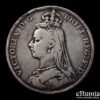


| Country | Great Britain |
|---|---|
| Ruler | Victoria (1837-1901) |
| Face Value | Crown |
| Year of issue | 1889 |
| Metal | Silver |
| Fineness | 925 |
| Catalogue # | KM# 765; SPINK 3921; ESC 2589; Davies 483 |
| Weight, g. | 27,69 |
| Diameter, mm. | 38,52 |
| Our code | G449 |
| Die Axis | ↑↑ |
| Additional info | - |
Crowns
Great Britain, Victoria, Crown 1889, aVF
Availability:
In stock
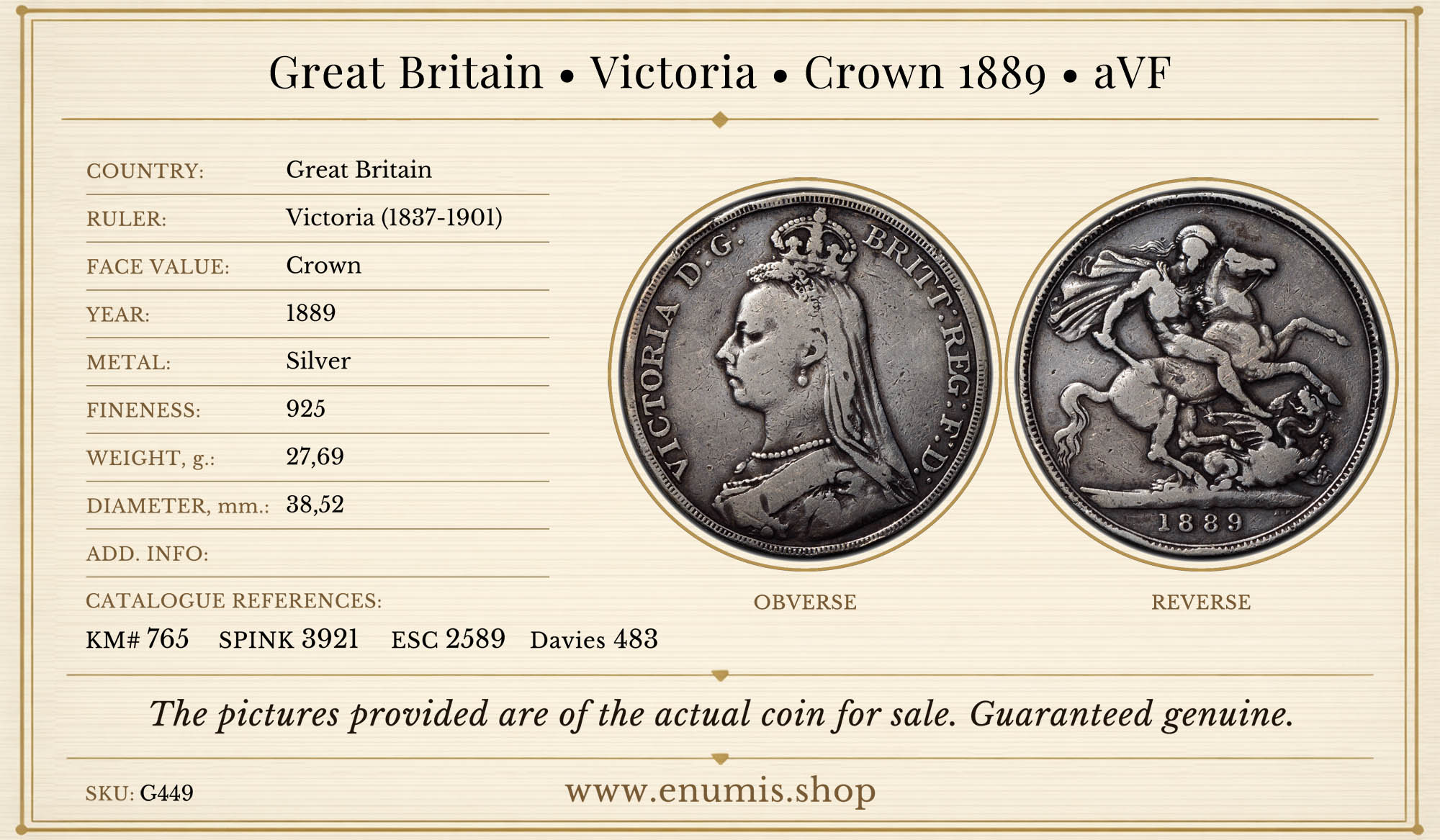
Obverse: Crowned and veiled bust (‘Jubilee Head’) of Queen Victoria left, legend around.
Lettering (Latin): VICTORIA D:G: BRITT: REG: F:D:
Engraver: Joseph Edgar Boehm

Reverse: St. George slaying the dragon right, date and engraver’s initials in exergue.
Lettering (Latin): 1889; B.P.
Engraver: Benedetto Pistrucci
Edge: Reeded
The pictures provided are of the actual coin for sale.
Guaranteed genuine.

€ 67
In stock
SHIPPING:
• We ship worldwide from Slovenia (member of the European Union) within 1 working day of payment received.
• We guarantee the items will be carefully packed and sent on time.
• The basic price of the shipment is 7 Euro for Europe and 8 Euro Worldwide.
• All orders will be sent by a registered mail by The Post of Slovenia with a tracking number.
• FREE delivery for orders over 300 Euro. They will be sent by a registered mail by The Post of Slovenia with a tracking number.
• FREE DHL Express  delivery for orders over 800 Euro. With FREE full insurance.
INSURANCE:
• Upon your request an order over 300 Euro can be sent with an extra insurance.
• The price of the insurance is about 1% of the order total (minimal price of the insurance is €5).
OTHER:
• Import duties, taxes and charges are not included in the item’s price or shipping charges. Buyers are responsible for these charges.
• Please check with your country’s customs office to determine what these additional costs will be prior to buying.
22 August 2025:
Important Notice for USA Customers
Please note that, due to the new U.S. customs tariffs, Post of Slovenia has temporarily suspended shipments to the United States. Unfortunately, this means we are unable to send orders to the USA at this time.
We will resume shipping to the USA as soon as the service becomes available again. Thank you for your understanding and patience.
However, we can still ship to the USA via DHL Express. Please be aware that additional U.S. customs duties or fees may apply, which are the responsibility of the buyer.
The coins remain with the seller until goods have been paid for in full.
We accept these different kinds of payment:
- All major debit or credit cards (services provided by Stripe Inc. and Bankart d.o.o.)
- Cash in Euro, US Dollars or British Pounds;
- Bank Transfer – to our corporate bank account (eNumis d.o.o., OTP banka d.d. Bank account: SI56 04 0000 2762 09090 BIC: KBMASI2X );
- We also accept PayPal (only for regular customers).
At eNumis.shop, your satisfaction is our top priority. If, for any reason, you are not completely satisfied with your purchase, please contact us immediately.
You may return any item within 30 days of receipt, provided it is in the same condition as when sent. All returns must be shipped using Registered Post or your country’s equivalent postal service with a tracking number.
Upon receiving and inspecting your return, we will offer you an exchange or a refund of the coin’s purchase price, as agreed.
Please note:
Return shipping costs are the responsibility of the buyer and are non-refundable.
Items must be securely packaged to avoid damage during return shipping.
Returns sent without prior notification may not be accepted.
To initiate a return, please contact us at info@enumis.shop or through our Contact Form.
Thank you for shopping with eNumis.shop, where your trust and confidence matter.
History
By 1889, Britain had a queen it could not quite agree on how to depict.
The Jubilee Head – the portrait on the obverse of this coin – had arrived in 1887 to mark Victoria’s fifty years on the throne, and it had been controversial from the moment it appeared in circulation. The sculptor Sir Joseph Edgar Boehm had spent a decade on the commission, sitting with the queen in her private apartments, producing model after model. What he eventually placed on the coinage was an honest portrait of a woman of seventy: veiled, mature, wearing a small diamond crown of her own commissioning, the faint heaviness of age visible beneath the precision of the engraving. It was, by the standards of royal portraiture, almost shockingly truthful.
The public was not certain it approved. The small crown, perching above the mourning veil, drew immediate mockery – it was too slight, too domestic, unworthy of an empress. The sixpence from the same Jubilee issue had already been withdrawn after fraudsters gilded it to pass as a half sovereign. The double florin, nearly indistinguishable in size from the crown, was being successfully passed off in dimly lit public houses across the country for more than its worth, earning the immortal nickname the Barmaid’s Ruin. Victoria herself, reviewing the coinage in September 1889, wrote that she disliked the new coins very much and wished the old ones could be restored. Her own government quietly began making arrangements for a replacement portrait.
None of which changed the fact that over a million and eight hundred thousand of these crowns were struck that year and sent into the commerce of an empire at the absolute apex of its power. The reverse carried Benedetto Pistrucci’s St George and the Dragon – the same design first cut in 1817, still the most enduring image in the history of British coinage, the armored saint wheeling his horse above the writhing serpent with a violence that no amount of repetition had yet diminished.
The empire whose currency this coin was in 1889 was a thing of almost incomprehensible extent. The Scramble for Africa was dividing an entire continent at conference tables in Berlin and drawing rooms in London. India was generating revenues that underwrote half the government’s ambitions. The Royal Navy ruled every ocean. And at the centre of it all – formally, constitutionally, on the obverse of every sovereign coin – a seventy-year-old widow in a veil, whom the country alternately revered and complained about, and who had by this point largely stopped caring what anyone thought.
The Jubilee Head coinage lasted only until 1893, when a new portrait – the Old Head, more severe and more imperial in its bearing – finally replaced it. Boehm did not live to see the change. He died in 1890, in circumstances that London society found quietly scandalous, at the studio of Princess Louise, the queen’s daughter.
This coin belongs to the brief, contested, oddly human interlude between two more formal portraits – a moment when British coinage showed, perhaps more honestly than it intended, exactly who was really on the throne.
Related products
-
Crowns
Great Britain, Victoria, Crown 1897, LXI, XF+
Obverse: Crowned and veiled bust (‘Old Head’) of Queen Victoria left, legend around.
Lettering (Latin): VICTORIA·DEI·GRA·BRITT·REGINA·FID·DEF · IND·IMP·
Engraver: Thomas Brock
Reverse: St. George slaying the dragon right, date and engraver’s initials in exergue.
Lettering (Latin): 1897; B.P.
Engraver: Benedetto Pistrucci
Edge (Text in Latin, Regnal year in Roman numerals): DECUS ET TUTAMEN. ANNO REGNI LXI
The pictures provided are of the actual coin for sale.
Guaranteed genuine.
SKU: F971 -
Crowns
Great Britain, Victoria, Crown 1900, LXIV, nicely toned, UNC
Obverse: Crowned and veiled bust (‘Old Head’) of Queen Victoria left, legend around.
Lettering (Latin): VICTORIA · DEI · GRA · BRITT · REGINA · FID · DEF · IND ·IMP ·
Engraver: Thomas Brock
Reverse: St. George slaying the dragon right, date and engraver’s initials in exergue.
Lettering (Latin): 1900; B.P.
Engraver: Benedetto Pistrucci
Edge (Text in Latin, Regnal year in Roman numerals): DECUS ET TUTAMEN. ANNO REGNI LXIV
The pictures provided are of the actual coin for sale.
Guaranteed genuine.
SKU: A198 -
Crowns
Great Britain, Victoria, Crown 1887, toned, PCGS MS 62

Obverse: Crowned and veiled bust (‘Jubilee Head’) of Queen Victoria left, legend around.
Lettering (Latin): VICTORIA D:G: BRITT: REG: F:D:
Engraver: Joseph Edgar Boehm
Reverse: St. George slaying the dragon right, date and engraver’s initials in exergue.
Lettering (Latin): 1887; B.P.
Engraver: Benedetto Pistrucci
Edge: Reeded
The pictures provided are of the actual coin for sale.
Guaranteed genuine.
You can verify PCGS certification numbers: 55400921
SKU: Z456 -
Crowns
Great Britain, Victoria, Crown 1847, VF+/aXF
Obverse: Young uncrowned portrait (‘Young Head’) of Queen Victoria left, legend around, date below.
Lettering (Latin): VICTORIA DEI GRATIA; 1847
Engraver: William Wyon
Reverse: Crowned quartered shield of arms within wreath, legend around, national flower emblems below.
Lettering (Latin): BRITANNIARUM REGINA FID: DEF:
Engraver: Jean Baptiste Merlen
Edge (Text in Latin, Regnal year): DECUS ET TUTAMEN ANNO REGNI XI
The pictures provided are of the actual coin for sale.
Guaranteed genuine.
SKU: A117


