




| Country | Great Britain |
|---|---|
| Ruler | Victoria (1837-1901) |
| Face Value | Crown |
| Year of issue | 1844 |
| Metal | Silver |
| Fineness | 925 |
| Catalogue # | KM# 741; SPINK 3882; ESC 338 R2; Davies 456 |
| Weight | 27,71 g |
| Diameter | 37,88 mm |
| Our code | G081 |
| Die Axis | ↑↓ |
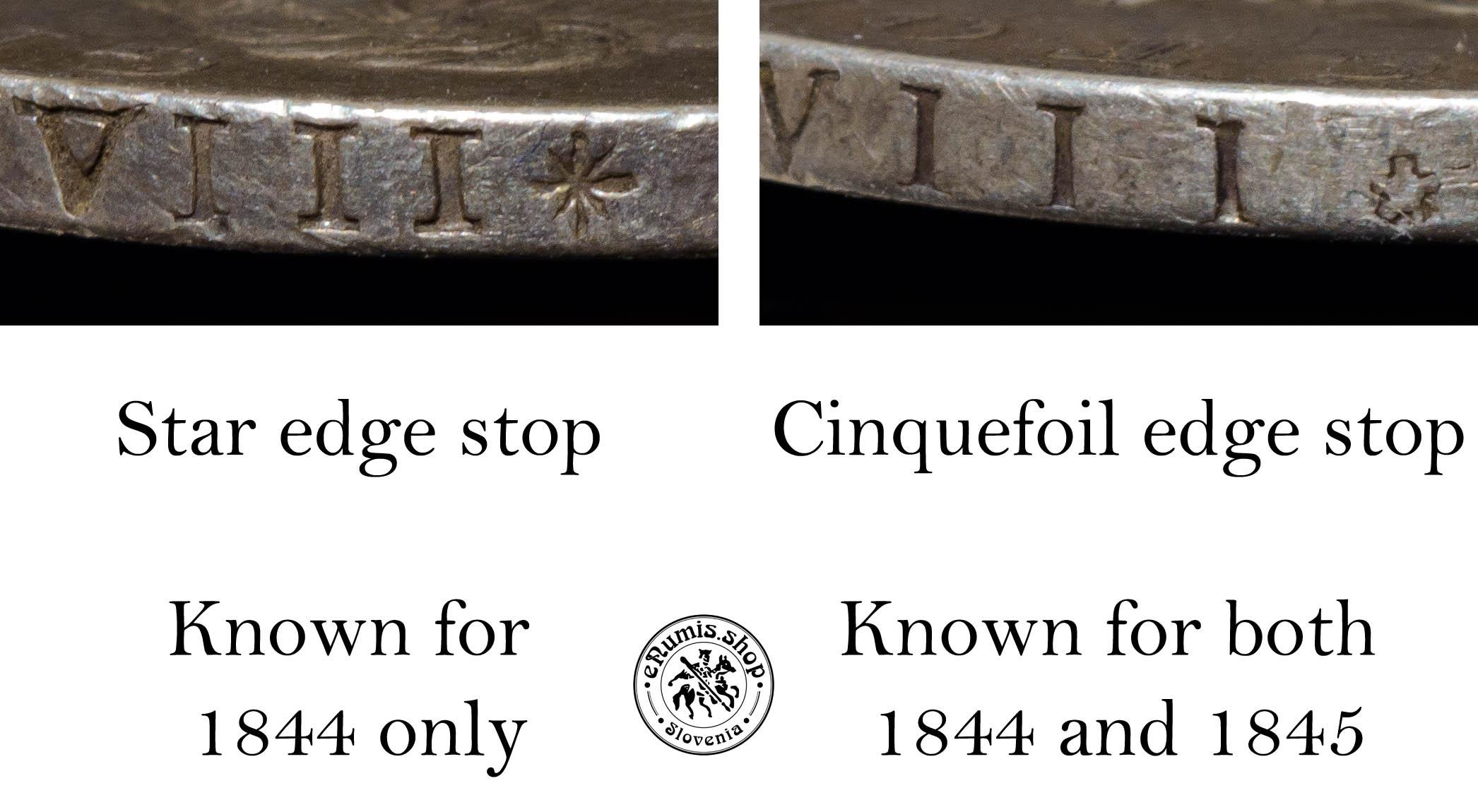
| Additional info | Edge variety: Star, Obv.: Unfinished die |
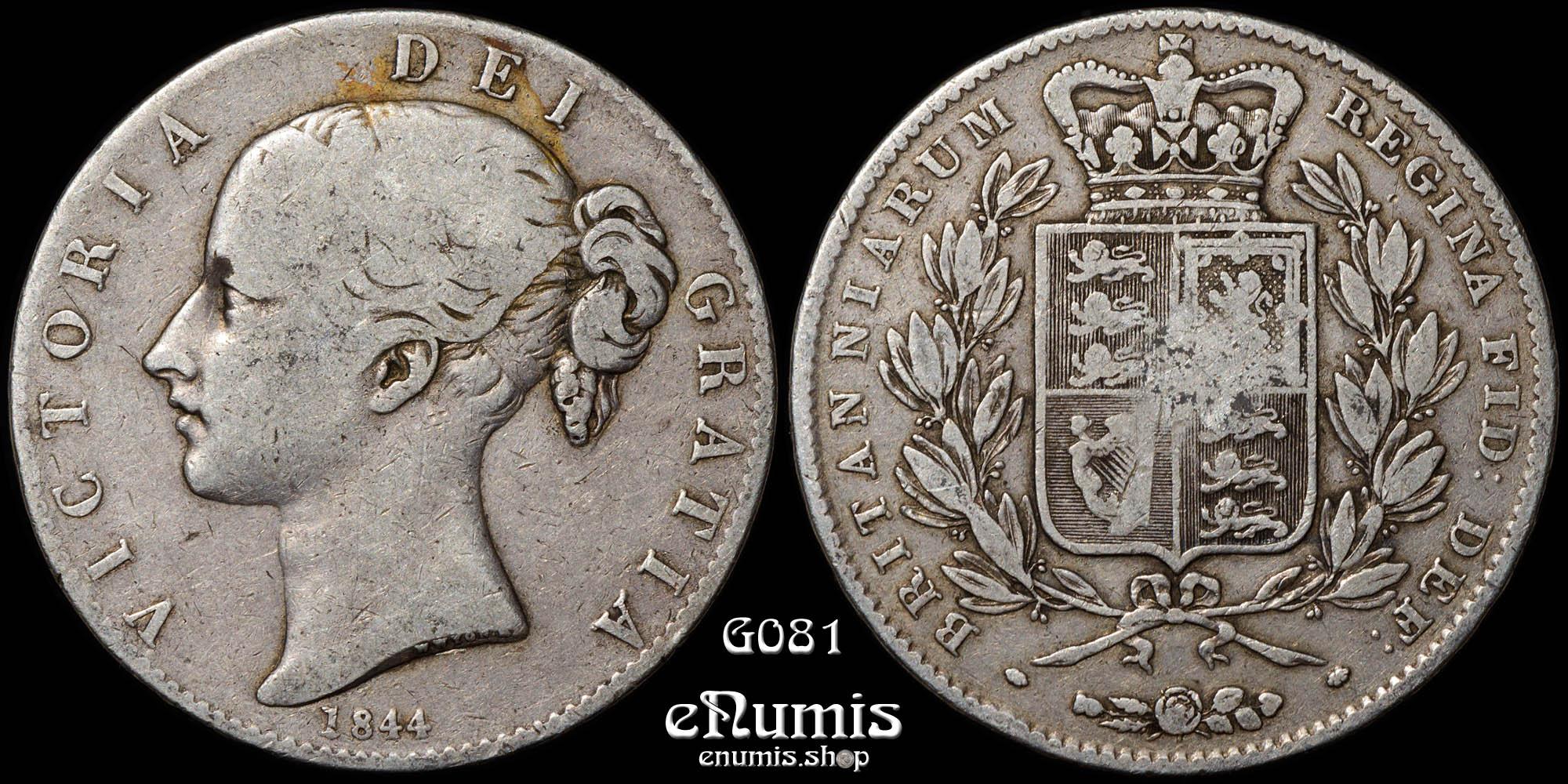
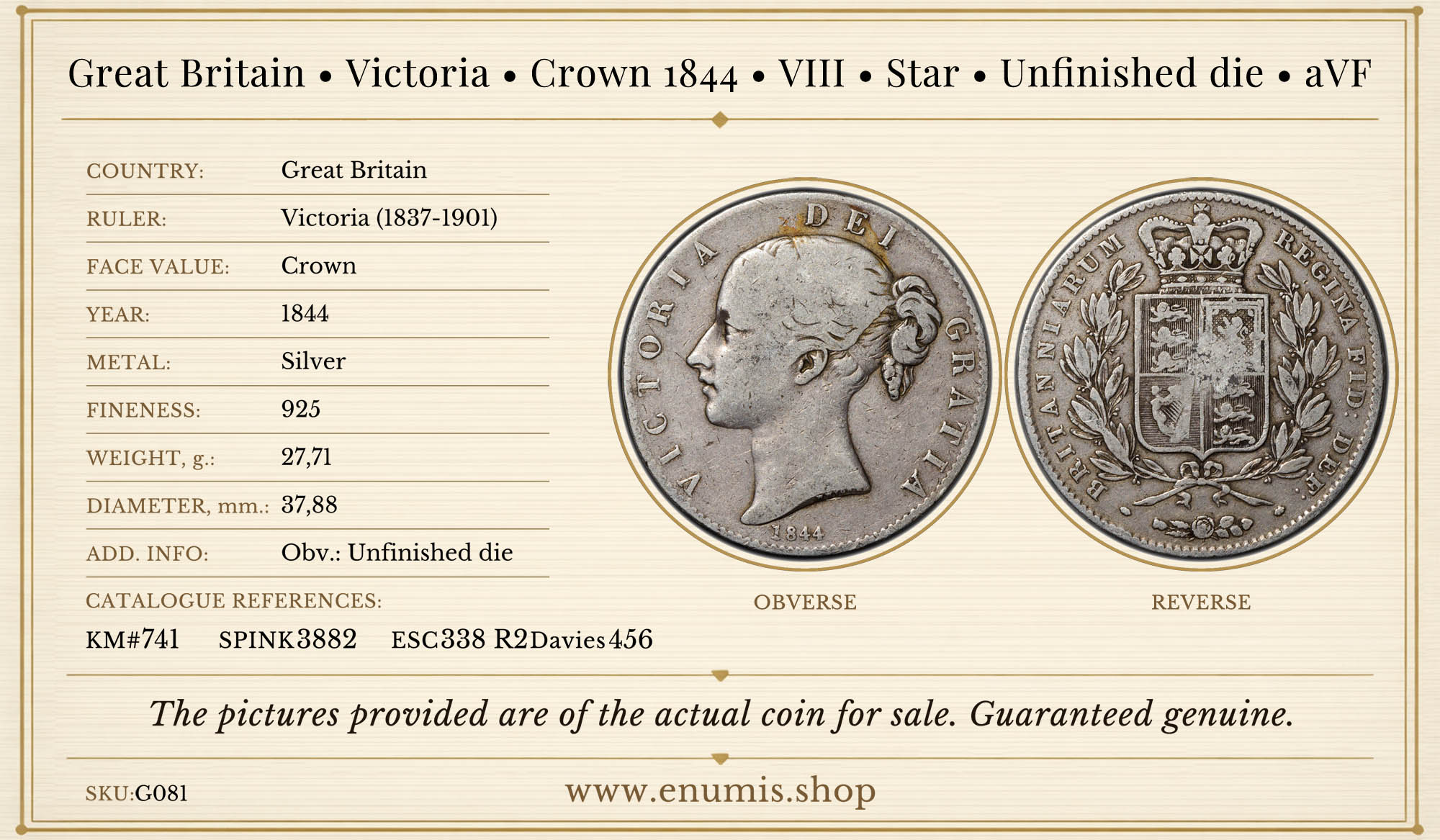
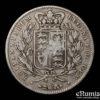
Great Britain, Victoria, Crown 1844, VIII, Star, Unfinished die, aVF
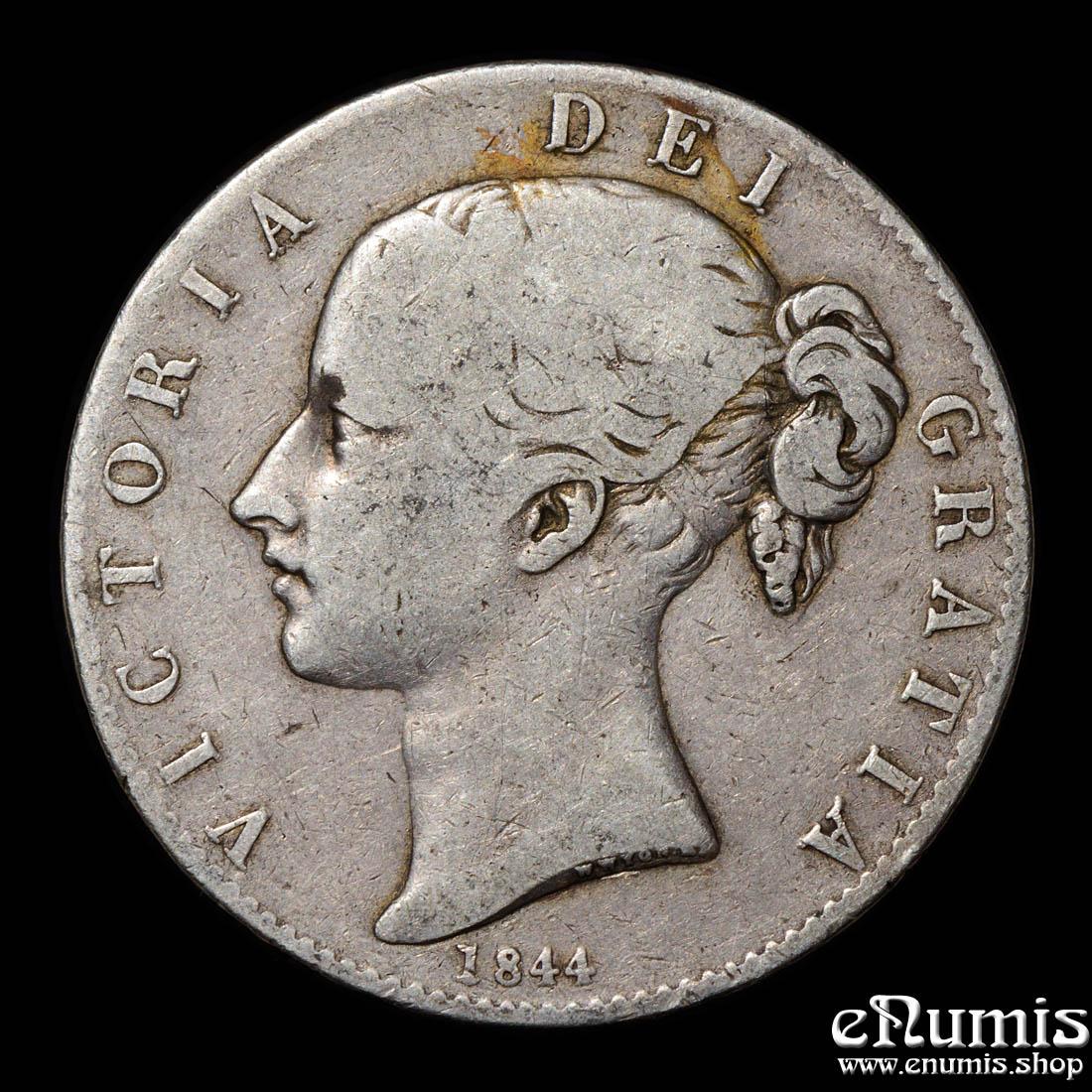
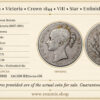
N.B.: the die is unfinished where the hair falls below the knot at the back of the Queen’s head, and shows as a triangular shape at the lowest extremity.

Young uncrowned portrait (‘Young Head’) of Queen Victoria left, legend around, date below.
Legend:
VICTORIA DEI GRATIA; 1844
Engraver:
♦
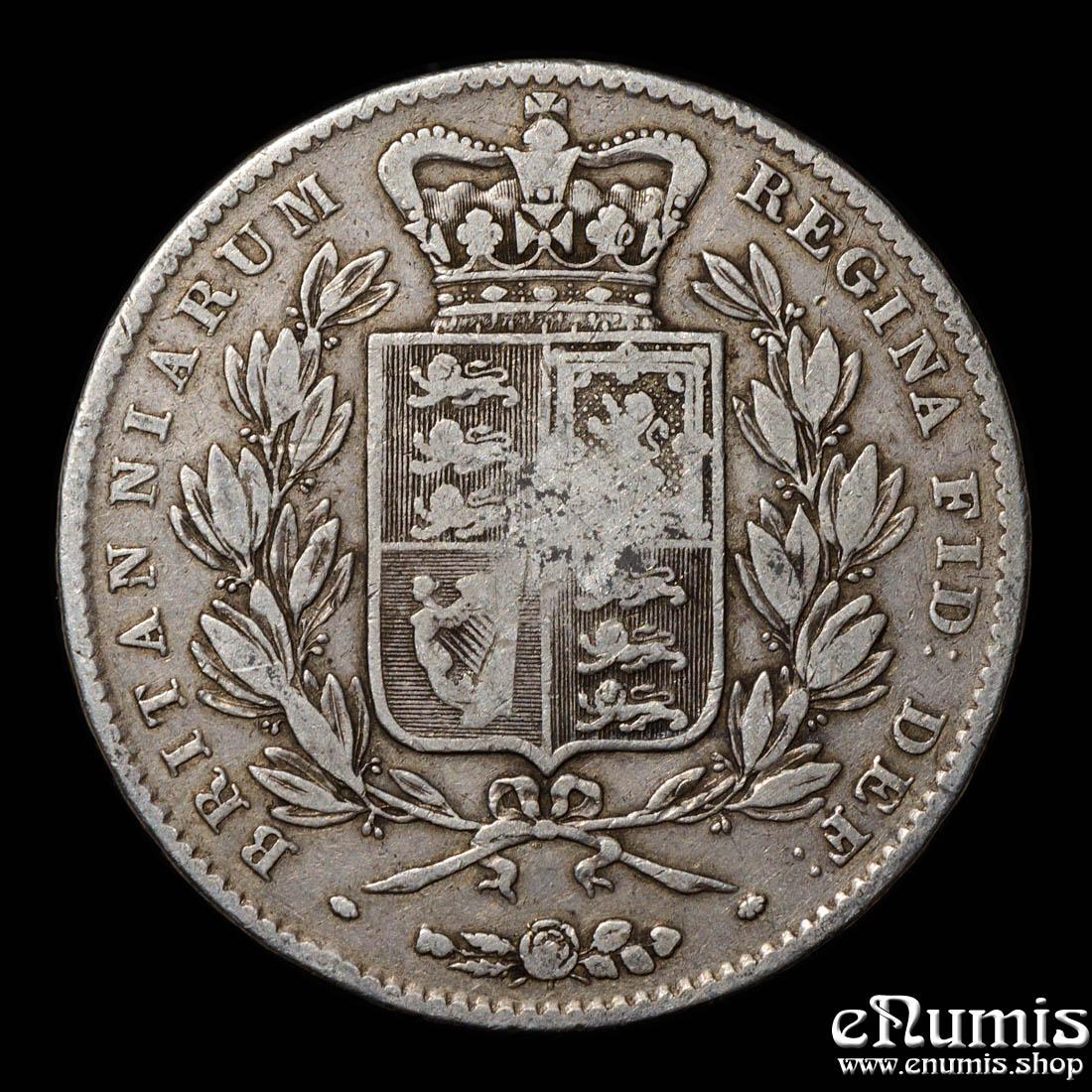
Crowned quartered shield of arms within wreath, legend around, national flower emblems below.
Legend:
BRITANNIARUM REGINA FID: DEF:
Engraver:
♦
Edge:
DECUS ET TUTAMEN ANNO REGNI VIII
Crowns
Authenticity Guaranteed
Actual Coin Pictured
Ships within 1 business day
Worldwide Shipping
Great Britain, Victoria, Crown 1844, VIII, Star, Unfinished die, aVF
Availability:
In stock
Authenticity Guaranteed
Actual Coin Pictured
Ships within 1 business day
Worldwide Shipping
N.B.: the die is unfinished where the hair falls below the knot at the back of the Queen’s head, and shows as a triangular shape at the lowest extremity.
Obverse: Young uncrowned portrait (‘Young Head’) of Queen Victoria left, legend around, date below.
Legend (Latin): VICTORIA DEI GRATIA; 1844
Engraver: William Wyon
Reverse: Crowned quartered shield of arms within wreath, legend around, national flower emblems below.
Legend (Latin): BRITANNIARUM REGINA FID: DEF:
Engraver: Jean Baptiste Merlen
Edge (Text in Latin, Regnal year): DECUS ET TUTAMEN ANNO REGNI VIII
The pictures provided are of the actual coin for sale.Guaranteed genuine.
169 € Shipping from 7 € — FREE over 300 €*
*Except US, shipped via DHL Express — see Postage tab
In stock
Shipping from 7 € · FREE over 300 €*
*US orders: DHL Express only - see Postage
Ships within 1 business day
Authenticity Guaranteed
Actual Coin Pictured
30-Day Returns
Worldwide Shipping
Secure payment




SHIPPING:
• We ship worldwide from Slovenia, a member of the European Union, within 1 business day after payment is received.
• Every order is carefully packed to ensure safe delivery.
• Standard registered shipping via The Post of Slovenia is available worldwide and includes a tracking number.
• DHL Express shipping is also available at checkout for customers who require faster delivery.
• Registered shipping via The Post of Slovenia: €7 within Europe and €8 for the rest of the world.
• FREE registered shipping via The Post of Slovenia for orders over €300.
• FREE DHL Express shipping, including full insurance, for orders over €800.
INSURANCE:
• Upon your request an order over 300 Euro can be sent with extra insurance.
• The price of the insurance is about 1% of the order total (minimum price of the insurance is €5).
OTHER:
• Import duties, taxes and charges are not included in the item’s price or shipping charges. Buyers are responsible for these charges.
• Please check with your country’s customs office to determine what these additional costs will be prior to buying.
22 August 2025 (updated 21 July 2026):
Important Notice for USA Customers
Please note that, due to the new U.S. customs tariffs, the Post of Slovenia has temporarily suspended shipments to the United States. Unfortunately, this means we are unable to send orders to the USA at this time.
We will resume shipping to the USA as soon as the service becomes available again. Thank you for your understanding and patience.
However, we can still ship to the USA via DHL Express. Please be aware that additional U.S. customs duties or fees may apply, which are the responsibility of the buyer.
The coins remain with the seller until the goods have been paid for in full.
We accept the following payment methods:
- All major debit and credit cards (services provided by Stripe Inc. and Bankart d.o.o.)
- Cash in Euros, US Dollars or British Pounds;
- Bank Transfer – to our corporate bank account (eNumis d.o.o., OTP banka d.d. Bank account: SI56 04 0000 2762 09090 BIC: KBMASI2X );
- We also accept PayPal (only for regular customers).
At eNumis.shop, your satisfaction is our top priority. If, for any reason, you are not completely satisfied with your purchase, please contact us immediately.
You may return any item within 30 days of receipt, provided it is in the same condition as when sent. All returns must be shipped using Registered Post or your country’s equivalent postal service with a tracking number.
Upon receiving and inspecting your return, we will offer you an exchange or a refund of the coin’s purchase price, as agreed.
Please note:
Return shipping costs are the responsibility of the buyer and are non-refundable.
Items must be securely packaged to avoid damage during return shipping.
Returns sent without prior notification may not be accepted.
To initiate a return, please contact us at info@enumis.shop or through our Contact Form.
Thank you for shopping with eNumis.shop, where your trust and confidence matter.
History
This coin carries a mistake. And that mistake is precisely what makes it remarkable.
On the obverse, at the very tip of Victoria’s chignon – the loose coil of hair gathered at the back of her young head – there is a small, anomalous square of unfinished metal. It should not be there. It is the ghost of a die that was not quite ready, sent to the press before the engraver had finished his work, producing a small but unmistakable flaw in an otherwise elegant portrait. When these coins first came to light in the late Victorian era, collectors assumed they were extraordinarily rare trial pieces – struck from a pattern die never meant for circulation. For decades they were catalogued accordingly, rated among the rarest of all Victorian crowns, priced and handled as objects of exceptional scarcity.
Then, slowly, more examples surfaced. It became clear that the unfinished die had not produced a handful of trial pieces but a genuine, if small, portion of the regular currency issue. The earliest crowns struck from that obverse die – before it was corrected – had gone into circulation carrying the flaw intact. What had seemed like a deliberate rarity turned out to be a production accident of modest but real significance: not a pattern, not a proof, but a currency coin carrying the evidence of a craftsman’s unfinished morning.
The engraver whose unfinished work this was signed his name in full on the truncation of Victoria’s neck: W. WYON. RA. William Wyon, Royal Academician, the most distinguished coin engraver Britain had produced since the Restoration. He had been at the Royal Mint since 1816, had designed the famous City Medal of 1837, and had created the Young Head portrait of Victoria that appeared on British coinage from 1838 until 1887 – a span of almost fifty years on the obverse of every British silver coin. The Young Head crowns are the only coins of Victoria’s reign on which Wyon signed himself with his full Royal Academy credentials. He was, in that small proud inscription, staking his professional reputation on the work.
Victoria in 1844 was twenty-five years old, seven years into a reign that would last sixty-three. The portrait Wyon carved showed her as she had looked at eighteen – young, serene, hair dressed with double fillets, the idealized image of a queen at the beginning of her story. The reverse, designed by the French engraver Jean Baptiste Merlen, carried the crowned quartered arms of England, Scotland, and Ireland within a laurel wreath, completing a coin of quiet classical authority.
The edge told its own story: DECUS ET TUTAMEN ANNO REGNI VIII – an ornament and a safeguard, in the eighth year of the reign. The star stops separating the words are the other distinguishing mark of this variety, setting it apart from the cinquefoil-stop issue struck the same year. Two varieties, one year, one tiny square of unfinished metal on one of them – and three centuries of collectors have been arguing about it ever since.
This is a coin that entered the world imperfectly, was mistaken for something rarer than it was, and turned out to be interesting for entirely different reasons than anyone first supposed. That, in its own quiet way, is a rather good story.
Coin condition (grade) is described using the following scale, based on internationally recognised numismatic grading standards. Where a grade is separated by a slash (e.g. VF/XF), the obverse and reverse differ in condition – VF obverse, XF reverse in this example.
| Grade | Full name | Description |
|---|---|---|
| F | Fine | Noticeable, moderate to considerable wear across the design; major details, lettering and date remain clearly legible |
| F+ | Choice Fine | Slightly better than Fine |
| F‑VF | Fine to Very Fine | Between Fine and Very Fine |
| aVF | About Very Fine | Slightly below Very Fine |
| VF | Very Fine | Moderate wear on the higher points; major design elements and lettering remain sharp and well-defined |
| VF+ | Choice Very Fine | Slightly better than Very Fine |
| VF‑XF | Very Fine to Extremely Fine | Between Very Fine and Extremely Fine |
| aXF | About Extremely Fine | Slightly below Extremely Fine |
| XF | Extremely Fine | Light wear confined to the highest points of the design; most original detail and some mint lustre remain |
| XF+ | Choice Extremely Fine | Slightly better than Extremely Fine |
| XF‑UNC | Extremely Fine to Uncirculated | Between Extremely Fine and Uncirculated |
| aUNC | About Uncirculated | Slightly below Uncirculated |
| UNC | Uncirculated | Shows no evidence of circulation wear; retains its original mint lustre, which may appear naturally subdued with age |
| Proof | Proof | Struck specifically for collectors from specially prepared, polished dies on polished planchets, giving sharp detail and mirror-like fields. Refers to how the coin was made, not to its state of preservation |
| Prooflike (PL) | Prooflike | A coin from the ordinary circulation production that happens to show mirror-like fields, usually from early strikes with fresh dies – it looks similar to a Proof but was not specially struck for collectors |
Grading is inherently somewhat subjective. If you would like additional photos or have any question about a coin’s condition before ordering, please contact us – we’re happy to help.