




| Country | Great Britain |
|---|---|
| Ruler | George V (1910-36) |
| Face Value | Halfcrown |
| Year of issue | 1911 |
| Metal | Silver |
| Fineness | 925 |
| Catalogue # | KM# 818.1; SPINK 4011; ESC 3709; Davies 1660 |
| Weight | 14,11 g |
| Diameter | 32,09 mm |
| Our code | Z471 |
| Die Axis | ↑↑ |
| Additional info | Rare in this condition |
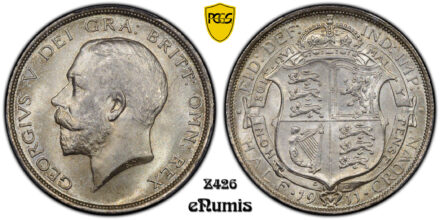
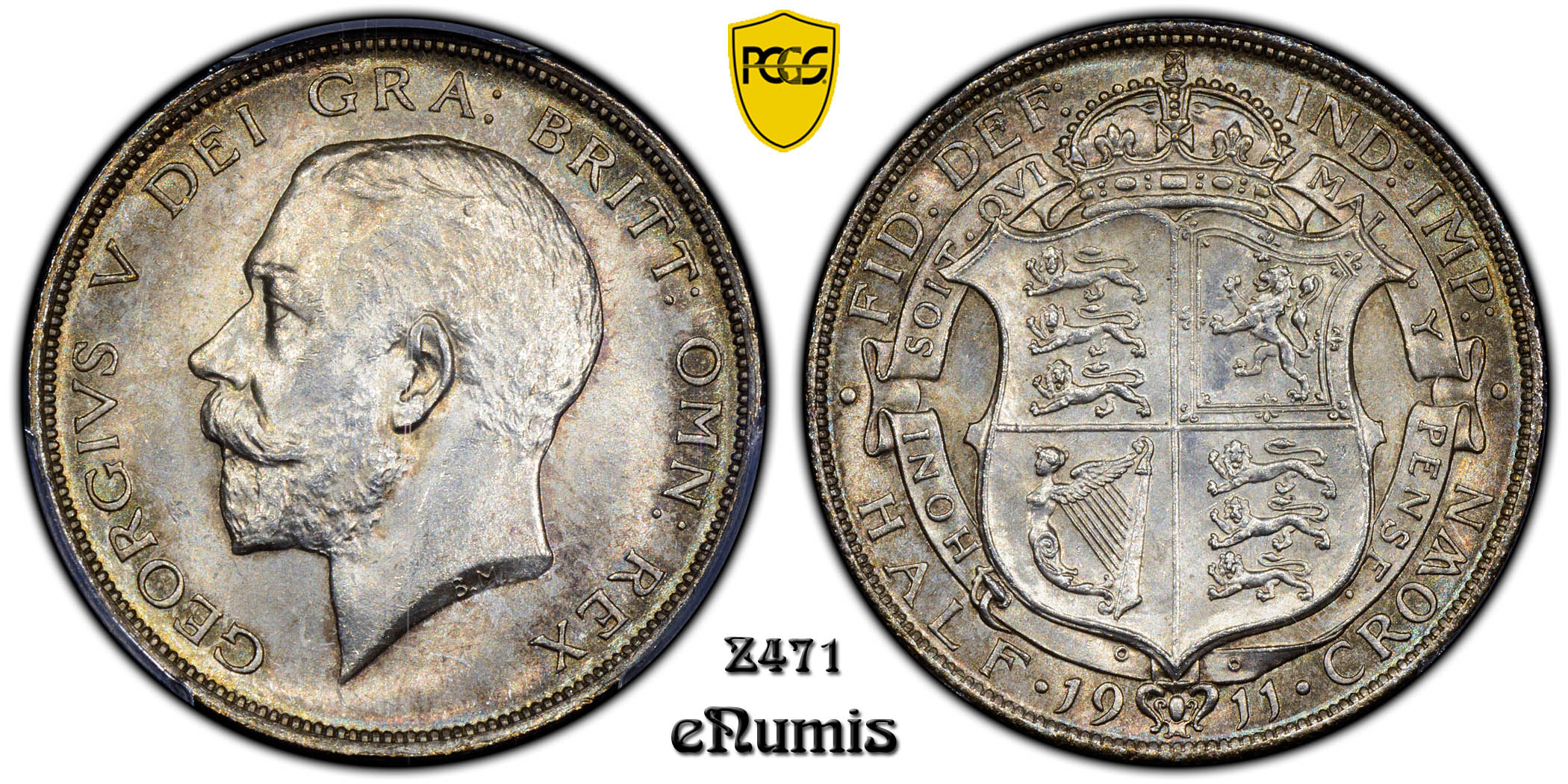
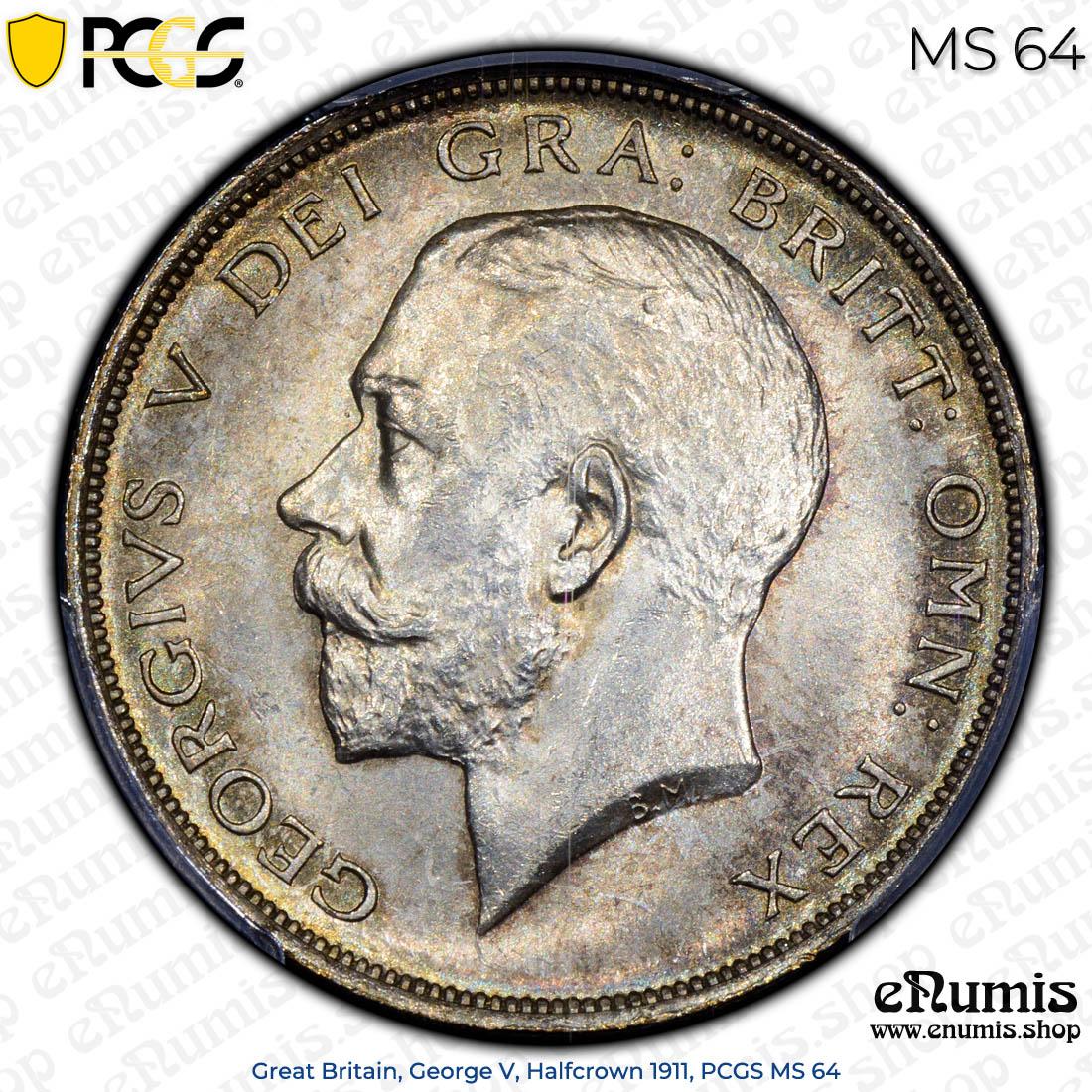
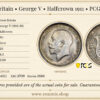
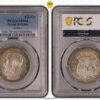
Great Britain, George V, Halfcrown 1911, PCGS MS 64
You can verify the PCGS certification number: 55400906
Legend:
GEORGIVS V DEI GRA: BRITT: OMN: REX; B.M.
Engraver:
♦
Crowned quartered shield of arms within Garter band, legend around, divided date below.
Legend:
· FID: DEF: IND: IMP: ·; HALF · 19 11 · CROWN; HONI SOIT· QVI MAL· Y PENSE·
Engraver:
♦
Edge:
Reeded
Halfcrowns
Authenticity Guaranteed
Actual Coin Pictured
Ships within 1 business day
Worldwide Shipping
Great Britain, George V, Halfcrown 1911, PCGS MS 64
Availability:
In stock
Authenticity Guaranteed
Actual Coin Pictured
Ships within 1 business day
Worldwide Shipping
Obverse: Uncrowned portrait of King George V left, legend around.
Legend (Latin): GEORGIVS V DEI GRA: BRITT: OMN: REX; B.M.
Engraver: Edgar Bertram MacKennal

Reverse: Crowned quartered shield of arms within Garter band, legend around, divided date below.
Legend (Latin, English): · FID: DEF: IND: IMP: ·; HALF · 19 11 · CROWN; HONI SOIT· QVI MAL· Y PENSE·
Engraver: George William de Saulles
Edge: Reeded
You can verify the PCGS certification number: 55400906
The pictures provided are of the actual coin for sale.Guaranteed genuine.
399 € Shipping from 7 € — FREE over 300 €*
*Except US, shipped via DHL Express — see Postage tab
In stock
Shipping from 7 € · FREE over 300 €*
*US orders: DHL Express only - see Postage
Ships within 1 business day
Authenticity Guaranteed
Actual Coin Pictured
30-Day Returns
Worldwide Shipping
Secure payment





SHIPPING:
• We ship worldwide from Slovenia, a member of the European Union, within 1 business day after payment is received.
• Every order is carefully packed to ensure safe delivery.
• Standard registered shipping via The Post of Slovenia is available worldwide and includes a tracking number.
• DHL Express shipping is also available at checkout for customers who require faster delivery.
• Registered shipping via The Post of Slovenia: €7 within Europe and €8 for the rest of the world.
• FREE registered shipping via The Post of Slovenia for orders over €300.
• FREE DHL Express shipping, including full insurance, for orders over €800.
INSURANCE:
• Upon your request an order over 300 Euro can be sent with extra insurance.
• The price of the insurance is about 1% of the order total (minimum price of the insurance is €5).
OTHER:
• Import duties, taxes and charges are not included in the item’s price or shipping charges. Buyers are responsible for these charges.
• Please check with your country’s customs office to determine what these additional costs will be prior to buying.
22 August 2025 (updated 21 July 2026):
Important Notice for USA Customers
Please note that, due to the new U.S. customs tariffs, the Post of Slovenia has temporarily suspended shipments to the United States. Unfortunately, this means we are unable to send orders to the USA at this time.
We will resume shipping to the USA as soon as the service becomes available again. Thank you for your understanding and patience.
However, we can still ship to the USA via DHL Express. Please be aware that additional U.S. customs duties or fees may apply, which are the responsibility of the buyer.
The coins remain with the seller until the goods have been paid for in full.
We accept the following payment methods:
- All major debit and credit cards (services provided by Stripe Inc. and Bankart d.o.o.)
- Cash in Euros, US Dollars or British Pounds;
- Bank Transfer – to our corporate bank account (eNumis d.o.o., OTP banka d.d. Bank account: SI56 04 0000 2762 09090 BIC: KBMASI2X );
- We also accept PayPal (only for regular customers).
At eNumis.shop, your satisfaction is our top priority. If, for any reason, you are not completely satisfied with your purchase, please contact us immediately.
You may return any item within 30 days of receipt, provided it is in the same condition as when sent. All returns must be shipped using Registered Post or your country’s equivalent postal service with a tracking number.
Upon receiving and inspecting your return, we will offer you an exchange or a refund of the coin’s purchase price, as agreed.
Please note:
Return shipping costs are the responsibility of the buyer and are non-refundable.
Items must be securely packaged to avoid damage during return shipping.
Returns sent without prior notification may not be accepted.
To initiate a return, please contact us at info@enumis.shop or through our Contact Form.
Thank you for shopping with eNumis.shop, where your trust and confidence matter.
History
George V came to the throne in May 1910 inheriting not just a crown but a constitutional crisis that was already two years old and showed no sign of resolving itself.
The trouble had begun in 1909, when Lloyd George’s radical People’s Budget – proposing new taxes on land and wealth to fund old-age pensions and social reform – was vetoed by the Conservative-dominated House of Lords. It was an act of extraordinary constitutional audacity. For centuries it had been accepted that the unelected Lords did not obstruct money bills. Now they had, and in doing so they had forced a question that could no longer be deferred: who, in a modern democracy, actually governed Britain? Two general elections in 1910 failed to resolve the deadlock. The new king, barely months into his reign, was asked by the Liberal government whether he would be prepared to create hundreds of new Liberal peers to flood the Lords and break the impasse. George V – a conscientious, steady, deeply uncomfortable man who disliked political theatre of any kind – agreed, reluctantly, that he would if it came to that. It never quite did. Faced with the prospect of being diluted out of existence, the Lords backed down and passed the Parliament Act in August 1911 by a margin of seventeen votes. The centuries-old veto of the upper house was gone.
The coronation of George V took place that same summer, in June 1911, and the Half Crown struck that year carries the fresh portrait of a new king on a throne transformed almost the moment he had sat down in it. The obverse portrait – the work of the Australian sculptor Bertram Mackennal, the first non-European to design the effigy of a British monarch – shows a bare-headed George V, composed and direct. The reverse carries the crowned and quartered shield within the Garter band, framed by the motto HONI SOIT QUI MAL Y PENSE – Shame on him who thinks evil of it – the ancient device of the Order of the Garter, unchanged on English silver since the medieval era.
The man on this coin was not a natural king. He had been a naval officer, the second son, never intended for the throne. His older brother Albert Victor had died of influenza in 1892, and the crown had passed unexpectedly to George, who spent the rest of his life taking the responsibility with a seriousness that bordered on the monastic. He was methodical, dutiful, and entirely without vanity – qualities that would serve him well through the catastrophes that lay ahead. The First World War. The Russian Revolution. The Irish War of Independence. The General Strike. He would navigate all of it, quietly and steadily, and die in 1936 still on his throne and still, somehow, trusted.
But in 1911, the worst was still unimaginable. The coronation crowds were jubilant, the empire was vast, and a new reign had just begun on the foundations of a constitution quietly, irrevocably changed.
Coin condition (grade) is described using the following scale, based on internationally recognised numismatic grading standards. Where a grade is separated by a slash (e.g. VF/XF), the obverse and reverse differ in condition – VF obverse, XF reverse in this example.
| Grade | Full name | Description |
|---|---|---|
| F | Fine | Noticeable, moderate to considerable wear across the design; major details, lettering and date remain clearly legible |
| F+ | Choice Fine | Slightly better than Fine |
| F‑VF | Fine to Very Fine | Between Fine and Very Fine |
| aVF | About Very Fine | Slightly below Very Fine |
| VF | Very Fine | Moderate wear on the higher points; major design elements and lettering remain sharp and well-defined |
| VF+ | Choice Very Fine | Slightly better than Very Fine |
| VF‑XF | Very Fine to Extremely Fine | Between Very Fine and Extremely Fine |
| aXF | About Extremely Fine | Slightly below Extremely Fine |
| XF | Extremely Fine | Light wear confined to the highest points of the design; most original detail and some mint lustre remain |
| XF+ | Choice Extremely Fine | Slightly better than Extremely Fine |
| XF‑UNC | Extremely Fine to Uncirculated | Between Extremely Fine and Uncirculated |
| aUNC | About Uncirculated | Slightly below Uncirculated |
| UNC | Uncirculated | Shows no evidence of circulation wear; retains its original mint lustre, which may appear naturally subdued with age |
| Proof | Proof | Struck specifically for collectors from specially prepared, polished dies on polished planchets, giving sharp detail and mirror-like fields. Refers to how the coin was made, not to its state of preservation |
| Prooflike (PL) | Prooflike | A coin from the ordinary circulation production that happens to show mirror-like fields, usually from early strikes with fresh dies – it looks similar to a Proof but was not specially struck for collectors |
Grading is inherently somewhat subjective. If you would like additional photos or have any question about a coin’s condition before ordering, please contact us – we’re happy to help.