



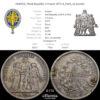

| Country | France |
|---|---|
| Face Value | 5 Francs |
| Year of issue | 1873 |
| Metal | Silver |
| Fineness | 900 |
| Catalogue # | KM# 820.1; Gadoury 745a; Le Franc 334/9 |
| Weight | 24,95 g |
| Diameter | 37,48 mm |
| Our code | G170 |
| Die Axis | ↑↓ |
| Additional info | ex-jewelry |
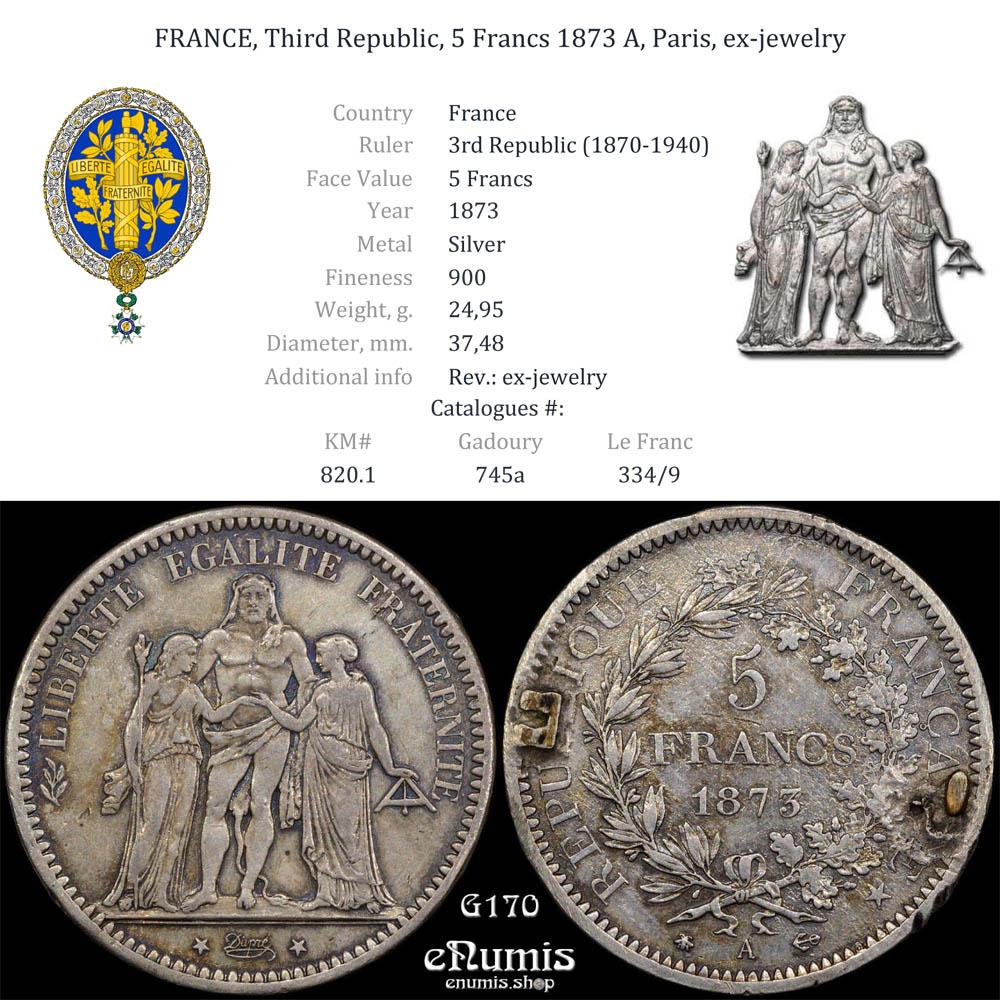
France, Third Republic, 5 Francs 1873 A, Paris, ex-jewelry
Hercules group, exergue below, legend around
Legend:
LIBERTÉ ÉGALITÉ FRATERNITÉ; Dupré
Engraver:
♦
Denomination and date within wreath
Legend:
RÉPUBLIQUE FRANÇAISE; 5 FRANCS; 1873; A
Engraver:
♦
Edge:
* DIEU * PROTEGE * LA * FRANCE
3rd Republic (1870-1940)
Authenticity Guaranteed
Actual Coin Pictured
Ships within 1 business day
Worldwide Shipping
France, Third Republic, 5 Francs 1873 A, Paris, ex-jewelry
Availability:
In stock
Authenticity Guaranteed
Actual Coin Pictured
Ships within 1 business day
Worldwide Shipping
Obverse: Hercules group, exergue below, legend around
Legend (French): LIBERTÉ ÉGALITÉ FRATERNITÉ; Dupré
Engraver: Augustin Dupré

Reverse: Denomination and date within wreath
Legend (French): RÉPUBLIQUE FRANÇAISE; 5 FRANCS; 1873; A
Engraver: Augustin Dupré
Edge (text in French): * DIEU * PROTEGE * LA * FRANCE
The pictures provided are of the actual coin for sale.Guaranteed genuine.
45 € Shipping from 7 € — FREE over 300 €*
*Except US, shipped via DHL Express — see Postage tab
In stock
Shipping from 7 € · FREE over 300 €*
*US orders: DHL Express only - see Postage
Ships within 1 business day
Authenticity Guaranteed
Actual Coin Pictured
30-Day Returns
Worldwide Shipping
Secure payment



SHIPPING:
• We ship worldwide from Slovenia, a member of the European Union, within 1 business day after payment is received.
• Every order is carefully packed to ensure safe delivery.
• Standard registered shipping via The Post of Slovenia is available worldwide and includes a tracking number.
• DHL Express shipping is also available at checkout for customers who require faster delivery.
• Registered shipping via The Post of Slovenia: €7 within Europe and €8 for the rest of the world.
• FREE registered shipping via The Post of Slovenia for orders over €300.
• FREE DHL Express shipping, including full insurance, for orders over €800.
INSURANCE:
• Upon your request an order over 300 Euro can be sent with extra insurance.
• The price of the insurance is about 1% of the order total (minimum price of the insurance is €5).
OTHER:
• Import duties, taxes and charges are not included in the item’s price or shipping charges. Buyers are responsible for these charges.
• Please check with your country’s customs office to determine what these additional costs will be prior to buying.
22 August 2025 (updated 21 July 2026):
Important Notice for USA Customers
Please note that, due to the new U.S. customs tariffs, the Post of Slovenia has temporarily suspended shipments to the United States. Unfortunately, this means we are unable to send orders to the USA at this time.
We will resume shipping to the USA as soon as the service becomes available again. Thank you for your understanding and patience.
However, we can still ship to the USA via DHL Express. Please be aware that additional U.S. customs duties or fees may apply, which are the responsibility of the buyer.
The coins remain with the seller until the goods have been paid for in full.
We accept the following payment methods:
- All major debit and credit cards (services provided by Stripe Inc. and Bankart d.o.o.)
- Cash in Euros, US Dollars or British Pounds;
- Bank Transfer – to our corporate bank account (eNumis d.o.o., OTP banka d.d. Bank account: SI56 04 0000 2762 09090 BIC: KBMASI2X );
- We also accept PayPal (only for regular customers).
At eNumis.shop, your satisfaction is our top priority. If, for any reason, you are not completely satisfied with your purchase, please contact us immediately.
You may return any item within 30 days of receipt, provided it is in the same condition as when sent. All returns must be shipped using Registered Post or your country’s equivalent postal service with a tracking number.
Upon receiving and inspecting your return, we will offer you an exchange or a refund of the coin’s purchase price, as agreed.
Please note:
Return shipping costs are the responsibility of the buyer and are non-refundable.
Items must be securely packaged to avoid damage during return shipping.
Returns sent without prior notification may not be accepted.
To initiate a return, please contact us at info@enumis.shop or through our Contact Form.
Thank you for shopping with eNumis.shop, where your trust and confidence matter.
History
In May 1873, France changed presidents – and in doing so, revealed just how fragile its young republic truly was.
Adolphe Thiers, the architect of France’s extraordinary recovery from the Franco-Prussian War, was forced from office by the royalist majority in the National Assembly. In two extraordinary years he had negotiated peace with Bismarck, suppressed the Paris Commune, and – with what contemporaries called almost miraculous speed – raised and paid the entire five-billion-franc war indemnity, prompting the last German occupation troops to leave French soil months ahead of schedule. France had humiliated itself at Sedan in 1870. By 1873 it had paid its debt and stood on its own feet again. Then it removed the man who had made it possible.
In his place the Assembly installed Marshal Patrice de MacMahon – a royalist, a Catholic conservative, a soldier of the old school who had been wounded at Sedan, suppressed the Commune with methodical brutality, and held not the faintest instinct for democratic politics. He was elected, it was understood by everyone, as a placeholder – a man to keep the republic warm while the monarchists settled their internal quarrels and agreed on which pretender to crown. The Bourbon claimant, the Comte de Chambord, was old, childless, and catastrophically stubborn – insisting on the white Bourbon flag rather than the tricolor that France had carried through revolution and empire. The negotiation collapsed. The monarchy, once again, was defeated not by republicans but by its own candidate’s intransigence.
The 5 Francs of 1873 circulated through all of this uncertainty. On the obverse stands the civic Hercules – flanked by Liberté and Égalité, that ancient republican image first designed during the Revolution and revived by every French republic as its most trusted declaration of values. The choice was pointed. In a year when the National Assembly was still debating whether France should have a king, the coin in everyday circulation carried the image of the republic as if the question had already been answered.
It was not yet answered. The constitution that finally settled the matter – by a single vote – would not be passed until 1875. The republic that year survived by inertia, by the monarchists’ inability to agree, by the stubbornness of one aging Bourbon who preferred principle to power.
This coin is silver from the eye of that particular storm – a republic that existed almost by accident, stamping its image onto metal as if stating, quietly but firmly, that it intended to remain.
Coin condition (grade) is described using the following scale, based on internationally recognised numismatic grading standards. Where a grade is separated by a slash (e.g. VF/XF), the obverse and reverse differ in condition – VF obverse, XF reverse in this example.
| Grade | Full name | Description |
|---|---|---|
| F | Fine | Noticeable, moderate to considerable wear across the design; major details, lettering and date remain clearly legible |
| F+ | Choice Fine | Slightly better than Fine |
| F‑VF | Fine to Very Fine | Between Fine and Very Fine |
| aVF | About Very Fine | Slightly below Very Fine |
| VF | Very Fine | Moderate wear on the higher points; major design elements and lettering remain sharp and well-defined |
| VF+ | Choice Very Fine | Slightly better than Very Fine |
| VF‑XF | Very Fine to Extremely Fine | Between Very Fine and Extremely Fine |
| aXF | About Extremely Fine | Slightly below Extremely Fine |
| XF | Extremely Fine | Light wear confined to the highest points of the design; most original detail and some mint lustre remain |
| XF+ | Choice Extremely Fine | Slightly better than Extremely Fine |
| XF‑UNC | Extremely Fine to Uncirculated | Between Extremely Fine and Uncirculated |
| aUNC | About Uncirculated | Slightly below Uncirculated |
| UNC | Uncirculated | Shows no evidence of circulation wear; retains its original mint lustre, which may appear naturally subdued with age |
| Proof | Proof | Struck specifically for collectors from specially prepared, polished dies on polished planchets, giving sharp detail and mirror-like fields. Refers to how the coin was made, not to its state of preservation |
| Prooflike (PL) | Prooflike | A coin from the ordinary circulation production that happens to show mirror-like fields, usually from early strikes with fresh dies – it looks similar to a Proof but was not specially struck for collectors |
Grading is inherently somewhat subjective. If you would like additional photos or have any question about a coin’s condition before ordering, please contact us – we’re happy to help.