

| Country | Austria |
|---|---|
| Ruler | Franz Joseph I (1848-1916) |
| Face Value | Taler |
| Year of issue | 1858 |
| Metal | Silver |
| Fineness | 900 |
| Catalogue # | KM# 2244; Herinek 452; Huszár 2125; Unger 1458.a |
| Weight | 18,51 g |
| Diameter | 33,07 mm |
| Our code | F516 |
| Die Axis | ↑↑ |
| Additional info | Kremnitz Mint, Thaler |
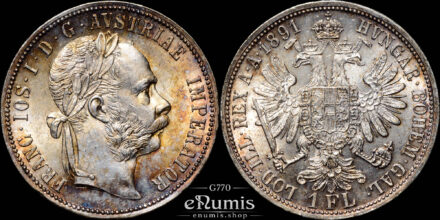
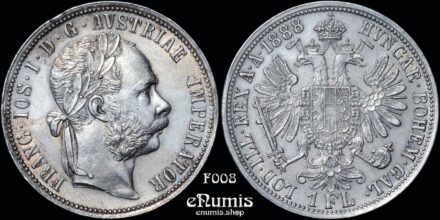
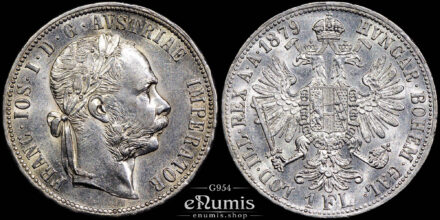
Austria, Franz Joseph I, Taler 1858 B, Kremnitz, aUNC
The bust of Franz Joseph I facing right, lettering around.
Legend:
FRANZ JOSEPH I· V· G· G· KAISER V· OESTERREICH; B
Translation:
Franz Joseph I, by the grace of God, Austrian Emperor
Engraver:
♦
Coat of Arms in a middle, legend around
Legend:
EIN VEREINSTHALER XXX EIN PFUND FEIN 1858
Engraver:
♦
Edge:
MIT VEREINTEN KRAEFTEN *
Translation:
With united strength
Before Forints (1848-67), Franz Joseph I (1848-1916), Gulden, Florin, Vereinsthaler system (1857-1892)
Authenticity Guaranteed
Actual Coin Pictured
Ships within 1 business day
Worldwide Shipping
Austria, Franz Joseph I, Taler 1858 B, Kremnitz, aUNC
Availability:
In stock
Authenticity Guaranteed
Actual Coin Pictured
Ships within 1 business day
Worldwide Shipping
Obverse: The bust of Franz Joseph I facing right, lettering around.
Legend (German): FRANZ JOSEPH I· V· G· G· KAISER V· OESTERREICH; B
Translation: Franz Joseph I, by the grace of God, Austrian Emperor
Engraver: Josef Daniel Böhm

Reverse: Coat of Arms in a middle, legend around
Legend (German): EIN VEREINSTHALER XXX EIN PFUND FEIN 1858
Engraver: Franz Gaul
Edge (text in German): MIT VEREINTEN KRAEFTEN *
Translation: With united strength
The pictures provided are of the actual coin for sale.Guaranteed genuine.
329 € Shipping from 7 € — FREE over 300 €*
*Except US, shipped via DHL Express — see Postage tab
In stock
Shipping from 7 € · FREE over 300 €*
*US orders: DHL Express only - see Postage
Ships within 1 business day
Authenticity Guaranteed
Actual Coin Pictured
30-Day Returns
Worldwide Shipping
Secure payment



SHIPPING:
• We ship worldwide from Slovenia, a member of the European Union, within 1 business day after payment is received.
• Every order is carefully packed to ensure safe delivery.
• Standard registered shipping via The Post of Slovenia is available worldwide and includes a tracking number.
• DHL Express shipping is also available at checkout for customers who require faster delivery.
• Registered shipping via The Post of Slovenia: €7 within Europe and €8 for the rest of the world.
• FREE registered shipping via The Post of Slovenia for orders over €300.
• FREE DHL Express shipping, including full insurance, for orders over €800.
INSURANCE:
• Upon your request an order over 300 Euro can be sent with extra insurance.
• The price of the insurance is about 1% of the order total (minimum price of the insurance is €5).
OTHER:
• Import duties, taxes and charges are not included in the item’s price or shipping charges. Buyers are responsible for these charges.
• Please check with your country’s customs office to determine what these additional costs will be prior to buying.
22 August 2025 (updated 21 July 2026):
Important Notice for USA Customers
Please note that, due to the new U.S. customs tariffs, the Post of Slovenia has temporarily suspended shipments to the United States. Unfortunately, this means we are unable to send orders to the USA at this time.
We will resume shipping to the USA as soon as the service becomes available again. Thank you for your understanding and patience.
However, we can still ship to the USA via DHL Express. Please be aware that additional U.S. customs duties or fees may apply, which are the responsibility of the buyer.
The coins remain with the seller until the goods have been paid for in full.
We accept the following payment methods:
- All major debit and credit cards (services provided by Stripe Inc. and Bankart d.o.o.)
- Cash in Euros, US Dollars or British Pounds;
- Bank Transfer – to our corporate bank account (eNumis d.o.o., OTP banka d.d. Bank account: SI56 04 0000 2762 09090 BIC: KBMASI2X );
- We also accept PayPal (only for regular customers).
At eNumis.shop, your satisfaction is our top priority. If, for any reason, you are not completely satisfied with your purchase, please contact us immediately.
You may return any item within 30 days of receipt, provided it is in the same condition as when sent. All returns must be shipped using Registered Post or your country’s equivalent postal service with a tracking number.
Upon receiving and inspecting your return, we will offer you an exchange or a refund of the coin’s purchase price, as agreed.
Please note:
Return shipping costs are the responsibility of the buyer and are non-refundable.
Items must be securely packaged to avoid damage during return shipping.
Returns sent without prior notification may not be accepted.
To initiate a return, please contact us at info@enumis.shop or through our Contact Form.
Thank you for shopping with eNumis.shop, where your trust and confidence matter.
History
In January 1857, the finance ministers and monetary officials of the German states gathered in Vienna and signed a document that would quietly reshape the commerce of Central Europe. The Vienna Coinage Treaty established a unified monetary standard across the German Confederation and the Austrian Empire – a common silver thaler, struck to identical specifications of weight and fineness, acceptable from Hamburg to Trieste without conversion or discount. It was called the Vereinsthaler: the Union Thaler. And the mint at Kremnitz was one of the first to strike it.
Kremnitz – Kremnica in Slovak, deep in the mountains of Upper Hungary – was one of the oldest and most distinguished mints in the Habsburg world. It had been striking coins since the fourteenth century, fed by the rich gold and silver deposits of the Carpathian ranges that surrounded it. By the nineteenth century it was still producing some of the finest coinage in the empire, its craftsmen carrying skills passed down across generations of continuous operation. The small letter B beneath the portrait on this coin’s obverse is Kremnitz’s mark – a quiet signature from a place that had been making silver coins for five hundred years.
The portrait itself belongs to Franz Joseph I, twenty-eight years old in 1858 – still a young man, though one who had already survived revolutionary war, the humiliation of Olmütz where Austria had been forced to restore the German Confederation under Prussian pressure, and the endless, grinding difficulty of governing an empire that contained a dozen nationalities with conflicting ambitions. The laureate bust on the obverse was a deliberate classicism – the young emperor rendered in the manner of Roman emperors, permanent and authoritative, above the turbulence of the age.
The reverse carries the crowned double-headed imperial eagle and the legend EIN VEREINSTHALER – One Union Thaler – alongside the critical technical inscription XXX EIN PFUND FEIN: thirty thalers from one pound of fine silver. In an era before electronic assay machines, these inscriptions were the guarantee. They told every merchant and banker in the German-speaking world exactly what they held in their hand.
The edge inscription added a final, characteristically Habsburg touch: MIT VEREINTEN KRÄFTEN – With United Forces. The same spirit as VIRIBVS VNITIS, simply translated into German for an audience that spanned both halves of a vast and complicated empire.
The Vereinsthaler did not last. Austria lost the war against Prussia in 1866, was expelled from German affairs, and reconfigured itself as the dual monarchy of Austria-Hungary in 1867. The common monetary framework dissolved. By 1892, Austria had abandoned the thaler system entirely, adopting the corona and converting to the gold standard that the modern world demanded.
This coin belongs to the brief, optimistic window between those upheavals – a moment when it seemed that Central Europe might bind itself together through commerce and shared silver, rather than come apart through blood and iron.
Coin condition (grade) is described using the following scale, based on internationally recognised numismatic grading standards. Where a grade is separated by a slash (e.g. VF/XF), the obverse and reverse differ in condition – VF obverse, XF reverse in this example.
| Grade | Full name | Description |
|---|---|---|
| F | Fine | Noticeable, moderate to considerable wear across the design; major details, lettering and date remain clearly legible |
| F+ | Choice Fine | Slightly better than Fine |
| F‑VF | Fine to Very Fine | Between Fine and Very Fine |
| aVF | About Very Fine | Slightly below Very Fine |
| VF | Very Fine | Moderate wear on the higher points; major design elements and lettering remain sharp and well-defined |
| VF+ | Choice Very Fine | Slightly better than Very Fine |
| VF‑XF | Very Fine to Extremely Fine | Between Very Fine and Extremely Fine |
| aXF | About Extremely Fine | Slightly below Extremely Fine |
| XF | Extremely Fine | Light wear confined to the highest points of the design; most original detail and some mint lustre remain |
| XF+ | Choice Extremely Fine | Slightly better than Extremely Fine |
| XF‑UNC | Extremely Fine to Uncirculated | Between Extremely Fine and Uncirculated |
| aUNC | About Uncirculated | Slightly below Uncirculated |
| UNC | Uncirculated | Shows no evidence of circulation wear; retains its original mint lustre, which may appear naturally subdued with age |
| Proof | Proof | Struck specifically for collectors from specially prepared, polished dies on polished planchets, giving sharp detail and mirror-like fields. Refers to how the coin was made, not to its state of preservation |
| Prooflike (PL) | Prooflike | A coin from the ordinary circulation production that happens to show mirror-like fields, usually from early strikes with fresh dies – it looks similar to a Proof but was not specially struck for collectors |
Grading is inherently somewhat subjective. If you would like additional photos or have any question about a coin’s condition before ordering, please contact us – we’re happy to help.