



| Country | Austria |
|---|---|
| Ruler | Franz Joseph I (1848-1916) |
| Face Value | 2 Corona |
| Year of issue | 1913 |
| Metal | Silver |
| Fineness | 835 |
| Catalogue # | KM# 2821; Herinek 781 |
| Weight | 9,95 g |
| Diameter | 27,04 mm |
| Our code | E978 |
| Die Axis | ↑↑ |
| Additional info | - |
Austria, Franz Joseph I, 2 Corona 1913, XF‑UNC
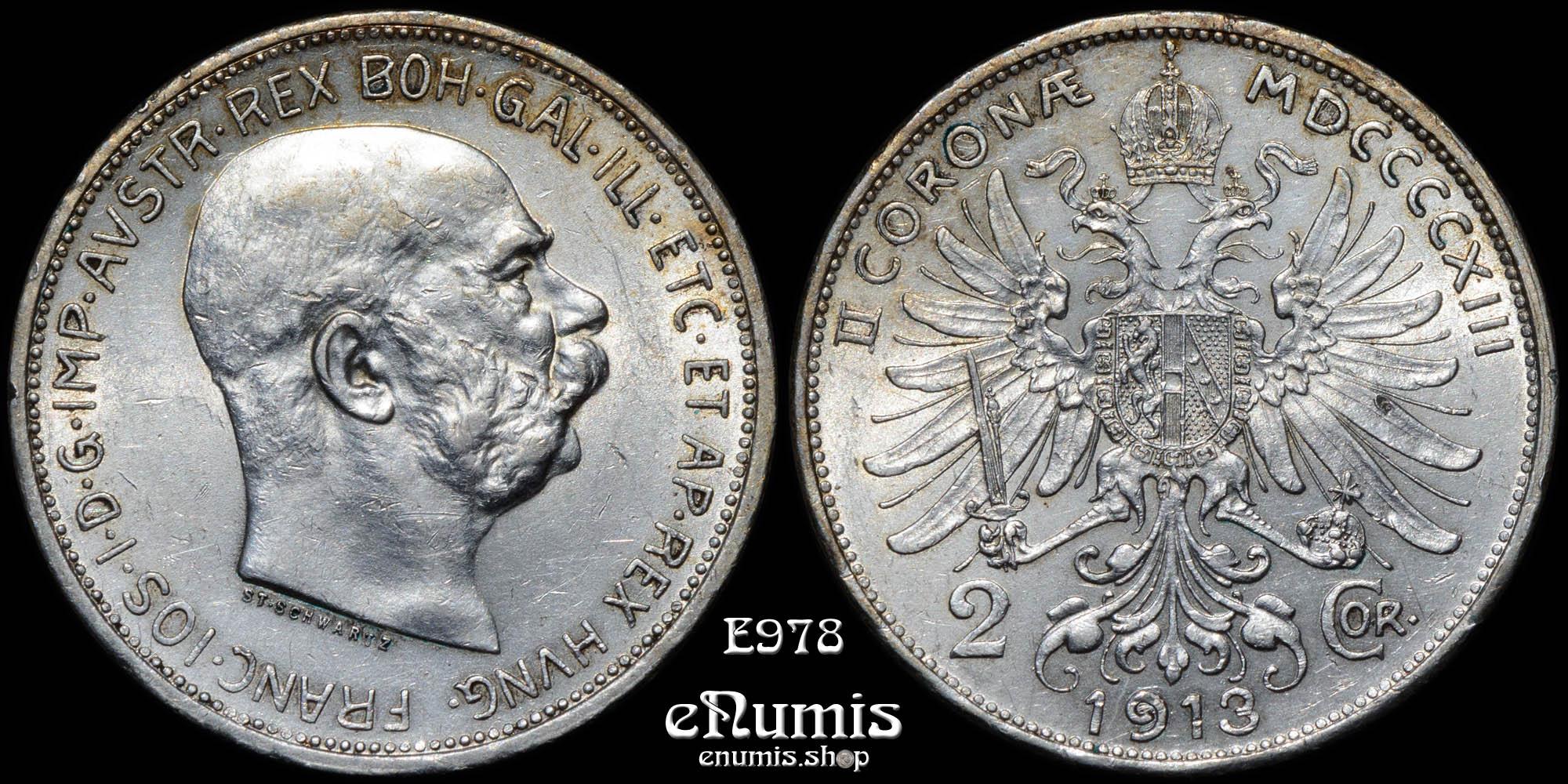
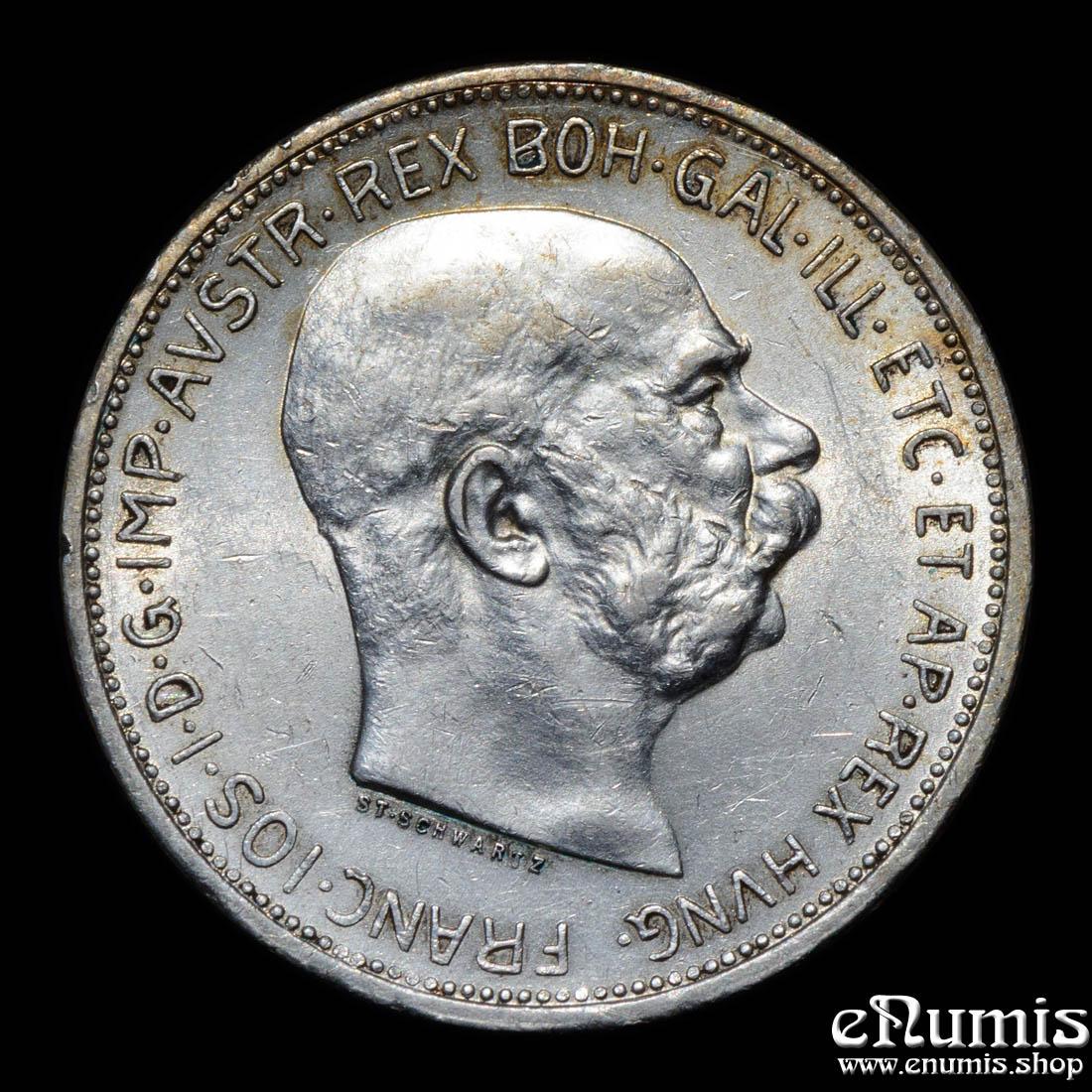
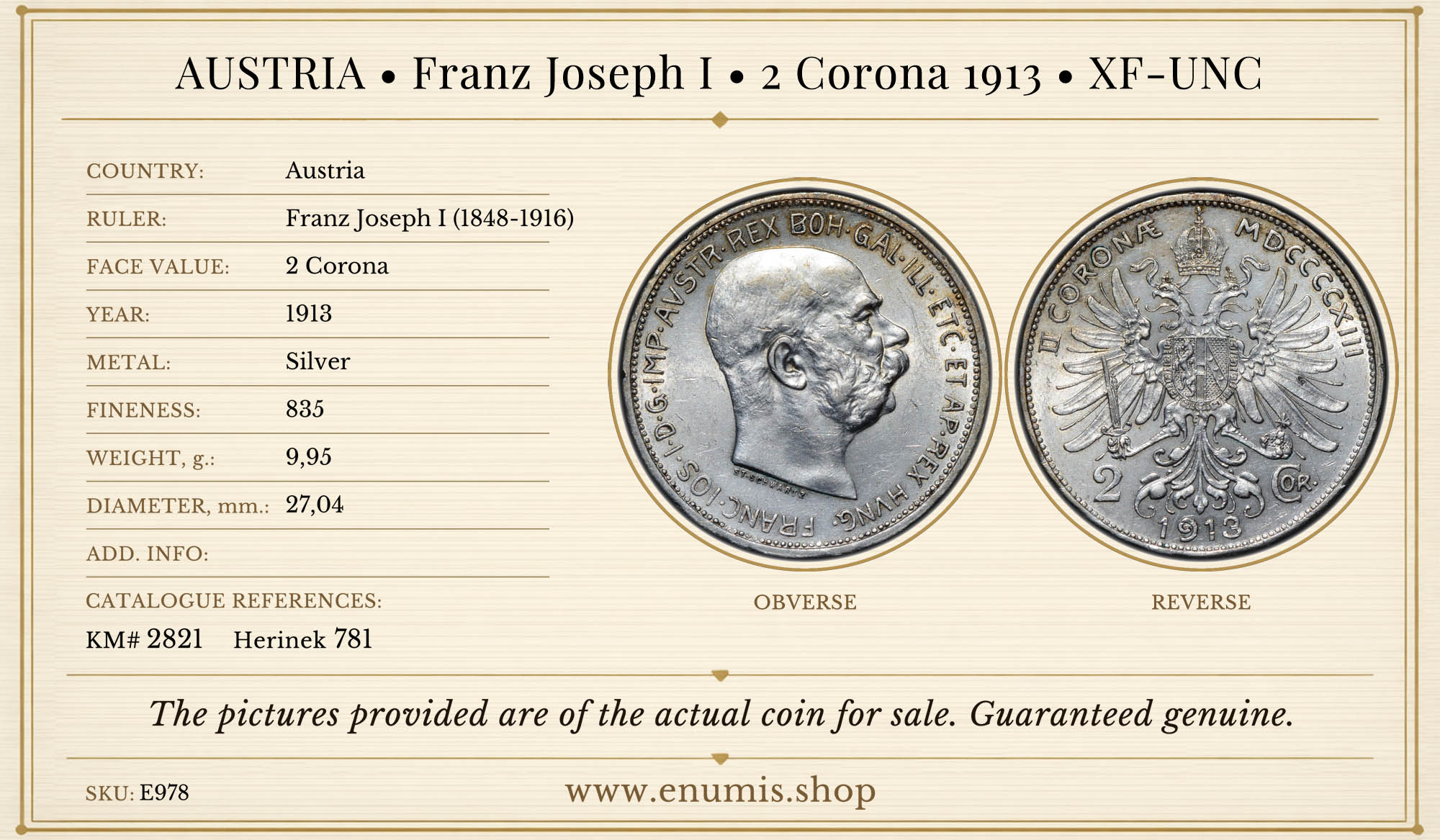
Franz Joseph I bust bare headed facing right surrounded by the legend. Signature below bust.
Legend:
FRANC ∙ IOS ∙ I ∙ D ∙ G ∙ IMP ∙ AVSTR ∙ REX BOH ∙ GAL ∙ ILL ∙ ETC ∙ ET AP ∙ REX HVNG ∙; ST. SCHWARTZ
Translation:
Franz Joseph I, by the grace of God, emperor of Austria, king of Bohemia, Galicia, Illyria and so forth and apostolic king of Hungary
Engraver:
♦
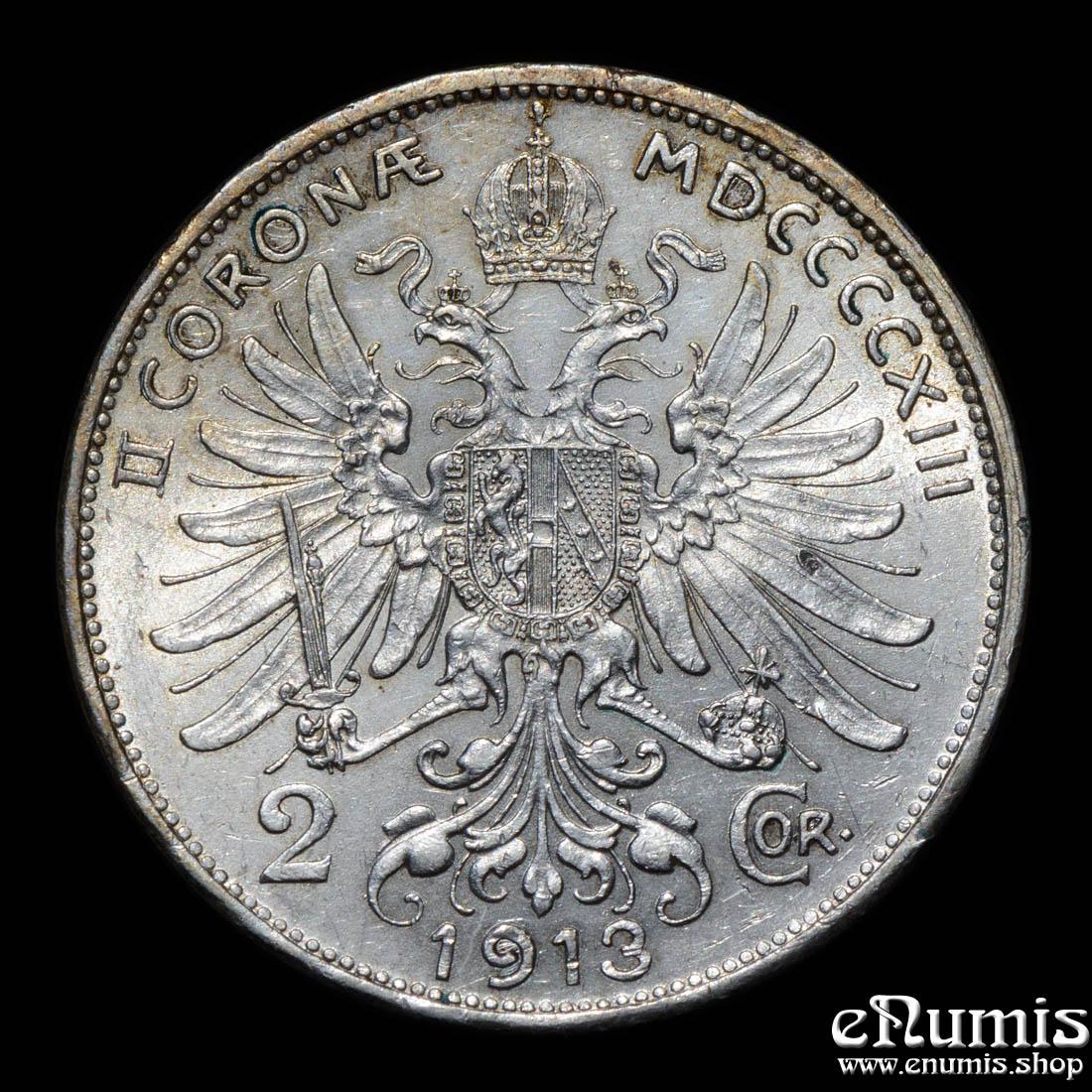
Crowned double headed imperial eagle with arms of the Habsburg-Lorraine. Value divided by the tail feathers, date below.
Legend:
II CORONÆ MDCCCCXIII; 2 COR.; 1913
Engraver:
♦
Edge:
VIRIBVS VNITIS
Translation:
With United Forces (the Motto of the house of Habsburg)
Corona, Krone System (1892-1918)
Authenticity Guaranteed
Actual Coin Pictured
Ships within 1 business day
Worldwide Shipping
Austria, Franz Joseph I, 2 Corona 1913, XF‑UNC
Availability:
In stock
Authenticity Guaranteed
Actual Coin Pictured
Ships within 1 business day
Worldwide Shipping
Obverse: Franz Joseph I bust bare headed facing right surrounded by the legend. Signature below bust.
Legend (Latin): FRANC ∙ IOS ∙ I ∙ D ∙ G ∙ IMP ∙ AVSTR ∙ REX BOH ∙ GAL ∙ ILL ∙ ETC ∙ ET AP ∙ REX HVNG ∙; ST. SCHWARTZ
Translation: Franz Joseph I, by the grace of God, emperor of Austria, king of Bohemia, Galicia, Illyria and so forth and apostolic king of Hungary
Engraver: Stefan Schwartz

Reverse: Crowned double headed imperial eagle with arms of the Habsburg-Lorraine. Value divided by the tail feathers, date below.
Legend (Latin): II CORONÆ MDCCCCXIII; 2 COR.; 1913
Engraver: Stefan Schwartz
Edge (text in Latin): VIRIBVS VNITIS
Translation: With United Forces (the Motto of the house of Habsburg)
The pictures provided are of the actual coin for sale.Guaranteed genuine.
32 € Shipping from 7 € — FREE over 300 €*
*Except US, shipped via DHL Express — see Postage tab
In stock
Authenticity guaranteedPhotos show the actual coin30-day
returns
returns
Ships within 1 business day, worldwide
Shipping from 7 € · FREE over 300 €*
*US orders: DHL Express only - see Postage
Ships within 1 business day
Authenticity Guaranteed
Actual Coin Pictured
30-Day Returns
Worldwide Shipping
Secure payment





SHIPPING:
• We ship worldwide from Slovenia, a member of the European Union, within 1 business day after payment is received.
• Every order is carefully packed to ensure safe delivery.
• Standard registered shipping via The Post of Slovenia is available worldwide and includes a tracking number.
• DHL Express shipping is also available at checkout for customers who require faster delivery.
• Registered shipping via The Post of Slovenia: €7 within Europe and €8 for the rest of the world.
• FREE registered shipping via The Post of Slovenia for orders over €300.
• FREE DHL Express shipping, including full insurance, for orders over €800.
INSURANCE:
• Upon your request an order over 300 Euro can be sent with extra insurance.
• The price of the insurance is about 1% of the order total (minimum price of the insurance is €5).
OTHER:
• Import duties, taxes and charges are not included in the item’s price or shipping charges. Buyers are responsible for these charges.
• Please check with your country’s customs office to determine what these additional costs will be prior to buying.
22 August 2025 (updated 21 July 2026):
Important Notice for USA Customers
Please note that, due to the new U.S. customs tariffs, the Post of Slovenia has temporarily suspended shipments to the United States. Unfortunately, this means we are unable to send orders to the USA at this time.
We will resume shipping to the USA as soon as the service becomes available again. Thank you for your understanding and patience.
However, we can still ship to the USA via DHL Express. Please be aware that additional U.S. customs duties or fees may apply, which are the responsibility of the buyer.
The coins remain with the seller until the goods have been paid for in full.
We accept the following payment methods:
- All major debit and credit cards (services provided by Stripe Inc. and Bankart d.o.o.)
- Cash in Euros, US Dollars or British Pounds;
- Bank Transfer – to our corporate bank account (eNumis d.o.o., OTP banka d.d. Bank account: SI56 04 0000 2762 09090 BIC: KBMASI2X );
- We also accept PayPal (only for regular customers).
At eNumis.shop, your satisfaction is our top priority. If, for any reason, you are not completely satisfied with your purchase, please contact us immediately.
You may return any item within 30 days of receipt, provided it is in the same condition as when sent. All returns must be shipped using Registered Post or your country’s equivalent postal service with a tracking number.
Upon receiving and inspecting your return, we will offer you an exchange or a refund of the coin’s purchase price, as agreed.
Please note:
Return shipping costs are the responsibility of the buyer and are non-refundable.
Items must be securely packaged to avoid damage during return shipping.
Returns sent without prior notification may not be accepted.
To initiate a return, please contact us at info@enumis.shop or through our Contact Form.
Thank you for shopping with eNumis.shop, where your trust and confidence matter.
Purchasing Power
In 1913 – the last full year of peacetime before the Great War – the Austro-Hungarian krone was a stable and respected currency. Two Corona represented a modest but meaningful sum for an ordinary working person. A skilled industrial worker in Vienna might earn between 3 and 5 Corona per day, so 2 Corona amounted to roughly half a day’s wages for such a man. An unskilled laborer earned considerably less, making the coin worth closer to a full day’s work.
In practical terms, 2 Corona in 1913 could buy approximately 2 kilograms of rye bread, or a kilogram of pork, or several liters of milk. A tram ride in Vienna cost around 12 to 16 heller (100 heller = 1 Corona), so 2 Corona was enough for a dozen journeys across the city. A cheap restaurant meal could be had for 60 to 80 heller, meaning 2 Corona would cover a modest lunch with change to spare.
The coin was not large enough to cover a week’s rent or a significant purchase, but it was far from trivial – the kind of sum a working-class family might carefully set aside rather than spend without thought.
History
In October 1913, Austria-Hungary issued an ultimatum to Serbia – demanding its withdrawal from Albanian territory – and Serbia backed down. Foreign Minister Berchtold noted the outcome with satisfaction. Ultimatums, it appeared, worked. It was a conclusion that would prove catastrophic within a year.
The 2 Corona of 1913 was struck into this atmosphere of dangerous overconfidence. The Balkan Wars of 1912 and 1913 had just convulsed the region, redrawing borders, enlarging Serbia dramatically, and leaving Vienna with the acute, unshakeable conviction that the small kingdom to its south had become an existential threat to the empire’s southern Slavic populations. The generals wanted war. The diplomats reached for ultimatums. The emperor, eighty-three years old and exhausted, held them back – but his patience, and his hold on power, was finite.
On the obverse, the laureate profile of Franz Joseph I, in the familiar rendering that had appeared on Austrian coinage for over sixty years. He had come to the throne in 1848 as an eighteen-year-old during a revolution, and had outlasted every crisis, every defeat, and every personal tragedy that history could contrive. By 1913 he was the longest-reigning monarch in Europe, an institution more than a man – rising before dawn each morning to work through his papers, receiving ministers, signing documents, maintaining the rhythm of an empire by sheer force of habit and duty. His eldest son had shot himself at Mayerling. His wife had been stabbed by an anarchist in Geneva. His heir presumptive, Archduke Franz Ferdinand, was a man he barely tolerated but who represented the empire’s last serious voice for restraint. In June 1914, Franz Ferdinand would be shot in Sarajevo. The old emperor, who had so often said there should be no more mobilization short of war, would find himself with no choice left.
The reverse carried the crowned double-headed imperial eagle above the denomination – austere, heraldic, the ancient symbol of a dynasty that had held central Europe together since the fifteenth century. Around the edge ran the motto VIRIBVS VNITIS – With United Forces – the words that Francis Joseph had chosen at the very beginning of his reign in 1848, when the empire was fracturing under revolutionary pressure, and which had accompanied every major Austrian coin ever since. In 1913 they still held, though the seams were visible to anyone who cared to look.
This coin was minted in the last full year of European peace. Twelve months after it left the Vienna mint, the continent was at war. The 2 Corona of 1913 circulated through the coffee houses and markets of an empire that was, without quite realizing it, spending its final ordinary year – the last year in which the morning papers brought manageable news, the last year in which the ultimatums still worked, the last year before everything Franz Joseph had spent sixty-five years holding together finally came apart in his hands.
Coin condition (grade) is described using the following scale, based on internationally recognised numismatic grading standards. Where a grade is separated by a slash (e.g. VF/XF), the obverse and reverse differ in condition – VF obverse, XF reverse in this example.
| Grade | Full name | Description |
|---|---|---|
| F | Fine | Noticeable, moderate to considerable wear across the design; major details, lettering and date remain clearly legible |
| F+ | Choice Fine | Slightly better than Fine |
| F‑VF | Fine to Very Fine | Between Fine and Very Fine |
| aVF | About Very Fine | Slightly below Very Fine |
| VF | Very Fine | Moderate wear on the higher points; major design elements and lettering remain sharp and well-defined |
| VF+ | Choice Very Fine | Slightly better than Very Fine |
| VF‑XF | Very Fine to Extremely Fine | Between Very Fine and Extremely Fine |
| aXF | About Extremely Fine | Slightly below Extremely Fine |
| XF | Extremely Fine | Light wear confined to the highest points of the design; most original detail and some mint lustre remain |
| XF+ | Choice Extremely Fine | Slightly better than Extremely Fine |
| XF‑UNC | Extremely Fine to Uncirculated | Between Extremely Fine and Uncirculated |
| aUNC | About Uncirculated | Slightly below Uncirculated |
| UNC | Uncirculated | Shows no evidence of circulation wear; retains its original mint lustre, which may appear naturally subdued with age |
| Proof | Proof | Struck specifically for collectors from specially prepared, polished dies on polished planchets, giving sharp detail and mirror-like fields. Refers to how the coin was made, not to its state of preservation |
| Prooflike (PL) | Prooflike | A coin from the ordinary circulation production that happens to show mirror-like fields, usually from early strikes with fresh dies – it looks similar to a Proof but was not specially struck for collectors |
Grading is inherently somewhat subjective. If you would like additional photos or have any question about a coin’s condition before ordering, please contact us – we’re happy to help.