

Pure metals, for all their value and beauty, are rarely ideal for coinage. Gold in its native state is too soft to survive circulation without rapid wear. Pure copper is workable but lacks the rigidity needed for sharp, durable designs. Throughout the history of coinage, mints have addressed this problem the same way: by combining metals to produce an alloy – a mixture whose properties differ from any of its components taken alone.
An alloy is defined simply as a metallic material composed of two or more elements, at least one of which is a metal. In coinage, the purpose of alloying is usually to improve hardness, durability, and workability, though cost reduction has historically been an equally powerful motive.
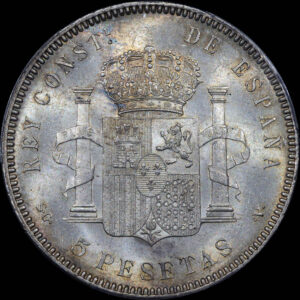
The most important alloys in the history of Western coinage are well established. Silver coins have almost universally been struck not in fine silver but in sterling – an alloy of 92.5% silver and 7.5% copper, used by the British Royal Mint for centuries and widely adopted elsewhere. The copper addition hardens the metal without meaningfully altering its colour or apparent purity. Lower-grade silver alloys, such as the 83.5% silver used in many nineteenth-century European coins or the 50% silver of mid-twentieth-century American issues, sacrifice purity for economy. When the silver content falls below roughly 50%, the resulting alloy is traditionally called billon.
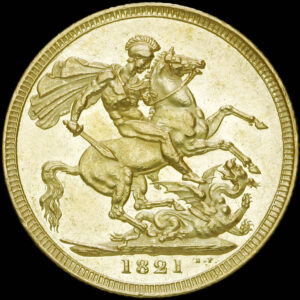
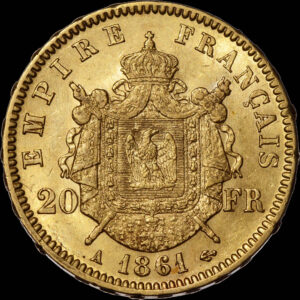
Gold coinage has followed a similar logic. The sovereign and other British gold coins were struck in 22-carat gold – an alloy of 91.7% gold with copper and sometimes silver – producing a coin harder and more resistant to wear than pure gold would be. Continental European gold coins frequently used 90% gold as their standard.
For base metal coinage, the relevant alloys are bronze (copper, tin, and zinc), brass (copper and zinc), cupronickel (copper and nickel), and various modern compositions designed to balance cost, durability, and magnetic properties suitable for vending machines and automated handling.
Understanding alloy composition matters for the collector because it affects a coin’s weight, colour, susceptibility to corrosion, and the character of its toning over time. It also underlies the concept of intrinsic value – the melt value of the metal content – which for silver and gold coins remains a permanent reference point regardless of numismatic premium.
Examples:
|
|
|
|
| Great Britain, George IV, Sovereign 1821 Gold 917 fineness |
France, Napoleon III, 20 Francs 1861 Gold 900 fineness |
SPAIN, Alfonso XIII, 5 Pesetas 1899 Silver 900 fineness |