

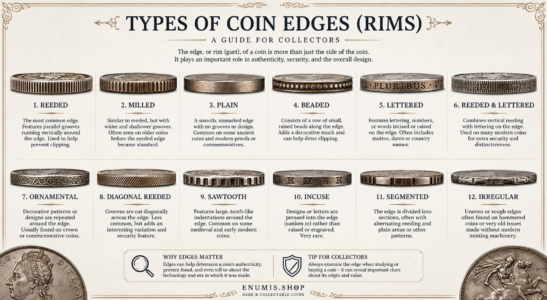
The edge of a coin – its third surface, easily overlooked between obverse and reverse – has always served a purpose beyond decoration. Mints adopted different edge treatments to deter clipping and sweating, to guard against counterfeiting, to distinguish denominations by touch alone, and, in some cases, simply to finish a coin with the care its design deserved.
Reeding – the familiar vertical grooves – became standard on silver and gold coinage after the introduction of edge-milling machinery in the 17th century, largely as a defense against the shaving of precious metal from a coin’s rim. Lettered edges, incused or raised, appear widely on European talers, crowns, and commemorative issues, often carrying a motto, a mint mark, or the coin’s denomination spelled out in full. Ornamental and beaded edges, along with diagonal reeding, turn up on specific issues and periods, giving certain series a silhouette recognizable before the design is even read. Plain edges, meanwhile, are typically found on coins of lower denomination or on issues where security concerns were less pressing.
For the collector, the edge is not a detail to skip. It is often the fastest and most reliable check in authentication: a lettered edge where none should be, a reeding pattern too fine or too coarse, an edge word misspelled or absent – these are the marks that separate a genuine piece from a later imitation. Some of the most sought-after varieties in numismatics are distinguished by edge alone, two coins otherwise identical in design but divergent in this single respect, and worth studying just as closely as any date or mintmark.
Learning to read a coin’s edge – its lettering, its milling, its wear – is part of learning to read the coin itself. It is a habit worth building, whether you are assembling your first collection or refining one built over decades.