



| Country | Austria |
|---|---|
| Ruler | Franz Joseph I (1848-1916) |
| Face Value | 5 Corona |
| Year of issue | 1909 |
| Metal | Silver |
| Fineness | 900 |
| Catalogue # | KM# 2813; Herinek 773 |
| Weight, g. | 23,85 |
| Diameter, mm. | 35,94 |
| Our code | C954 |
| Die Axis | ↑↑ |
| Additional info | Only one year type |
Corona, Krone System (1892-1918), Franz Joseph I (1848-1916)
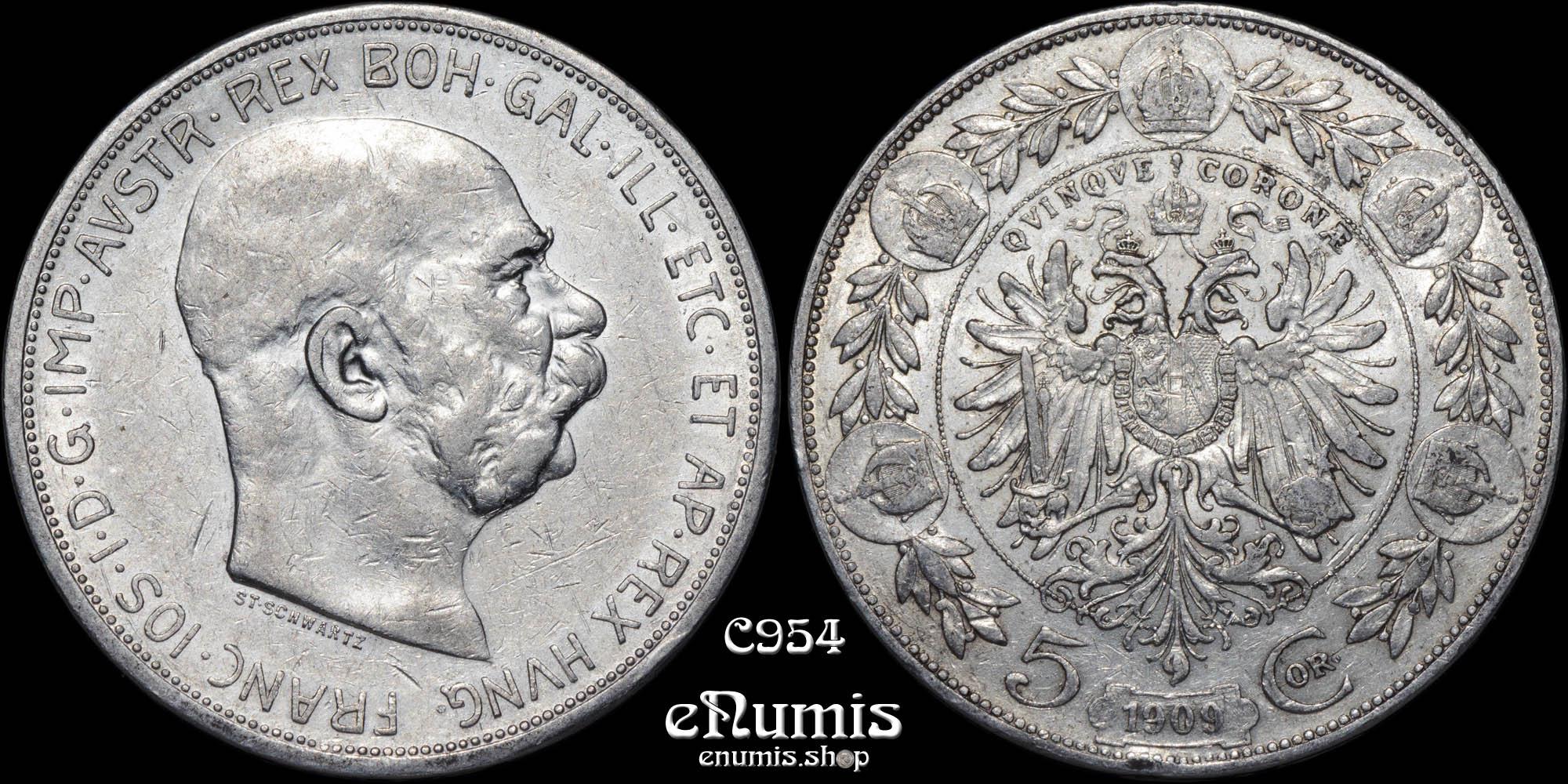
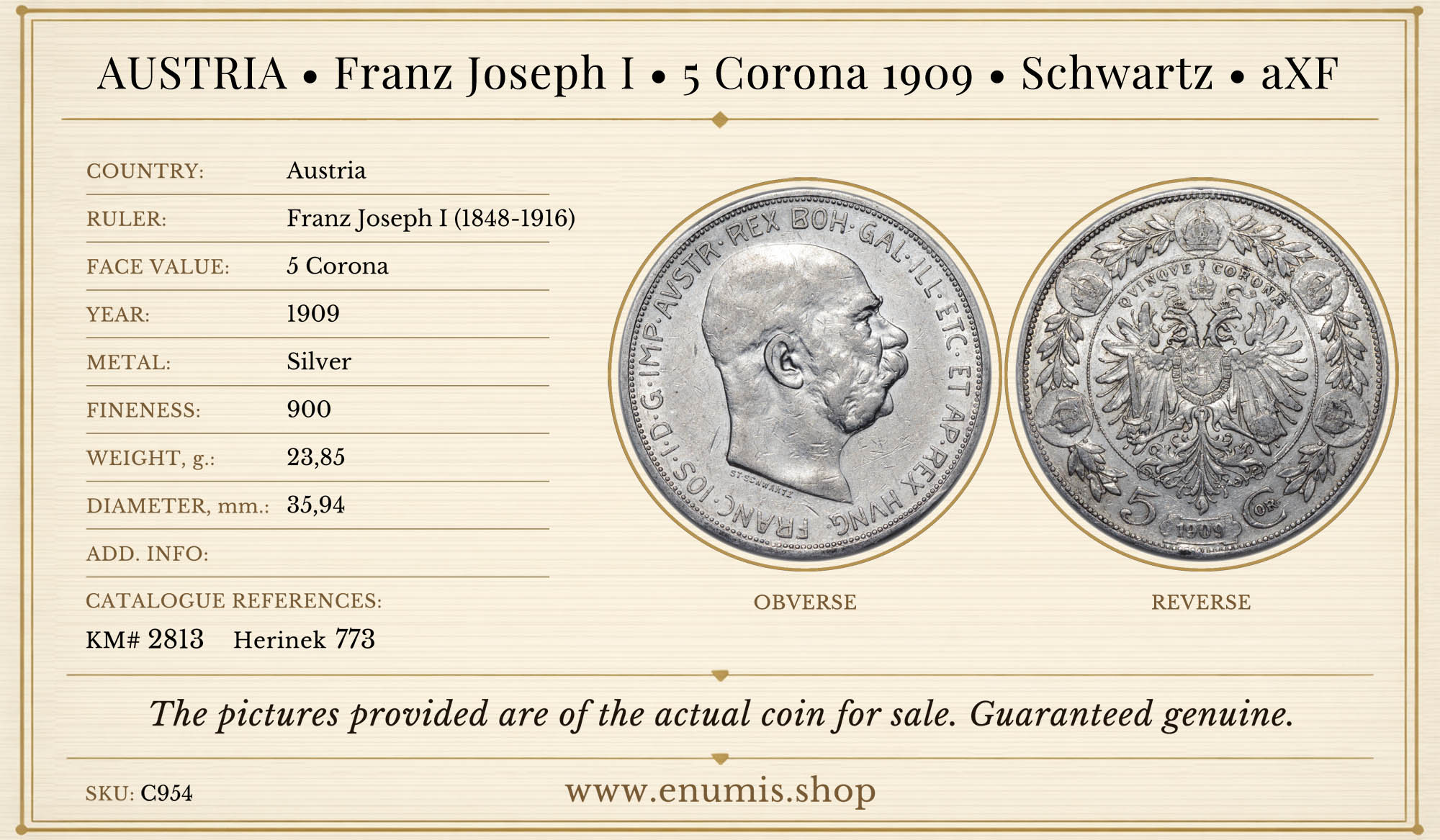
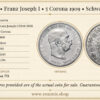
AUSTRIA, Franz Joseph I, 5 Corona 1909, Schwartz, aXF
Availability:
Out of stock
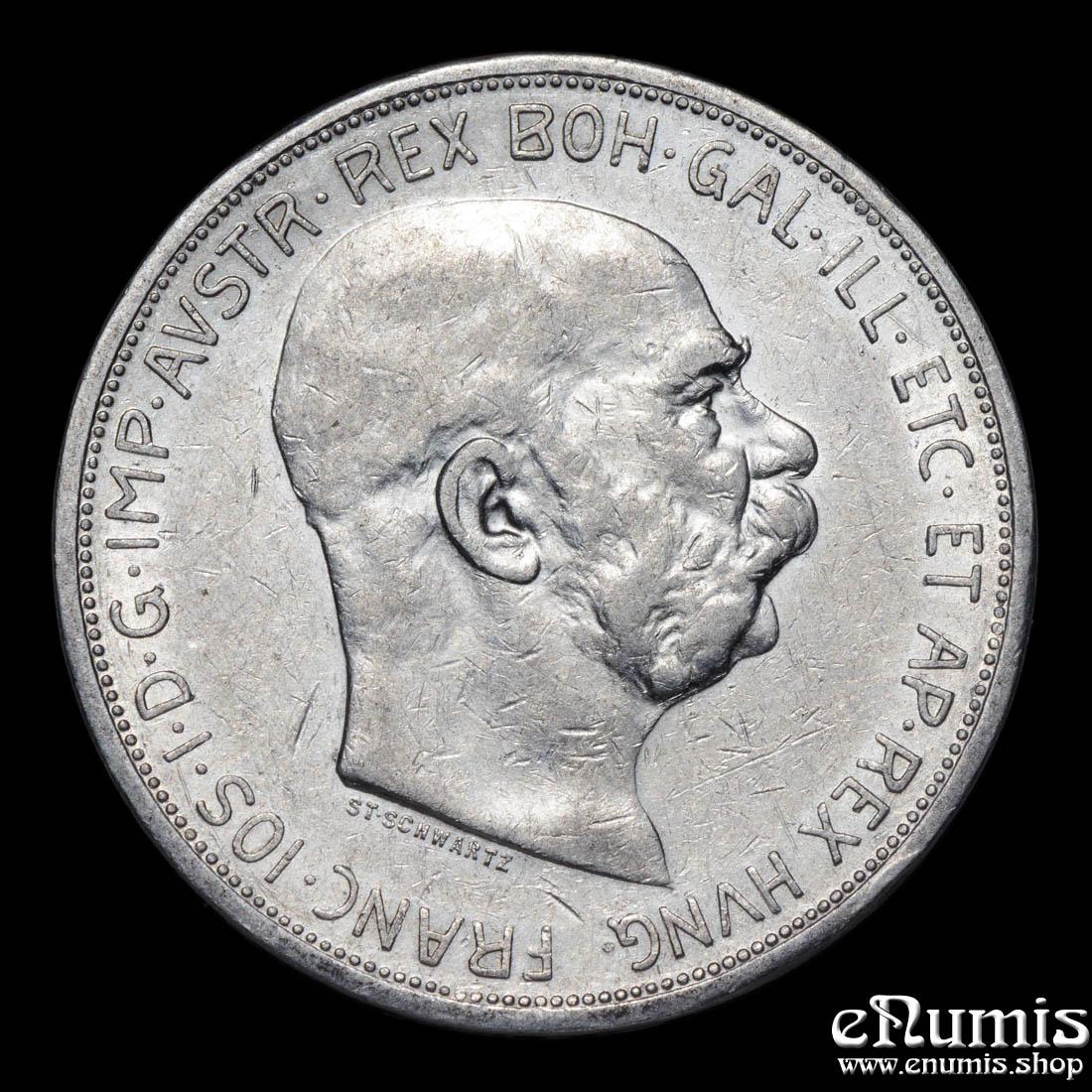
Obverse: The bust of Franz Joseph I facing right surrounded by the legend
Legend (Latin): FRANC ∙ IOS ∙ I ∙ D ∙ G ∙ IMP ∙ AVSTR ∙ REX BOH ∙ GAL ∙ ILL ∙ ETC ∙ ET AP ∙ REX HVNG ∙; St∙ Schwartz
Translation: Franz Joseph I, by the grace of God, emperor of Austria, king of Bohemia, Galicia, Illyria and so forth and apostolic king of Hungary
Engraver: Stefan Schwartz

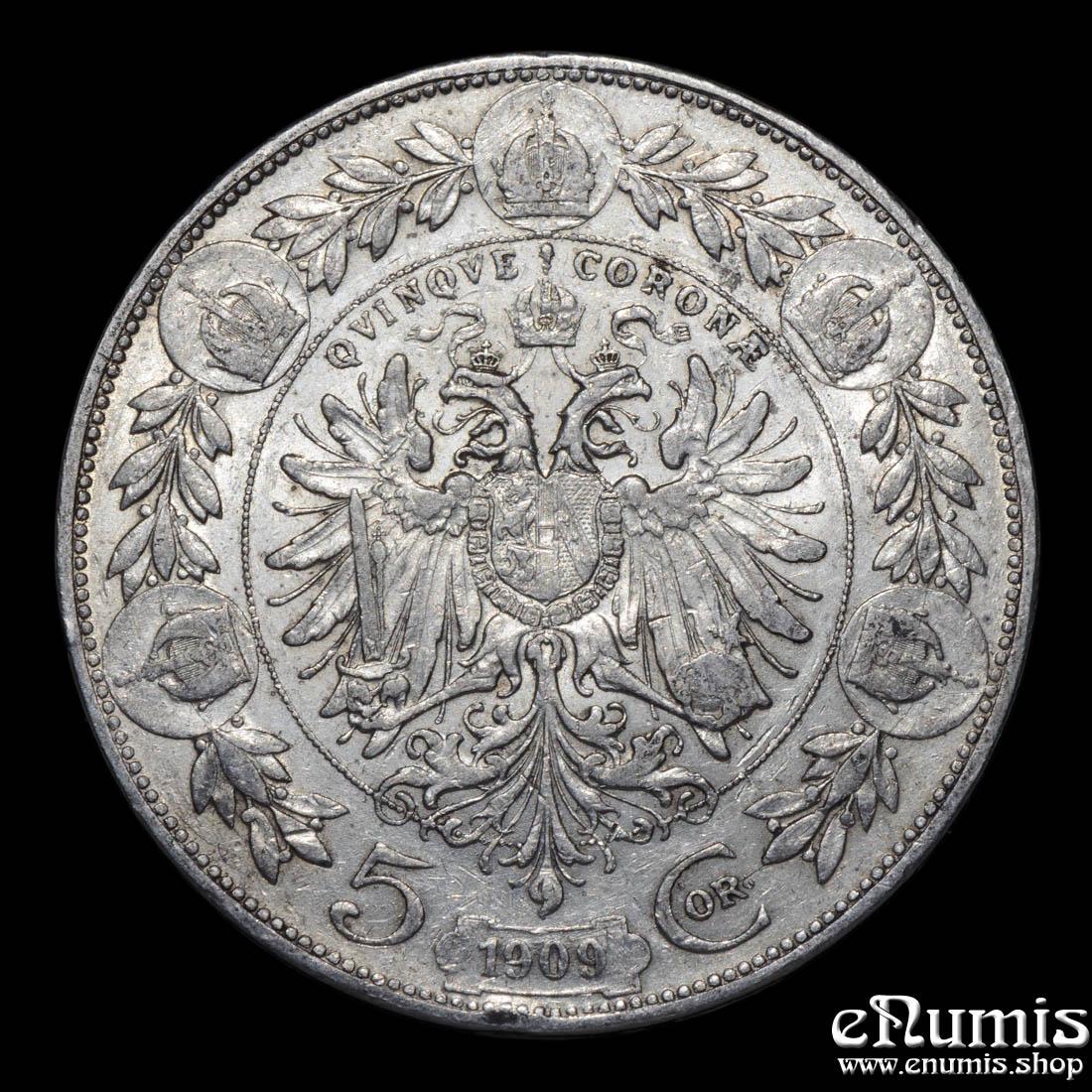
Reverse: Imperial eagle in a circle, value above in Latin, all surrounded by a wreath of crowns and leaves. Value divided by the date below.
Legend (Latin): QUINQUE CORONÆ; 5 COR.; 1909
Engraver: Anton Scharff, Andreas Neudeck
Edge (text in Latin): VIRIBVS VNITIS
Translation: With United Forces (the Motto of the house of Habsburg)
The pictures provided are of the actual coin for sale.
Guaranteed genuine.

SOLD!
Out of stock
SHIPPING:
• We ship worldwide from Slovenia, a member of the European Union, within 1 working day after payment is received.
• Every order is carefully packed to ensure safe delivery.
• Standard registered shipping via The Post of Slovenia is available worldwide and includes a tracking number.
• DHL Express shipping is also available at checkout for customers who require faster delivery.
• Registered shipping via The Post of Slovenia: €7 within Europe and €8 for the rest of the world.
• FREE registered shipping via The Post of Slovenia for orders over €300.
• FREE DHL Express shipping, including full insurance, for orders over €800.
INSURANCE:
• Upon your request an order over 300 Euro can be sent with an extra insurance.
• The price of the insurance is about 1% of the order total (minimal price of the insurance is €5).
OTHER:
• Import duties, taxes and charges are not included in the item’s price or shipping charges. Buyers are responsible for these charges.
• Please check with your country’s customs office to determine what these additional costs will be prior to buying.
22 August 2025 (updated 21 July 2026):
Important Notice for USA Customers
Please note that, due to the new U.S. customs tariffs, Post of Slovenia has temporarily suspended shipments to the United States. Unfortunately, this means we are unable to send orders to the USA at this time.
We will resume shipping to the USA as soon as the service becomes available again. Thank you for your understanding and patience.
However, we can still ship to the USA via DHL Express. Please be aware that additional U.S. customs duties or fees may apply, which are the responsibility of the buyer.
The coins remain with the seller until goods have been paid for in full.
We accept these different kinds of payment:
- All major debit or credit cards (services provided by Stripe Inc. and Bankart d.o.o.)
- Cash in Euro, US Dollars or British Pounds;
- Bank Transfer – to our corporate bank account (eNumis d.o.o., OTP banka d.d. Bank account: SI56 04 0000 2762 09090 BIC: KBMASI2X );
- We also accept PayPal (only for regular customers).
At eNumis.shop, your satisfaction is our top priority. If, for any reason, you are not completely satisfied with your purchase, please contact us immediately.
You may return any item within 30 days of receipt, provided it is in the same condition as when sent. All returns must be shipped using Registered Post or your country’s equivalent postal service with a tracking number.
Upon receiving and inspecting your return, we will offer you an exchange or a refund of the coin’s purchase price, as agreed.
Please note:
Return shipping costs are the responsibility of the buyer and are non-refundable.
Items must be securely packaged to avoid damage during return shipping.
Returns sent without prior notification may not be accepted.
To initiate a return, please contact us at info@enumis.shop or through our Contact Form.
Thank you for shopping with eNumis.shop, where your trust and confidence matter.
History
There is a particular kind of mastery that announces itself quietly. No flourish, no self-advertisement – just the work itself, asking to be looked at closely.
Stefan Schwartz was born in Pest in 1851, the son of a carpenter, and arrived in Vienna at sixteen with an apprentice’s hands and an artist’s ambitions. He studied at the Vienna School of Applied Arts under Professor Otto König, whose sculptures adorned the great buildings of the Ringstrasse – the Opera, the Burgtheater, the Kunsthistorisches Museum. By the time Schwartz was appointed professor and established the department of engraving at that same institution, he had become one of the most respected medalists in the Habsburg Empire. His peers were Anton Scharff and Josef Tautenhyn; his work could be found in the Hofburg, in Parliament, in the private collections of the imperial family. When the Emperor’s 50th and 60th jubilees were commemorated in silver and gold, it was Schwartz who was asked to render the old man’s face.
The portrait on this coin is the product of that trust. Where other engravers of the era tended toward the ceremonial – an emperor as institution, as symbol, as abstraction – Schwartz approached his subjects as a sculptor approaches a living face: with patience, with precision, and with a sculptor’s unsparing eye for the truth beneath the surface. The result is a Franz Joseph that feels inhabited. Seventy-nine years old in 1909, the Emperor carries in Schwartz’s rendering something that official portraiture rarely permitted – the quiet weight of a man who has simply seen too much.
The reverse carries the double-headed imperial eagle and the inscription on the edge VIRIBVS VNITIS – With United Forces – the Habsburg motto that had held together a dozen languages and a hundred grievances for centuries. In 1909, it was beginning to sound more like aspiration than fact. The annexation of Bosnia the previous year had pushed the empire and Serbia to the brink. The nationalities within were restless. The great centrifugal forces of nationalism were pulling at every seam.
But the coin itself is a small monument to a dying art form. Hand-engraving of this quality – portrait work cut directly into steel dies, reversed, without the aid of machinery or computers – was already giving way to mechanical reduction and photographic processes. Schwartz and his generation were among the last practitioners of an unbroken craft tradition stretching back to the Renaissance.
This is a coin that rewards a second look. And a third.
Related products
-
Corona, Krone System (1892-1918), Franz Joseph I (1848-1916)
AUSTRIA, Franz Joseph I, 2 Corona 1912, toned, XF-UNC
 Corona, Krone System (1892-1918), Franz Joseph I (1848-1916)
AUSTRIA, Franz Joseph I, 2 Corona 1912, toned, XF-UNC
Obverse: Franz Joseph I bust bare headed facing right surrounded by the legend. Signature below bust.
Legend (Latin): FRANC ∙ IOS ∙ I ∙ D ∙ G ∙ IMP ∙ AVSTR ∙ REX BOH ∙ GAL ∙ ILL ∙ ETC ∙ ET AP ∙ REX HVNG ∙; ST. SCHWARTZ
Translation: Franz Joseph I, by the grace of God, emperor of Austria, king of Bohemia, Galicia, Illyria and so forth and apostolic king of Hungary
Engraver: Stefan Schwartz
Reverse: Crowned double headed imperial eagle with arms of the Habsburg-Lorraine. Value divided by the tail feathers, date below.
Legend (Latin): II CORONÆ MDCCCCXII; 2 COR.; 1912
Engraver: Stefan Schwartz
Edge (text in Latin): VIRIBVS VNITIS
Translation: With United Forces (the Motto of the house of Habsburg)
The pictures provided are of the actual coin for sale.
Guaranteed genuine.
SKU: E544 -
Corona, Krone System (1892-1918), Franz Joseph I (1848-1916)
AUSTRIA, Franz Joseph I, 1 Corona 1893, VF
 Corona, Krone System (1892-1918), Franz Joseph I (1848-1916)
AUSTRIA, Franz Joseph I, 1 Corona 1893, VF
Obverse: Franz Joseph I‘s bust facing right surrounded by the legend
Legend (Latin): FRANC ∙ IOS ∙ I ∙ D ∙ G ∙ IMP ∙ AVSTR ∙ REX BOH ∙ GAL ∙ ILL ∙ ETC ∙ ET AP ∙ REX HVNG ∙
Translation: Franz Joseph I, by the grace of God, emperor of Austria, king of Bohemia, Galicia, Illyria and so forth and apostolic king of Hungary
Engraver: Anton Scharff
Reverse: Imperial crown between laurel springs, date below.
Legend (Latin): 1; 1893
Engraver: Anton Scharff, Andreas Neudeck
Edge (text in Latin): VIRIBVS VNITIS
Translation: With United Forces (the Motto of the house of Habsburg)
The pictures provided are of the actual coin for sale.
Guaranteed genuine.
SKU: F105 -
Corona, Krone System (1892-1918), Franz Joseph I (1848-1916)
AUSTRIA, Franz Joseph I, 5 Corona 1909, XF+/XF-UNC
 Corona, Krone System (1892-1918), Franz Joseph I (1848-1916)
AUSTRIA, Franz Joseph I, 5 Corona 1909, XF+/XF-UNC
Obverse: Aged portrait of Franz Joseph, bare headed facing right, smaller head, surrounded by the legend
Legend (Latin): FRANC· IOS· I· D· G· IMP· AVSTR· REX BOH· GAL· ILL· ETC· ET AP· REX HVNG.
Translation: Franz Joseph I, by the grace of God, emperor of Austria, king of Bohemia, Galicia, Illyria and so forth and apostolic king of Hungary
Engraver: Rudolf Marschall/Rudolf Neuberger
Reverse: Imperial eagle in a circle, value above in Latin, all surrounded by a wreath of crowns and leaves. Value divided by the date below.
Legend (Latin): QUINQUE CORONÆ; 5 COR.; 1909
Engraver: Anton Scharff, Rudolf Neuberger
Edge (text in Latin): VIRIBVS VNITIS
Translation: With United Forces (the Motto of the house of Habsburg)
The pictures provided are of the actual coin for sale.
Guaranteed genuine.
SKU: E005 -
Corona, Krone System (1892-1918), Franz Joseph I (1848-1916)
AUSTRIA, Franz Joseph I, 1 Corona 1900, aVF
 Corona, Krone System (1892-1918), Franz Joseph I (1848-1916)
AUSTRIA, Franz Joseph I, 1 Corona 1900, aVF
Obverse: Franz Joseph I‘s bust facing right surrounded by the legend
Legend (Latin): FRANC ∙ IOS ∙ I ∙ D ∙ G ∙ IMP ∙ AVSTR ∙ REX BOH ∙ GAL ∙ ILL ∙ ETC ∙ ET AP ∙ REX HVNG ∙
Translation: Franz Joseph I, by the grace of God, emperor of Austria, king of Bohemia, Galicia, Illyria and so forth and apostolic king of Hungary
Engraver: Anton Scharff
Reverse: Imperial crown between laurel springs, date below.
Legend (Latin): 1; 1900
Engraver: Anton Scharff, Andreas Neudeck
Edge (text in Latin): VIRIBVS VNITIS
Translation: With United Forces (the Motto of the house of Habsburg)
The pictures provided are of the actual coin for sale.
Guaranteed genuine.
SKU: F109